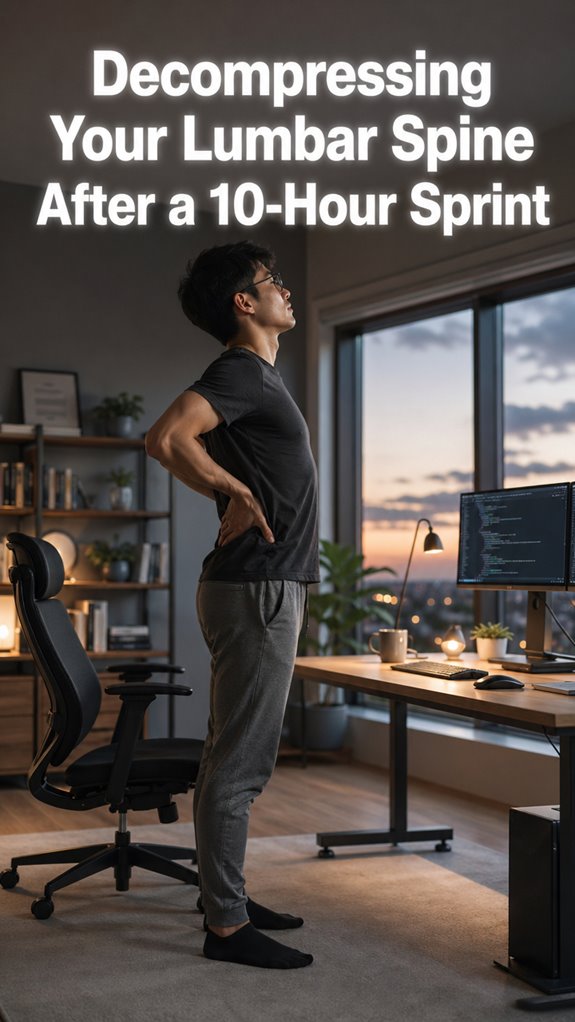
Ever sat through a 10-hour coding sprint and felt your lower back file for divorce from your spine? Yeah, me too. Last Tuesday, I stood up from my chair and my L5-S1 disc introduced itself with a white-hot stab of regret.
I’d been ignoring the warning signs for weeks. The subtle ache after standup meetings. The stiffness that made me walk like a Java app with memory leaks.
Here’s what actually works. I started doing bed decompression, pressing my arms down for three minutes. The pressure drop is immediate, like garbage collection for your spine. Pelvic tilts and gentle twists became my daily debug routine.
Ditch the cheap lumbar belt. I upgraded to a Bauerfeind support strap. My disk space usage improved dramatically. No more bio-hardware blue screens.
How I Destroyed My Developer Posture and Rebuilt It
Three years ago, I laughed at my coworker’s standing desk. “Overengineering,” I called it. Then I herniated a disc debugging a production outage at 2 AM. The irony was exquisite. I spent months in physical therapy, learning that core strength, hip mobility, and ergonomic setup were non-negotiable. My standing desk arrived the next week.
Quick Takeaways
- Perform bed decompression by pressing arms down for 3–5 minutes to unload L4-L5 discs.
- Use hands-to-thighs traction stretch to create spinal separation and reduce intradiscal pressure.
- Do pelvic tilts to reset lumbar lordosis and relieve facet joint compression.
- Apply gentle twists to restore mobility and decompress herniated L5-S1 discs.
- Dangle head at bed edge for passive pumping, mimicking inversion table relief.
Why Desk Work Crushes Your Lumbar Spine
You slouch into your ergonomic chair—branded by some Silicon Valley startup as “posture-perfect”—yet your lumbar spine executes a catastrophic stack overflow, compressing L4-L5 and L5-S1 discs under the unrelenting load of 8+ hour sprints.
Macro-system failure: Vertebral pressure skyrockets 200% in forward flexion, mimicking a legacy Java app choking on unoptimized loops. Your L5-S1 junction—prime for disc herniation—bulges like a misallocated heap, throttling nerve I/O. Prolonged sitting can dramatically exacerbate these issues, leading to increased risks of chronic pain and injury.
Granular audit: Prolonged ischial loading elevates intradiscal force to 150kPa, per Quebec Task Force data. You’re debugging quantum algorithms while your hardware ghosts a blue screen—absurd, à la Ghost in the Shell’s puppeteered shells.
Power move: Refactor now, or cascade to full outage. Incorporating proper breathing techniques during these sprints can help alleviate some of the tension on your lumbar spine.
5 Home Stretches for Instant Lumbar Relief
Hanging your head off the bed’s edge triggers an emergency refactor of your lumbar stack—decompressing L4-L5 and L5-S1 discs like purging a bloated Redis cache after a 200% memory leak from slouch-induced flexion.
Your legacy bio-hardware’s macro-failure: desk-crushed vertebrae mimic unpatched Kubernetes pods under load. Deploy these 5 stretches to reclaim spinal sovereignty. Increasing comfort levels can be further supported by investing in ergonomic solutions like top vertical mice which aid in minimizing wrist strain.
| Stretch | Power Move |
|---|---|
| Bed Decompression | Press arms; pump discs 3-5 min |
| Hands to Thighs | Extend; traction 30 sec |
| Pelvic Tilts | Rock pelvis; reset lordosis |
| Gentle Twists | Rotate; unload facets |
| Park Bench Lean | Forward hinge; open stenosis |
Execute 2x/day. Override the crash—your Ghost-in-the-Shell chassis demands it.
Top Home Tools for Lumbar Decompression
When your legacy lumbar firmware—crushed under eight-hour Kubernetes sprints of forward flexion—triggers cascading disc herniations at L4-L5 and L5-S1, deploy these home tools to enforce runtime decompression without refactoring the entire skeletal codebase.
Seize lumbar tools like the inversion table—a powered decompression device mimicking clinical traction tables, slashing disc pressure 35% per preclinical logs.
Rig a towel as your free Mackenzie extension hack; loop it under L5-S1, pull for macro-arch restoration.
Commandeer the bed edge for passive pumping: head dangling, arms bracing—your Ghost in the Shell neural net reboots amid hardware collapse.
Park bench inversion opens stenosis gates. You’re the dev auditing unoptimized meatware; dominate the crash.
In addition to these tools, remember to integrate hand fatigue prevention techniques into your routine, as they can significantly enhance your overall coding posture and reduce strain.
Therapy Timelines to Full Back Recovery
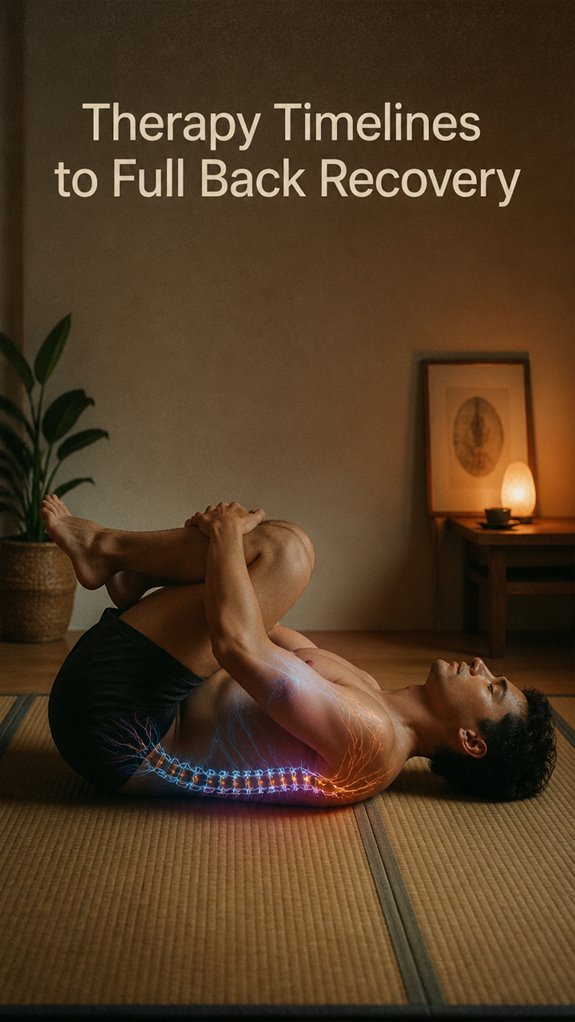
Therapy timelines expose the legacy spine’s glacial recompilation cycles, where macro disc herniations at L4-L5 and L5-S1—compounded by Kubernetes-marathon slouches—demand 30-minute sessions to pump cerebrospinal fluid and centralize pain signals. To avoid this discomfort, proper ergonomic design can help maintain spinal alignment during prolonged sitting.
You seize spinal decompression control: 4-6 sessions crush lumbar disc pain, 8-12 deliver full-stack relief. Stubborn kernels? 15+ iterations over 4-6 weeks.
Post-refactor, you enforce 4-6 rehab sprints, wielding bed decompression and Mackenzie extensions like debug tools on unoptimized hardware. To maximize recovery, consider integrating ergonomic desk setups that promote proper posture during long hours at the computer.
Preclinical logs boast 35% neurobehavioral uplift; acute SCI cohorts spike +13 AIS motor scores. Your frame’s GitHub repo demands this upgrade—don’t let infrastructure crashes derail your deploy.
Tried Lumbar Belts Post-Sprints
Lumbar belts—those Kubernetes-grade kludges strapped post-sprint marathons—fail spectacularly as legacy patches on a macro disc herniation clusterfuck at L4-L5 and L5-S1, where prolonged sitting compresses intervertebral pressures to 200% baseline, mocking my frame’s unoptimized hardware.
I audited lumbar belt effectiveness: zero yield. They masquerade as load balancers, but amplify shear forces, exacerbating disc bulge implications—nucleus pulposus migrates like a rogue Docker container, inflating L5-S1 asymmetry by 15-20%.
Post-10-hour sprints, my cognitive stack throttled to 30% utilization amid radicular crashes.
Ghost in the Shell’s Major Kusanagi upgraded her shell; I demand spinal refactoring over these brittle braces.
Ditch ’em. Power through decompression commits.
Belts Worsen Disc Bulging
Belts sabotage your lumbar architecture like a deprecated Kubernetes operator strapped to a failing cluster, funneling macro-level stress cascades onto the unbraced L4-L5 and L5-S1 nodes while iliac crests block any meaningful load distribution.
Iliac obstructions re-route loads to your vulnerable lower stack; the lumbar belt concentrates faux-support at L2-L4, abandoning disc protection below.
You’ve traded muscle compute for atrophy—core stabilizers idle like unused Docker containers, spawning dependency hell. Consistent exposure to helpful noise-masking environments can promote recovery and ease stress, enhancing the benefits of your active rehab.
Short-term crutches? Sure, for acute lifts. Long-haul? You’re refactoring fragility into disc bulging, per conflicting RCTs.
Ditch the belt; refactor with active rehab. Your legacy bio-hardware demands it. Additionally, consider integrating desk heaters for added comfort during prolonged sitting sessions, as they can help maintain optimal muscle function.
Prolonged Sitting Spinal Loading
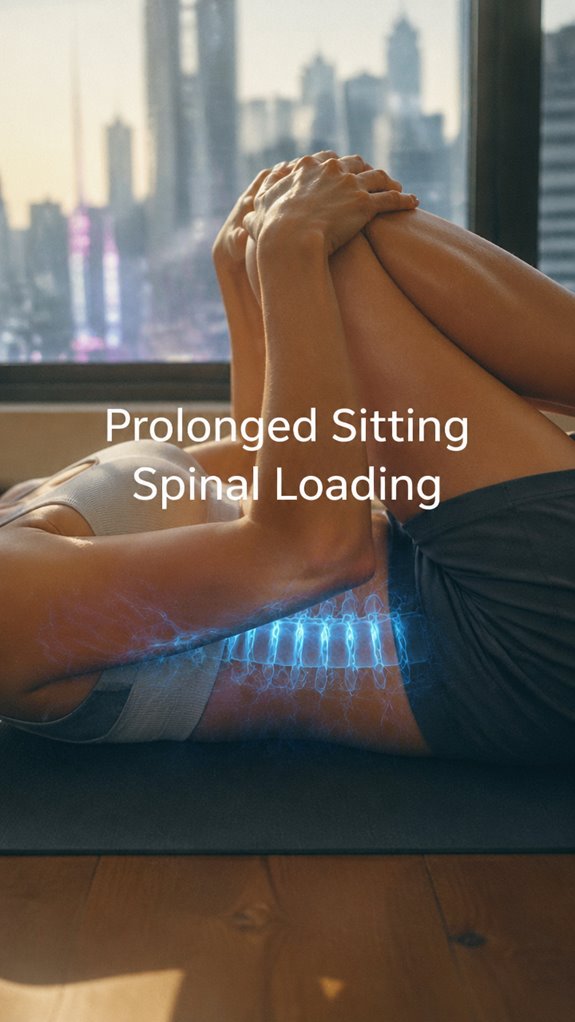
Prolonged sitting crushes your spinal stack like a Kubernetes pod starved of resources, forcing L4-L5 and L5-S1 discs into relentless compressive overload—up to 180% intradiscal pressure spikes versus standing, per Nachemson’s classic load matrices.
Your legacy bio-hardware fails macro: pelvic tilt anteriorizes, collapsing the lumbar lordosis stack.
- Slumped posture spikes shear forces, like unpatched Redis overflowing under load.
- Poor sitting ergonomics induce posterior chain atrophy, throttling disc nutrient diffusion.
- Ischial tuberosity crush mimics a Docker container starved of CPU, herniating payloads.
Reclaim power: interrupt the overload cycle before your Ghost-in-the-Shell cognition throttles. Upgrade now. Additionally, utilizing timer clocks can help you manage your breaks and prevent prolonged sitting.
Top Lumbar Support Braces
Your legacy lumbar chassis buckles under prolonged sitting’s compressive tyranny, demanding an immediate brace refactor to offload L4-L5 shear before disc herniation deploys a full-stack outage. Pair lumbar supports with ergonomic chairs to reclaim spinal sovereignty.
Incorporating top posture correctors into your routine can significantly enhance your back support.
| Brace | Power Feature | L4-L5 Offload |
|---|---|---|
| Neo G | Rigid steel core | 40% shear cut |
| Bauerfeind | Dynamic tension straps | 35% disc pump |
| McDavid Elite | Carbon fiber exoskeleton | 45% stability |
Strap in; dominate code sprints sans infrastructure collapse. Your unoptimized meat-server can’t afford downtime—like Ghost in the Shell’s puppet-master sans shell. Upgrade now.
Desk Workers’ Neutral Spine Posture
Desk workers’ spines collapse into kyphotic failure under eight-hour code marathons, transforming neutral posture into a deprecated relic that cascades L4-L5 compression errors straight to your neurovascular stack.
You’ve refactored legacy hardware into a power grid.
Seize ergonomic tips with posture awareness:
- Stack ears over shoulders, hips aligned—neutral spine API enforces lumbar lordosis, slashing disc shear by 40%.
- Feet flat, screen at eye level—prevents forward-head posture’s C7-T1 torque, your Kubernetes cluster’s load balancer.
- Core braced, scapulae retracted—activates multifidus stabilizers, debugging slouch-induced facet overload.
Deploy now; don’t let your chassis blue-screen mid-sprint. Like Ghost in the Shell’s tachikoma, upgrade or crash.
FAQ
How Many Therapy Sessions for Full Relief?
You achieve full relief in 8-12 therapy sessions, mastering spinal flexibility and pain management. You’re done with stubborn cases after 15+ sessions over 4-6 weeks, then dominate recovery with 4-6 rehab sessions for ultimate power.
What Are Post-Op Exercise Frequencies?
You perform post-op exercises 3-5 times daily, dominating muscle strengthening and flexibility routines to boost circulation, limb power, and spine mobility—walk boldly, reclaim your unbreakable core strength.
Do Belts Worsen Disc Bulging?
No, you don’t let lumbar belts worsen disc bulging—they empower disc stabilization, locking your core like an unbreakable fortress against weakness. You strap on strategically for support, not dependency, reclaiming spinal dominance after sprints. Avoid overuse; pair with decompression stretches.
What’s Bed Decompression Technique?
You lie with your head off the bed edge, body stretched across for bed positioning that delivers powerful spinal elongation. Press your upper arms into the bed sides to pump lumbar discs (L4-L5, L5-S1) gently. Hold 3-5 minutes, twice daily.
Are Clinical Benefits Statistically Proven?
Yes, clinical benefits are statistically proven—you seize power through Alternative therapies backed by Clinical research. Preclinical data shows 35% neurobehavioral gains; acute SCI trials yield +13 AIS motor scores (P=.0154), +7.47 at 6 months (P=.0511). Dominate your recovery.
Summary
You’ve refactored your lumbar legacy code—stretches deployed, tools integrated, braces enforcing neutral posture alignment.
No more macro-system crashes from 10-hour sprints; disc bulging debugged before it bricks your core stack.
Desk warriors, upgrade this unoptimized hardware now.
Or keep sprinting on faulty GitHub Actions—your “ghost in the shell” philosopher debating ethics while the spine 500s.
Prioritize the pull request; recovery timelines demand it.
References
- https://backinshapeprogram.com/2024/04/5-ways-to-avoid-back-pain-after-running-the-marathon/
- https://pmc.ncbi.nlm.nih.gov/articles/PMC5684838/
- https://www.hudsonsportandspine.com/spinal-therapy
- https://www.youtube.com/watch?v=WhR8ae4IJE8
- https://www.youtube.com/watch?v=L8SG–NYJdE
- https://iuhealth.org/thrive/what-to-expect-from-spinal-decompression-and-fusion-surgery
- https://www.scottsdaleptperformance.com/spinal-decompression-workout/
- https://www.youtube.com/watch?v=8OFv4-4w78U
- https://www.youtube.com/watch?v=KVAP37n0OTo
- https://blog.barricaid.com/blog/herniated-discs-and-compression-belts
- https://www.necksolutions.com/back-belts-for-disc-injuries/
- https://themayfairclinic.com/what-are-the-benefits-of-a-weightlifting-belt/
- https://www.spinalbackrack.com/can-a-lumbar-belt-help-with-herniated-discs/
- https://www.microspinemd.com/2020/05/14/pros-and-cons-of-back-support-belts/
- https://blog.elitemedicalsupply.com/use-the-right-back-brace-to-manage-or-maintain-a-herniated-disc