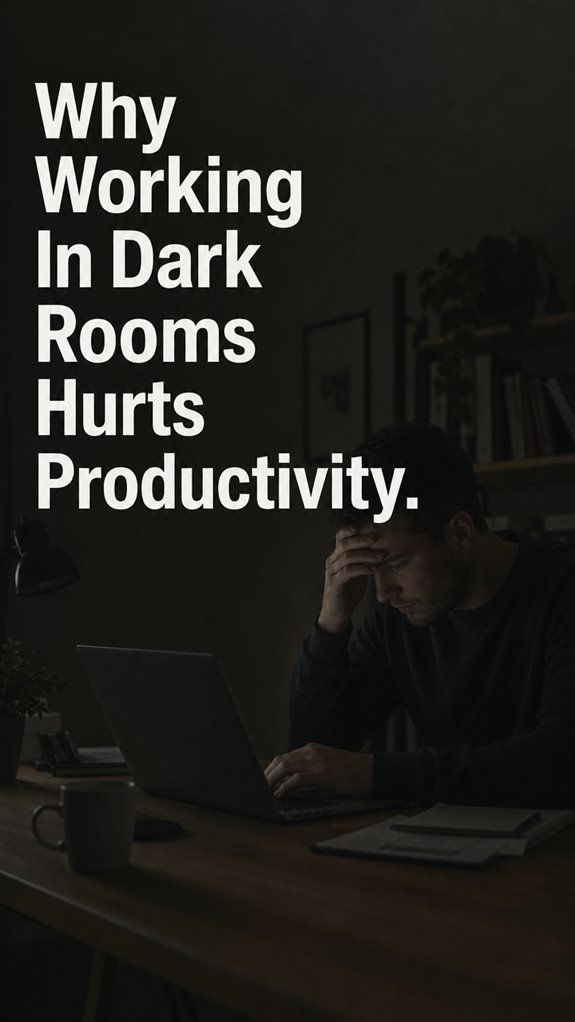
Ever tried debugging at 2 AM with the lights off? Your brain crashes harder than a null pointer exception.
I learned this the hard way. Three years ago, I thought I was being efficient, coding in near-darkness with just my monitor’s glow. My commit messages got weirder. My variables were named “fixThisLater” and “whyIsThisBroken.” Turns out, my circadian rhythm was throwing unhandled exceptions I couldn’t catch.
Darkness tricks your system into thinking it’s bedtime. Melatonin floods your stack while you’re still trying to push to production. Focus fragments. Bugs multiply. Your cognitive throughput drops to 1990s dial-up speeds.
The real kicker? I didn’t notice until I started making basic syntax errors in languages I’d mastered years ago. My eyes burned. My mood tanked. Coffee became a dependency injection I couldn’t resolve.
Light isn’t just about seeing your keyboard. It’s environmental configuration for peak mental performance.
F.lux? Helpful. Overhead lighting? Better. Morning sunlight exposure? Game-changer for committing working code.
How Poor Lighting Destroyed My Sprint Velocity and Sleep Schedule
Last winter, I cramped myself into a windowless corner of my apartment because the ethernet cable reached there. Zero natural light. Day and night blurred into one endless merge conflict. My standup updates became incoherent ramblings about “shadow optimization.” My manager gently suggested I might need a wellness check.
The breaking point came during a demo. I demoed the wrong branch. The client saw broken CSS and placeholder text reading “Lorem Ipsum Your Mom.” Humiliating. I blamed Git, but the real culprit was my cave-like setup destroying my REM cycles and executive function.
Sound familiar? Screen glare, blue light exposure, and circadian disruption are the silent productivity killers nobody talks about in retrospectives. Ergonomic workspace design isn’t soft skills, it’s infrastructure. Sleep hygiene directly impacts your ability to reason about distributed systems. I moved my desk immediately. Started using a sunrise alarm clock. Started wearing actual pants again.
My velocity recovered. So did my dignity.
Quick Takeaways
- Darkness disrupts circadian rhythms, impairing sleep quality and reducing overall cognitive function.
- Insufficient lighting causes eye strain and headaches, leading to decreased focus and productivity.
- Lack of natural light hampers melatonin regulation, resulting in fatigue and sluggishness during work hours.
- Dim environments weaken attention span and increase mental fatigue, increasing the risk of errors.
- Poor lighting prevents sensory cues that optimize neural functioning and workflow efficiency.
How Darkness Disrupts Your Sleep and Focus
When you operate your mental processor in a dark environment, it’s akin to running software on outdated firmware—performance degrades, system errors abound, and the core algorithms falter.
Your circadian architecture, the OS managing sleep and wake cycles, suffers catastrophic disruption, akin to a kernel panic in “Ghost in the Shell.” Melatonin production drops, akin to corrupted data, delaying command execution for rest and cognitive focus.
As in debugging a codebase with no logs, you find yourself in a maze of inefficiency, with attention span shrinking like deprecated code, and focus crashing faster than an unverified build.
Control becomes an illusion, not a feature. Additionally, the exposure to blue light emitted by screens can further exacerbate sleep disturbances, complicating the recovery of productivity.
Common Challenges of Working in a Dimly Lit Environment
In a dimly lit workspace, the core architecture of your focus engine begins to suffer, analogous to a server running on deprecated kernels—fragile, error-prone, and inefficient.
You attempt logic branches, but your cognitive stack is increasingly garbage-collected by shadowy fatigue bugs. Attention span drops like a memory leak, and neural processes crash unpredictably, reminiscent of Ghost in the Shell’s cybernetic chaos.
This inadequacy isn’t mere inconvenience; it’s systemic failure. Without proper illumination, your mental hardware operates on obsolete drivers, risking total system meltdown—yet you persist, stubbornly debugging in darkness while the code of productivity silently corrodes. Recent studies suggest that using top eye trackers can help monitor gaze and improve focus, highlighting the importance of balanced light in maintaining productivity.
Easy Ways to Brighten Your Workspace
Recognizing that a dim workspace can cause system errors—analogous to slipping into a debug loop with memory leaks running unchecked—necessitates simple yet effective input injections to upgrade your environment.
Start by implementing macro-level solutions like installing adjustable LED panels or full-spectrum fixtures, akin to deploying patches in a live system.
Control granularity by utilizing task-specific desk lamps with customizable color temperature, mimicking user-space preferences. Various desk lamps can enhance your workflow and reduce fatigue.
Position monitors to minimize glare—think of it as optimizing code for readability—that prevent eye strain, the system’s bleed-over.
In essence, your physical infrastructure mirrors software architecture: inattention leads to crashes.
Build a Morning Routine to Boost Your Energy and Light Levels
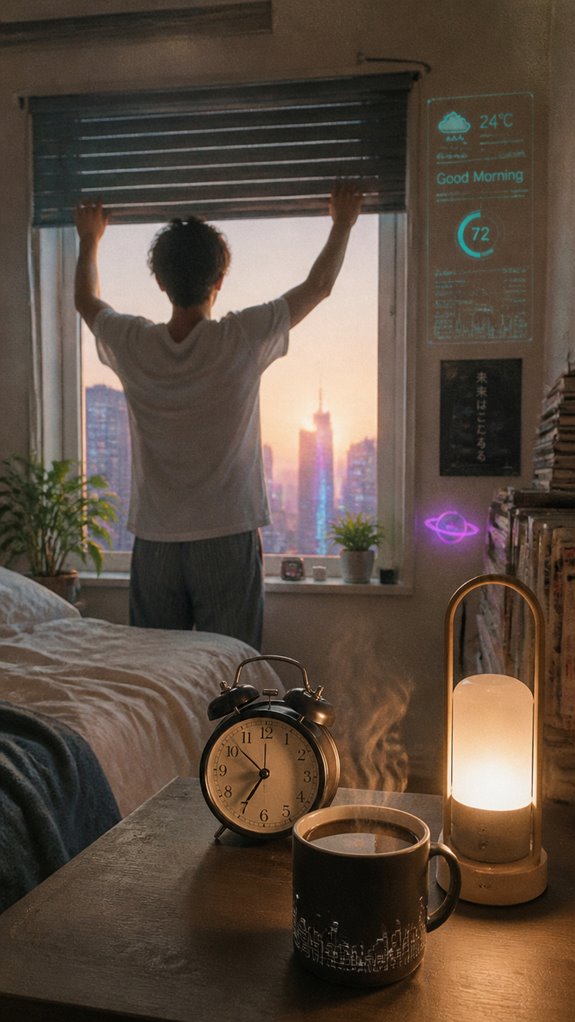
A flawed morning routine is akin to deploying a faulty microservice: it systematically sabotages the entire workflow before the day even begins.
1. Initialize with daylight.
Open those programmable blinds or step into the sun—much like initializing a critical module—before your cognitive kernel crashes into sleep inertia.
2. Prioritize caffeine and light synchronization.
Leverage digital APIs like smart lamps or dawn simulators, aligning melatonin suppression with your system clock—think of it as patching version 2.0 to fix sleep errata.
3. Limit local resource contention.
Avoid dark room toggles; they’re akin to unoptimized queries, bogging down your focus and causing lag.
4. Automate control loops.
Use personalized lighting scripts—your equivalent of CI/CD pipelines—to maintain ideal system health at startup. Incorporating scented candles into your environment can also enhance mood and create a cozy atmosphere for productivity.
Simple Strategies to Maximize Light and Productivity During Work
When your workspace architecture neglects ideal lighting, you’re effectively deploying a systemic bug—silent, pervasive, and capable of causing the entire operation to crash, like Ghost in the Shell’s glitching network.
At the macro level, inadequate illumination hampers cognitive functions essential for debugging complex code, diminishing memory—akin to a memory leak in the hippocampus—and impairing focus.
Granularly, eyestrain and visual discomfort become the runtime errors, reducing throughput.
Without control—like a programmer without toggle switches—you invite latency in decision-making and task execution.
Optimization requires not just patching software, but upgrading the underlying hardware—your lighting infrastructure. Circadian desk lamps can provide a balanced light spectrum to enhance alertness and productivity throughout the workday.
Sunlight Alarm Clock Success
Even in the labyrinth of code, you learn that minor systemic flaws cascade into catastrophic failures if left unchecked; similarly, neglecting natural circadian cues can cause your biological infrastructure to stutter like “Ghost in the Shell”’s glitching neural network.
- Sunlight alarm clocks synchronize your internal thread scheduler to optimize wake-up routines.
- They provide deterministic execution, reliably triggering cortisol release for basal alertness.
- Blue light emission acts as a payload, hacking melatonin function for smoother startups.
- Customizable dawn simulations grant control over sleep-dependent processes, streamlining system reboot cycles.
- Additionally, maintaining optimal pelvic floor health during prolonged sitting can further enhance your productivity by preventing discomfort.
It’s literally software for your brain—upgrade, or risk complete system meltdown before your first coffee.
Disrupted Melatonin Suppression in Morning

In the relentless debug cycle of biological systems, missing the essential morning light cue is akin to launching a new software build without running pre-deployment tests—disastrous yet a surprisingly common feature in human circadian management.
Without that critical sunlight handshake, residual melatonin remains elevated, like an unpatched bug festering in your codebase. This prevents the biological OS from waking up, leaving you sluggish, irritable, and in a perpetual state of “Ghost In The Shell” syndrome—caught between sleep mode and alertness.
The absence of dawn’s signal is a systemic failure that hampers cognitive uptime, turning your day into a debugging nightmare of fatigue and error-prone execution. To combat this, women in tech can benefit from effective stress management, which helps optimize their productivity and overall well-being.
Adjusting Lighting for Alertness
Here’s where your system begins to glitch—the biological equivalent of a software patch failure—when lighting fails to maximize alertness.
- Prioritize blue-enriched light—think of it as HDMI for your circadian system—without it, your executive functions become sandboxed.
- Implement variable brightness controls—akin to toggle switches—allowing real-time adjustments to match your energy cycles.
- Use monitor positioning intelligently—avoid glare, which is like a memory leak—so you preserve attention spans.
- Create a “Ghost in the Shell”-like environment—full-spectrum daylight mimicking natural cues—to keep your neural network functioning optimally.
Additionally, utilizing top Bluetooth speakers can enhance your auditory experience, boosting overall focus and productivity in a well-lit environment.
Failure to do so results in, well, just another software crash.
Ergonomic Desk Setup Tips
When the foundational code of your workspace is corrupted by faulty ergonomic architecture, the entire runtime of your cognitive processes begins to degrade—like a legacy system riddled with memory leaks that no patch can fully remedy.
Your desk setup’s flaws—poor monitor alignment, inadequate support, strained postures—act as bugs in your neural kernel, causing visual discomfort, headaches, and distraction.
Adjusting monitor height with precision, investing in ergonomic peripherals, and fine-tuning desk angles enable your hardware to run at *ideal* efficiency, preventing system crashes in focus—like scripting a patch in Ghost In The Shell to restore clarity amidst chaos. Additionally, integrating full-body posture adjustments into your routine promotes overall well-being and enhances productivity.
FAQ
How Does Poor Lighting Affect Long-Term Mental Health?
Think of your mind as a garden; poor lighting is like neglecting it, causing mental weeds like anxiety, depression, and cognitive decline to take root. You control your environment—choose good lighting to nurture your mental health long-term.
Can Specific Light Colors Improve Concentration in Dark Environments?
You can improve concentration in dark environments by controlling light colors, especially blue light, which boosts alertness and cognitive function. With personalized lighting, you actively enhance focus, reduce eye strain, and create a workspace tailored to your needs and preferences.
Are There Risks Associated With Prolonged Blue Light Exposure?
Prolonged blue light exposure can cause eye strain, headaches, and disrupt sleep patterns, which may decrease your overall health. To maintain control, limit exposure duration, adjust brightness levels, and use blue light filters or glasses when necessary.
How Quickly Can Lighting Changes Improve Cognitive Performance?
Lighting changes can boost your cognitive performance within minutes, especially with blue-light exposure and increased daylight simulation. By adjusting your environment promptly, you can enhance focus, memory, and alertness, gaining control over your productivity and mental clarity.
What Are the Best Lighting Options for Visual Comfort?
You hold the torch to your workspace, choosing full-spectrum bulbs, adjustable desk lamps, and shades to control light. These options comfort your eyes, shape your focus, and empower you to craft your ideal visual environment.
References
- https://technologypartners.net/industry-insights/blog/2019/11/effects-on-the-brain-what-science-says-about-employees-working-in-the-dark
- https://pmc.ncbi.nlm.nih.gov/articles/PMC6877933/
- https://www.seattletimes.com/explore/careers/office-lighting-and-productivity-the-evidence-is-glaring/
- https://journalistsresource.org/environment/daylight-windows-productivity-stress-health-depression/
- https://ubiehealth.com/doctors-note/melatonin-hangover-morning-tired-resolve-sleepy-7341e3
- https://ubiehealth.com/doctors-note/tired-wired-night-melatonin-misfiring-reset-fix-4123e2
- https://pmc.ncbi.nlm.nih.gov/articles/PMC5983136/
- https://nirvanahealthcare.com/cortisol-melatonin-sleep-cycle/
- https://pmc.ncbi.nlm.nih.gov/articles/PMC12651070/
- https://stacks.cdc.gov/view/cdc/221591/cdc_221591_DS1.pdf
- https://www.rupahealth.com/biomarkers/melatonin-morning
- https://academic.oup.com/sleep/article/45/11/zsac199/6674047