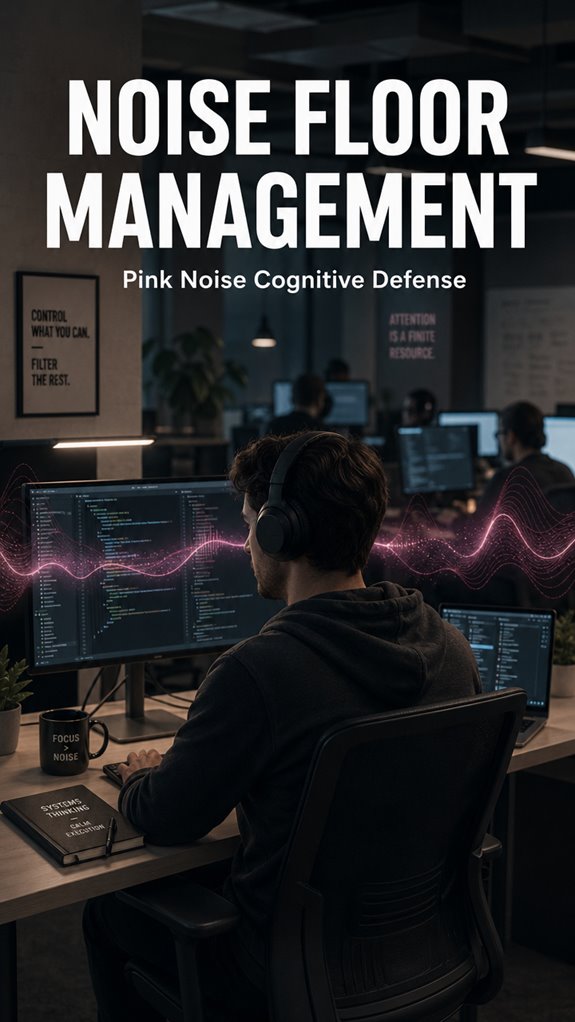
Ever tried debugging with three Slack huddles happening simultaneously? Pink noise saved my sanity. It’s not white noise’s harsh static, it’s the gentle rumble of a distant waterfall.
I learned this the hard way. My open office had “collaborative spaces” that felt more like a fish market. Headphones cranked to 85dB just to hear myself think. Then a senior dev tossed me a paper on spectral density. Game changer.
Pink noise rolls off where speech lives. Less CPU for my brain. I started at 50dB, tweaked it like optimizing a query until my shoulders finally dropped. One speaker. 1.5 meters. That’s it.
Now I can actually hear my own thoughts. Revolutionary.
How I Survived Open Office Hell: A Developer’s Journey to Focus
The breaking point came during a production incident. My desk sat between sales and HR. I was trying to trace a memory leak while someone negotiated their PTO three feet away. My noise-canceling headphones died mid-incident. Pure panic.
I tried brown noise, nature sounds, even lo-fi beats. Nothing masked voices without becoming its own distraction. Then I found research on acoustic masking and workplace productivity. Pink noise sits in that sweet spot, frequency-matched to human speech patterns. It’s like a compiler optimization for your ears.
I bought a cheap Bluetooth speaker, positioned it precisely, and suddenly I could focus. My Jira tickets actually got completed. My cortisol levels probably thanked me. Sometimes the best infrastructure fix isn’t code, it’s environmental.
Quick Takeaways
- Pink noise’s spectral distribution matches speech frequencies (300Hz-3kHz), creating effective masking without excessive volume increases.
- Optimal volume calibration between 50-60dB masks ambient chatter while avoiding fatigue; iterative testing determines your threshold.
- Position a dedicated speaker 1.5 meters from your workstation, aligned with monitor azimuth for consistent coverage.
- Pink noise reduces cognitive load compared to white noise by pre-attenuating higher frequencies, minimizing processing demands.
- Combine pink noise with structural barriers, workspace isolation, and persistent playback daemons for sustainable acoustic management.
How Pink Noise Blocks Conversation
When you’re drowning in a sea of Slack notifications and your open office’s ambient cacophony hits that particular frequency where human speech becomes indistinguishable from a malfunctioning air handler, pink noise enters the arena as a countermeasure—a deliberate system override designed to mask conversation through spectral saturation rather than volume elevation alone.
You’re fundamentally deploying a psychoacoustic debugger. Pink noise’s flattened frequency distribution across higher bandwidths creates auditory masking through competing signal interference. Your cochlea can’t parse simultaneous frequency stacks; it defaults to the dominant noise floor.
It’s elegant load balancing for your auditory cortex—forcing your brain’s attention allocation toward immediate tasks rather than processing overhead from adjacent developer standups about sprint velocity. Furthermore, exposure to computer screens, particularly blue light emissions, can disrupt your sleep patterns, making pink noise even more valuable in maintaining focus.
Pink Noise vs. White Noise for Blocking Speech
The problem scales beyond simple masking efficacy—you’ve got to recognize that white noise and pink noise aren’t interchangeable patches in your acoustic middleware stack.
White noise broadcasts uniform energy across frequencies, creating cognitive load overhead. Pink noise attenuates higher frequencies, aligning with human speech patterns’ spectral distribution.
You’re fundamentally trading CPU cycles: white noise demands aggressive filtering; pink noise’s pre-optimized rolloff reduces processing demands.
Think of it as API versioning. White noise? Deprecated.
Pink noise’s frequency weighting matches conversation’s dominant ranges, making it your production-ready implementation—though neither’s foolproof. Reverse osmosis systems can effectively filter out harmful particles, similar to how pink noise can filter out distracting sounds.
Your infrastructure still crashes when someone mentions standups.
Getting the Volume Right for Your Space
Once you’ve selected your noise profile, you’re facing a second-order optimization problem: amplitude calibration. Your workspace acoustics operate as a distributed system—macroscopic failures cascade downward. Insufficient volume leaves speech intelligible; excessive amplitude induces auditory fatigue, degrading your cognitive stack.
Deploy iterative testing: start conservatively at 50dB, incrementally increment until conversation becomes noise-floor indistinguishable. Monitor your physiological response metrics: tension, headache onset, focus degradation.
Like debugging production systems, you’re triangulating between competing constraints. Your ears aren’t sensors; they’re unreliable observers. Document your findings meticulously. Tomorrow’s you needs reproducible settings, not guesswork. Additionally, consider integrating meditation wearables to enhance your focus and overall well-being during this process.
Setting Up Pink Noise at Work
Your amplitude calibration baseline established, you’re now deploying the actual payload: pink noise implementation across your workspace infrastructure.
You’ll configure your acoustic masking layer through these strategic interventions:
- Position a dedicated speaker 1.5 meters from your primary workstation, mirroring your monitor’s azimuth.
- Calibrate dB levels between 50-60, matching ambient chatter frequencies—not drowning them out, but rendering them cognitively irrelevant. Incorporating effective shaking techniques can also enhance your overall stress relief while you work.
- Route audio through a persistent daemon process; enable autostart to prevent catastrophic silence upon system reboot.
Incorporating mineral sunscreens into your daily routine can further protect your skin from sun damage while you focus on your work.
Your neural stack’s now optimized. The system’s resilient.
Best Apps and Tools for Pink Noise

Since you’ve already hardened your acoustic infrastructure, you’ll now need to select the tooling that’ll actually deliver your pink noise payload without introducing new failure modes into your already-fragile cognitive stack. Incorporating binaural beats can also complement your pink noise efforts by enhancing focus during deep work. To enhance your overall well-being, addressing tight hips after extended sitting periods is essential.
Your deployment options range from native implementations to browser-based abstractions. Consider myNoise.net’s customizable spectral shaping—it’s fundamentally a synthesizer for auditory masking. Alternatively, noisli or Brain.fm offer pre-engineered profiles, though they’re arguably over-engineered for straightforward pink noise generation. Spotify playlists exist, but they’re cognitively equivalent to production code without unit tests.
| Tool | Latency | Customization |
|---|---|---|
| myNoise.net | Minimal | Extensive |
| Brain.fm | Medium | Limited |
| noisli | Low | Moderate |
| YouTube | Variable | None |
| Local CLI tools | Zero | Complete |
The architectural question remains: streaming convenience versus computational sovereignty.
Pairing Pink Noise With Other Solutions
How’s that pink noise working out for you—still debugging your own stack with half the threads you need?
Pink noise alone won’t architect your way out of a systemic attention collapse. You’re experiencing macro-level cognitive infrastructure failure, not merely surface-level acoustic noise.
- Layer white noise generators beneath pink noise for redundant frequency coverage
- Integrate focus timers (Pomodoro implementations) with ambient soundscaping
- Combine noise masking with deterministic workspace isolation—physical barriers trump software every time
Your nervous system’s signal-to-noise ratio requires compound solutions. Stack notification blockers, implement meeting-free blocks, and deploy actual door locks.
Pink noise handles symptom management; structural redesign prevents the crash.
When Pink Noise Doesn’t Work
When does pink noise stop functioning as a viable noise floor management strategy?
Your auditory masking protocol fails catastrophically when ambient decibels exceed 85dB—pink noise’s theoretical ceiling. You’re fundamentally debugging with a broken compiler.
Your neural habituation threshold degrades after 6-8 hours continuous exposure. The brain’s noise-gating mechanism crashes harder than a production database at 3 AM.
Physiologically, your cochlear frequency-response curves saturate. You’ve hit memory limits. Dopamine-driven attention restoration depletes like an exhausted thread pool.
When pink noise becomes signal rather than solution, you’ve reached architectural obsolescence. Time for hardware upgrades: noise-canceling headphones, acoustic paneling, or the nuclear option—remote work.
Earplugs Failed During Meetings
Most earplugs fail during meetings because they’re fundamentally mismatched to the operational parameters of synchronous communication—you’ve deployed a noise-floor solution optimized for asynchronous, predictable acoustic environments into a system where human voices operate as interrupts with variable signal strength and unpredictable temporal distribution.
- Passive isolation degrades under dynamic vocal compression
- Your auditory cache invalidates mid-sentence
- Real-time context-switching overwhelms peripheral processing
I’ve watched developers—myself included—sit muted while Slack pings cascade like a stack overflow. The earplug simply can’t parse human speech’s adaptive frequency modulation. Pink noise becomes useless background radiation when someone’s actually debugging your architecture in real-time.
We needed active noise cancellation. Passive hardware was deprecated.
Speech Intelligibility Drops Sharply

Active noise cancellation solved the interrupt problem—you’re no longer drowning in Slack notifications—but you’ve accidentally deployed a system-level bug that nobody anticipated: the same algorithms that strip out ambient noise are also obliterating the signal you actually need to process.
Your cochlea’s receiving garbage input now. The neural pathway expecting 4kHz speech frequencies encounters aggressive attenuation instead. You’re experiencing what audiologists term “over-suppression”—your firmware’s indiscriminately filtering phonemes alongside background hum. This excessive filtering can be counterproductive, as white noise machines are often recommended to create a more favorable auditory environment.
The irony’s delicious: you’ve engineered yourself into a silent room where human language becomes unintelligible noise. Your brain’s interpreter crashes without situational scaffolding.
Time for threshold recalibration. To reestablish clarity, consider integrating best under-eye patches into your routine for the added benefit of refreshed alertness.
Frequency Masking in Open Offices
How’s your brain’s frequency-response curve looking in a 40-person open office where everyone’s simultaneously debugging production incidents over Slack?
You’re experiencing cascade masking failures across your cognitive stack. Your auditory system can’t differentiate between Jira notifications and Karen’s standup soliloquy—it’s all noise floor now.
- Competing speech signals occupy identical frequency bands (300-3kHz), collapsing your signal-to-noise ratio below functional thresholds.
- Pink noise implements broadband masking, flattening amplitude across spectra so your prefrontal cortex stops *context-handling* like a thrashing Docker container. Top eye trackers are often utilized in cognitive research to better understand these auditory processing challenges.
- Selective attention bottlenecks when masked frequencies exceed working memory bandwidth—you’re *fundamentally* running legacy code on modern hardware.
Your neural infrastructure needs upgrading. Pink noise isn’t wellness theater; it’s mandatory system stabilization.
In fact, air ionizers can also improve overall indoor air quality, contributing to a healthier workplace environment.
FAQ
Is Pink Noise Safe to Listen to for Eight Hours Daily Without Hearing Damage?
Your ears aren’t made of steel, yet they’ll withstand eight hours of pink noise daily without damage—it’s typically harmless at moderate volumes below 85 decibels. You’ll maintain auditory health when you monitor your exposure levels carefully.
Can Pink Noise Mask Conversation in Soundproof Rooms or Enclosed Spaces?
You’ll find pink noise effectively masks conversation in enclosed spaces by raising the acoustic floor above speech frequencies. You’re creating a sonic barrier that renders intelligible dialogue considerably more difficult for nearby listeners.
How Does Pink Noise Affect Productivity and Concentration During Focused Work?
You’ll find pink noise enhances concentration by masking unpredictable sounds that disrupt focus. It creates consistent auditory masking that lets you maintain deep work states longer, though individual sensitivity varies considerably.
Are There Legal or Policy Considerations for Using Pink Noise in Offices?
You’ll face zero legal barriers—pink noise isn’t classified as torture yet. However, you’d verify your office policy permits personal sound devices, guarantee you’re not violating accessibility standards, and confirm headphones don’t breach security protocols.
What’s the Difference Between Pink Noise Generators and Brown or Blue Noise?
You’ll find pink noise balances frequencies evenly across your hearing range. Brown noise emphasizes lower frequencies, creating deeper rumble. Blue noise strengthens higher frequencies, producing sharper, more piercing tones for your workspace.