Ever wonder why my back screams after eight hours of coding? It’s my feet. All day. Every day.
I used to collapse my arches like a bad merge conflict, knees knocking inward, hips grinding. The pain propagated upstream. Classic.
Then I noticed: flat shoes, twisted legs, spine compressed like deprecated code. Adjusted my footrest. Found my tripod stance. Suddenly my stack aligned.
The technical debt was real. I was running production on corrupted foundation layers, expecting clean output.
Now? I debug my posture before my code. My spine’s stability improved dramatically. Still hate my chair, though.
Ergonomic Foot Positioning for Developers: Why My Standing Desk Broke Me
Three months ago, I installed a standing desk. Felt heroic. Then my left arch collapsed into pronation, my sacroiliac joint flared, and I couldn’t sit or stand without wincing. I had ignored foot mechanics entirely. No anti-fatigue mat, no neutral stance, just vanity metrics about “healthier workflow.” The irony crushed me harder than the lumbar support I desperately added later. Now I alternate positions, monitor ankle-knee-hip alignment, and treat my feet like infrastructure. They are. Core stability, pelvic tilt, dynamic movement… all downstream from what touches the floor.
Quick Takeaways
- Feet form the foundational element of postural hierarchy; misalignment cascades upward, destabilizing ankles, knees, hips, and spine through compensatory movements.
- Proper foot positioning at 90° angles distributes load evenly across heel, big toe, and pinky toe, minimizing spinal strain and maximizing stability.
- Excessive pronation or supination causes internal tibial rotation, destabilizing the sacroiliac joint and cascading spinal instability throughout the kinetic chain.
- Symmetric weight distribution and correct footrest height prevent postural drift, reducing long-term degenerative spinal issues and compensatory lumbar strain.
- Optimized plantar pressure profiling balances load distribution, preventing hotspots and compensatory spinal errors that trigger systemic postural dysfunction.
Why Foot Positioning Triggers Spinal Misalignment
When you’ve spent the better part of a decade debugging distributed systems while your own skeletal framework operates on deprecated architecture, you’ll recognize the irony immediately: we’re fundamentally running legacy code in bipedal form.
Your feet represent the lowest-level API in your postural stack. Misaligned foot positioning cascades upstream through ankle-knee-hip joints like unhandled exceptions propagating through middleware layers.
When your feet splay outward or collapse inward—what orthopedists term pronation/supination failures—you’re basically deploying without proper load balancing.
Your lumbar spine compensates immediately, rotating laterally to distribute forces your foundation can’t handle. It’s a runtime error manifesting as chronic misalignment. Additionally, incorporating top indoor plants into your space can promote relaxation, potentially aiding in better posture and reducing tension.
How Neutral Foot Positioning Restores Spine Stability
Because your feet are where the buck stops—literally the terminal nodes in your kinetic chain—you’ll find that correcting pronation/supination failures upstream propagates stability through your entire skeletal architecture like a well-executed rollback. Research shows that proper foot alignment is essential for overall body mechanics.
Neutral foot positioning realigns your closed-loop postural system. Your ankles, knees, and hips synchronize into proper load-bearing vectors, reducing cascading compensation errors throughout your lumbar spine.
Think of it as debugging your baseline. When your foundation’s architecture collapses—overpronation creating internal rotation—your system propagates that bug upward.
Correcting foot mechanics doesn’t just patch symptoms; it executes a full infrastructure rebuild.
You’re reinstalling your OS. Additionally, using lumbar support rolls can enhance your comfort while promoting better posture as you work on foot alignment.
Pronation and Supination: Why Foot Position Matters for Spine Health
Your feet aren’t executing proper load-bearing algorithms, and you’ve probably never run a diagnostic on them—much like shipping production code without unit tests.
Pronation (inward roll) and supination (outward roll) represent your foot’s deviation from neutral positioning. Excessive pronation collapses your medial arch; supination overloads your lateral edge.
Both conditions cascade upstream, destabilizing your kinetic chain.
Your spine inherits compensatory strain.
Think of it architecturally: misaligned foundation causes structural failure. Proper foot positioning distributes ground reaction forces symmetrically, preventing the entire system from entering a critical failure state. Staying alert while working from home can also be influenced by proper foot support, as it enhances circulation and reduces fatigue.
Correct your substrate before debugging higher layers.
Optimal Foot Angles for Seated Spinal Support
Most developers haven’t debugged their seated posture stack—we’re too busy situation-switching between Jira tickets and production incidents to notice we’re executing spinal compression in O(8) hours daily.
Your feet aren’t decorative peripherals; they’re load-bearing infrastructure. Position them at 90-degree angles, hip-width apart, establishing ground-truth contact. This baseline configuration distributes gravitational forces predictably, preventing cascading failures upstream through your lumbar segments. Implementing an optimal desk setup can enhance both comfort and productivity during those long hours.
| Foot Angle | Spinal Load | Stability Index |
|---|---|---|
| 90° (optimal) | Minimal | High |
| 110° (sloppy) | Moderate | Medium |
| 45° (chaos) | Critical | Low |
Treat this like version control: implement, test, iterate.
Foot Positioning Mistakes That Collapse Spinal Stability
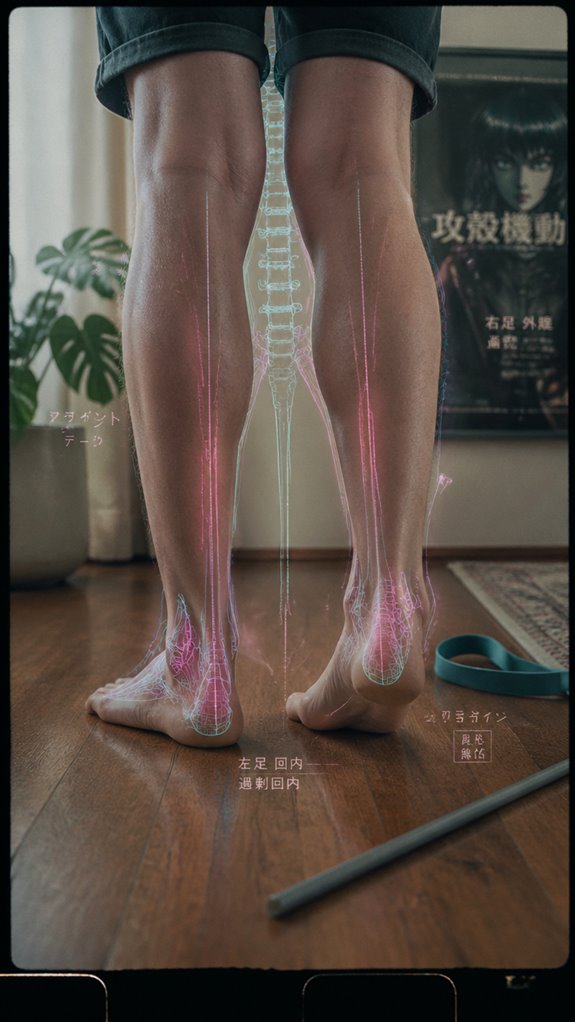
The cascade of postural degradation doesn’t originate at your feet—it propagates backward through the dependency chain, manifesting as lumbar strain, thoracic kyphosis, and cervical forward head posture that’d make any stack trace weep.
You’re deploying your weight asymmetrically. One foot bears excessive load; the other becomes vestigial. Your pelvis tilts. Your L5-S1 vertebrae compensate through lateral shear forces—essentially a null pointer exception in your kinetic architecture.
You’re pronating excessively inward, collapsing your medial arch like deprecated legacy code. Supination externally rotates your tibia. Both conditions destabilize your sacroiliac joint’s load-bearing capacity, cascading failure upward through interconnected systems. To mitigate this, incorporating a proper footrest position can significantly align your feet and improve overall spinal stability.
Moreover, wearing blue light glasses could help reduce eye strain caused by screen time, which can exacerbate postural issues over time.
Your debugging framework needs immediate refactoring.
Train Better Foot Positioning to Fix Posture
Once you’ve identified that your feet are executing like untested code in production, you’ll need to implement a systematic refactoring protocol—because half-measures won’t debug a foundational architecture failure.
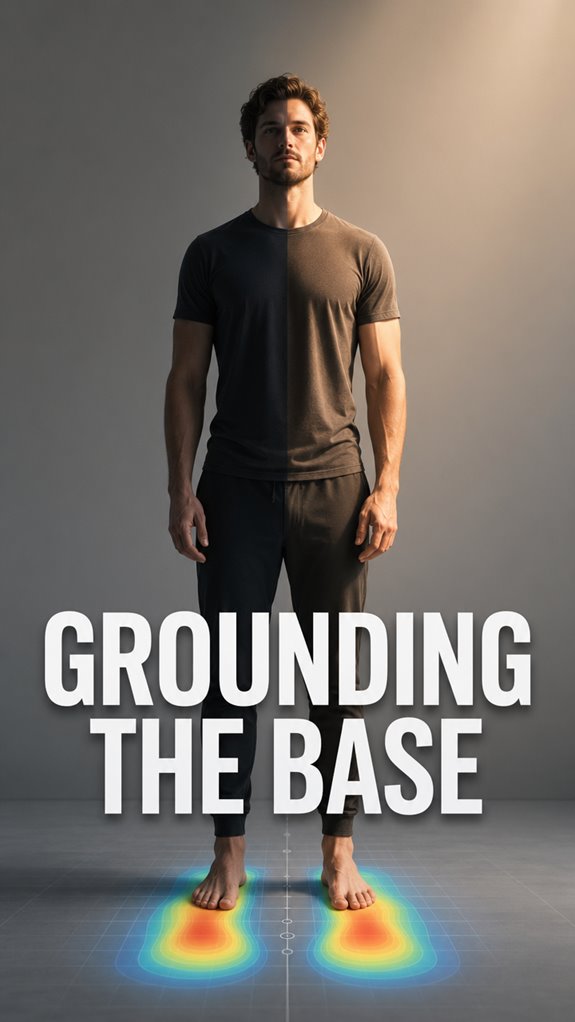
Start with tripod foot positioning: distribute load across your heel, big toe, and pinky toe. This isn’t wellness theater; it’s systems engineering. Incorporating top glucose monitors can help track your body’s responses as you stabilize your posture.
Daily drills matter. Practice barefoot stance work during standups.
Calf raises build proprioceptive resolution.
Your spine’s stability stack collapses without proper ground-truth data from your feet. You’re literally running mission-critical processes on corrupted sensory input.
Fix the base layer first. Everything else cascades from there. Incorporating gel wrist rests can also enhance overall ergonomic support during various tasks.
Footrest Angle Affects Posture
If you’ve optimized your tripod stance but you’re still debugging postural failures at scale, your footrest angle is probably introducing systematic bias into your entire kinetic chain—much like deploying code without accounting for environmental variables.
I’ve learned that footrest geometry isn’t ergonomic theater; it’s foundational infrastructure.
- 90-degree ankle alignment prevents compensatory pronation cascading upward
- 5-10 degree decline reduces lumbar compression during eight-hour sprints; adjustable footrests can be particularly beneficial in achieving this alignment.
- Asymmetrical positioning corrupts proprioceptive feedback loops instantaneously
- Material friction coefficients determine whether your foundation holds or drifts
- Height miscalibration introduces systematic L4-L5 shear stress
Your spine doesn’t care about your debugging philosophy. It executes what you’ve configured. Moreover, optimal noise-cancelling earbuds can enhance concentration in your workspace, improving overall posture and comfort.
Inadequate Footrest Height Misalignment
How many times have you rationalized a footrest that’s off by three centimeters as “close enough,” only to spend the next six hours debugging why your L5 vertebra’s throwing exceptions like you’re running production code on a Monday morning?
Misalignment cascades through your kinetic chain like a null pointer exception propagating up the stack trace. Your feet don’t ground properly, destabilizing the entire spinal architecture.
| Height Variance | Compensation Pattern | Vertebral Stress |
|---|---|---|
| +2cm | Hip flexion increase | L4-L5 shear load |
| -2cm | Lumbar hyperextension | Facet joint compression |
| Ideal | Neutral alignment | Distributed load |
| Off-tolerance | Postural drift | Cumulative degeneration |
Fix this.
Plantar Pressure Distribution Matters
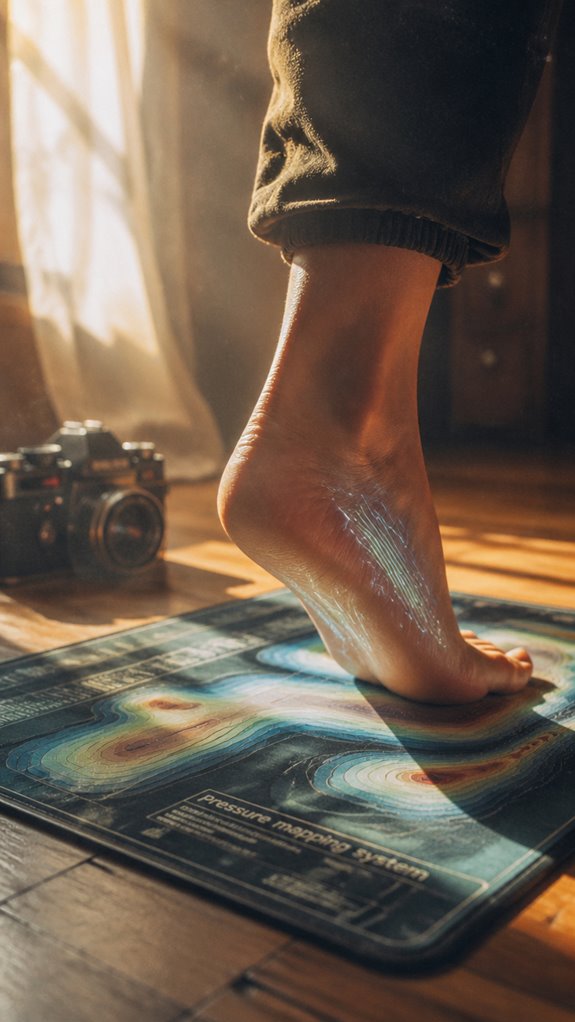
Your plantar pressure distribution‘s fundamentally a load-balancing algorithm that your body’s been running without proper instrumentation—and you’ve never bothered to profile it.
Consider your feet as legacy infrastructure supporting enterprise-grade cognitive overhead. You’re executing Docker containers in your prefrontal cortex while your foundation’s misconfigured.
- Uneven weight distribution creates cascading failures through your kinetic chain
- Medial/lateral imbalance triggers compensatory Stack Overflow errors up the spine
- Pressure hotspots function as memory leaks—bleeding resources inefficiently
- Poor ground contact reduces system stability coefficients by measurable margins
- Heel-dominant loading bypasses your arch’s shock-absorption middleware
Your body’s architecture demands symmetric load-bearing. Profile it.
FAQ
How Long Does It Take to See Posture Improvements From Correcting Foot Positioning?
You’ll notice initial postural shifts within days of correcting your foot positioning, though you’ll require 4-6 weeks of consistent practice to establish neuromotor patterns that stabilize your spine thoroughly.
Are Foot Positioning Exercises Beneficial for People With Existing Spinal Injuries?
You’re threading a needle—foot positioning exercises can benefit your spinal injury recovery, but you’ll need professional guidance. They’ll strengthen stabilizer muscles, reduce compensatory stress, and facilitate healing when tailored specifically to your condition.
Which Footwear Types Best Support Proper Foot Positioning and Spinal Alignment?
You’ll find that minimalist shoes with zero drop and wide toe boxes best support your proper foot positioning and spinal alignment. They’ll enhance your proprioceptive feedback while you’re establishing stable foundational mechanics.
Can Foot Positioning Corrections Help Reduce Chronic Back Pain Without Other Interventions?
You’d love believing your feet are magic wands. They’re not. While foot positioning corrections considerably reduce chronic back pain, you’ll maximize results by combining them with core strengthening, posture awareness, and consistent practice.
How Does Foot Positioning Affect Spinal Health During Different Types of Physical Activities?
You’ll discover that your foot positioning dynamically adjusts spinal stability across activities. During lifting, you’ll ground force through your feet, enhancing lumbar support. Running demands forefoot engagement; static postures require tripod alignment for ideal vertebral protection.