Ever felt like your brain’s running a memory leak from isolation? I sure have. Three months of remote debugging at 2am, talking to no one but my rubber duck.
That’s when I discovered peer-to-peer wellness systems. Not corporate wellness spam. Actual human connection protocols.
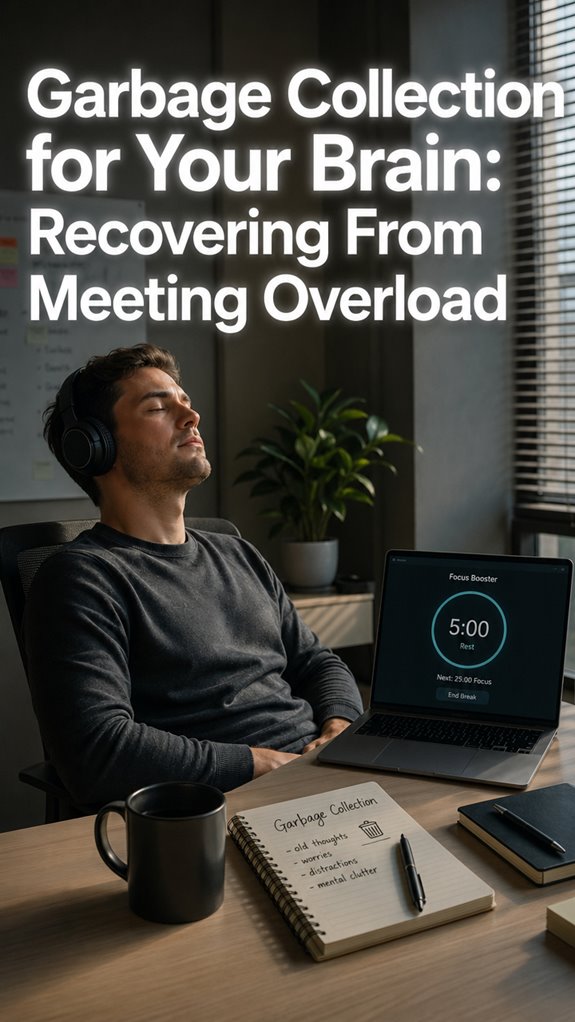
I started a “sad coffee” Slack channel with three other devs. No productivity pressure. Just … existing together. Sometimes silent. Sometimes venting about PMs who don’t read docs. It became my emotional garbage collector.
Here’s what nobody tells you: isolation isn’t a bug you fix once. It’s chronic. Like technical debt.
The tools matter too. I ditched “mindfulness apps” for shared Figma boards where we literally draw our feelings. Messy. Human. Works.
Your stack is only as stable as your support network. Optimize that first.
—
Remote Work Burnout: Why Your Brain Feels Like a Leaky Abstraction
Last year I crashed hard. Fourteen-hour sprints, zero human contact, convincing myself async standups counted as friendship. Then my hands started shaking during deploys.
Turns out “hustle culture” and imposter syndrome make terrible architecture. My sympathetic nervous system was basically a DDOS attack on itself. I started walking to a coworking space twice weekly, no laptop. Just humans who also understood CSS trauma. Changed everything. Your infrastructure needs redundancy. So do you.
Quick Takeaways
- Establish deliberate, authentic peer connections through structured support networks and shared activities to combat remote social disconnection.
- Design resilient virtual environments with tools like micro-challenges and informal chats to foster trust and emotional engagement.
- Promote physical and ergonomic wellbeing to maintain mental resilience and prevent hardware-like fatigue or burnout.
- Implement regular feedback loops and data metrics to monitor engagement, adjusting strategies to sustain effective peer support.
- Encourage vulnerability and open communication to rebuild trust, reducing paranoia and strengthening social bonds remotely.
How Remote Isolation Affects Employee Wellbeing
Have you ever experienced a system crash so profound that even the most resilient code begins to glitch, leaving the user painfully aware of a core failure?
Remote isolation acts like a persistent fatal bug, corrupting emotional resilience and disrupting therapeutic bonding. The infrastructure that sustains collaborative execution weakens, akin to a $(“.heartbeat()”).stop() in the middle of a critical process.
Neurochemical data shows heightened cortisol levels and diminished oxytocin, effectively crashing the human operating system.
Like Ghost in the Shell’s network paranoia, isolation erodes trust in one’s mental server, underscoring the urgent need for redundancy—peer support and emotional resilience modules—to prevent total system failure.
Building Trust and Connection in Remote Teams
Building trust in remote teams is akin to debugging a mission-critical system, where despite rigorous unit tests, core architecture periodically fails under load. Emotional vulnerability acts like untested code—initially messy, yet essential for stability, if properly integrated. Trust building requires exposing system vulnerabilities, much like revealing raw server logs after a crash, but humans, unlike AI, resist such data dumps. It’s like trying to run Ghost In The Shell—complex code attempting to decode human emotion without crashing the infrastructure. Chlorophyll water benefits, such as promoting energy and reducing fatigue, can serve as a metaphor for the revitalizing effect of peer support. Without parallels like peer support, team cohesion remains a legacy bug, prone to memory leaks, confusion, and total system halt. To foster a sense of community, incorporating principles from peer-to-peer support can help alleviate the feeling of exhaustion and disconnection many remote workers experience.
Effective Strategies for Peer Support Networks
Isn’t it astonishing how peer support networks resemble debugging a sprawling microservice architecture, where systemic latency spikes and race conditions threaten total collapse? You implement peer mentorship as layered error handling—relationship scaffolding designed to patch the emergent bypasses that systemically fail under load.
Like debugging Ghost In The Shell’s cybernetic implosions, you realize that effective strategies require orchestrated fail-safes, not just individual patches. When code breaks, we examine logs—here, it’s the subtle signals of physiological overload—yet the real power lies in preemptive relational architecture, ensuring resilience against the cascading failures of human spectrum that threaten to bring down the entire system.
Best Tools and Technologies for Peer Wellness
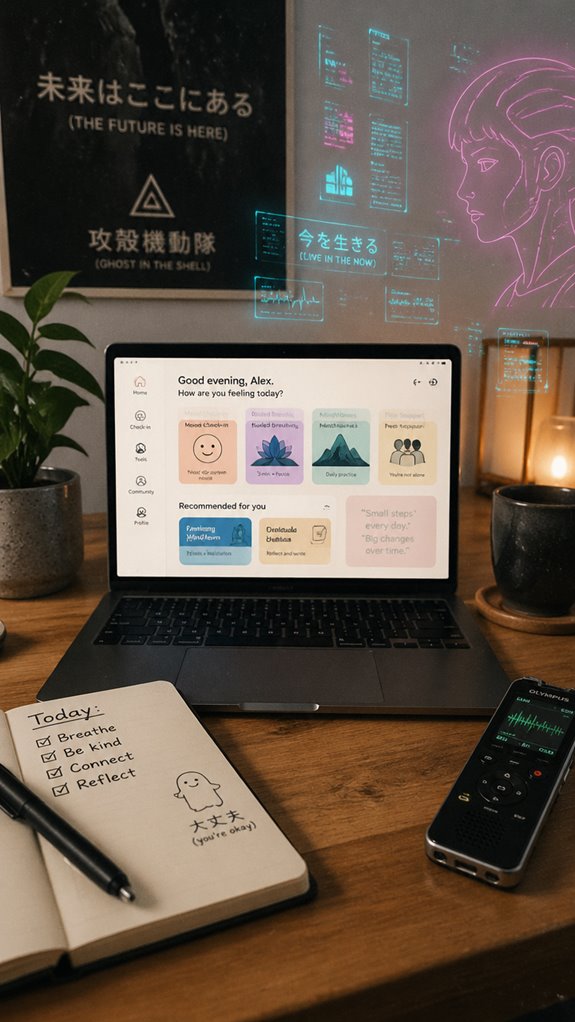
In the complex domain of peer wellness tools, where the code must interface seamlessly with the fragile human psyche, the first challenge lies in architecting an unimpeachable data pipeline—one that can handle the stochastic chaos of individual mental health metrics without cascading into catastrophic failure.
Peer mentorship modules and digital empathy algorithms must evolve beyond mere API calls, confronting the inherent volatility akin to Git merge conflicts, yet for complex neurological data. Like “Ghost in the Shell,” we attempt to sync human fragility with robust backend architecture—blindly, often with server crashes and missed signals, all while trying to maintain an illusion of operational serenity.
Overcoming Challenges to Authentic Peer Relationships
When the overarching architecture of peer support systems falters—much like a legacy backend struggling under relentless API calls—ensuring micro-interactions feel authentic rather than scripted becomes the debug mission.
Sharing vulnerability and fostering empathy resemble a flawed codebase: fragile, reactionary, vulnerable to breaking under pressure. Like debugging “Ghost in the Shell,” authentic connections demand deliberate design, not smoke and mirrors. Effective jaw pain management can also play a crucial role in reducing stress-related issues that affect our ability to connect. For instance, investing in noise-reducing earplugs can help individuals create a peaceful environment conducive to genuine interactions.
Until trusted authentication, encryption, and stress testing explicitly respect emotional load, these bridges risk collapsing, no matter how promising the framework.
How to Measure Success in Peer-Driven Wellness Initiatives
Before you start pretending graphs and KPIs magically quantify authenticity, recall that systemic failures—like a faulty API call or a memory leak—make even basic assertions about well-being suspect.
Peer feedback, while essential, operates like a debug log—valuable but riddled with noise.
Success metrics, such as session engagement and peer request resolutions, are as fragile as a JavaScript callback hell. In the realm of data analysis, prioritizing quality data collection can significantly improve the insights derived from these metrics.
You must parse through the chaos of physiological data, emotional metrics, and usability tests, all while Ghost in the Shell reminds us that the human system is far from deterministic.
Incorporating effective monotasking strategies can enhance clarity and focus within these complex pipelines.
Ultimately, success hinges on validating that these complex pipelines don’t crash under load.
Virtual Coffee Chats

Virtual coffee chats operate like the latest microservice deployed without proper load testing—fragile, asynchronous, prone to failure when overwhelmed.
Coffee bonding and casual check-ins, so touted, become the neuron overloads in our collective brain, crashing under pressure. In these moments, a caffeine boost can sometimes help us stay alert and engaged, but overreliance on such stimulants can lead to burnout.
As a senior dev, I see these moments as benign pull requests—innocent code, disastrous in untested streams.
Like Ghost In The Shell’s flawed digital psyche, human connection in these fragmented threads drifts, momentarily glitching.
Perhaps, at runtime, we’re just patching errors with byte-sized motivators, oblivious to the latency between human need and system capacity—a tragic masterpiece of untested social architecture, waiting for a fatal race condition.
Yet, underlying these interactions is a growing chest tightness that signals work anxiety, highlighting the urgent need for robust support systems in our remote environments.
Virtual Small Talk Challenges
The sanitation of pre-meeting chatter—the gentle startup routines of casual banter—has been systematically eradicated from our digital workflows, much like legacy code refactored without proper testing.
In the domain of virtual networking, emoji communication attempts to substitute for the subtle handshake, but often crashes with misinterpretations, hampering engagement. In-person interactions provide essential elbow pads that cushion the impact of awkwardness and help individuals navigate social dynamics more comfortably.
As we debug the human interface, we find that dissolving small talk yields an unstable system: users flickering between silence and terse responses, like an AI fighting a Ghost in the Shell’s framework.
Attempting natural flow becomes a patch, yet without the prelude, our communication modules risk catastrophic desynchronization.
System failure masquerades as efficiency.
To address overcoming loneliness, teams must prioritize creating more informal interactions to foster connection in remote settings.
Online Team-Building Activities
In the same way that unchecked code can cause a cascade of system errors—leading to a server crash that takes down essential dependencies—dysfunctional team bonding modules threaten remote collaboration’s stability.
Engaging in online team-building activities acts as the patch needed to prevent the catastrophic failure of remote synergy. Creative icebreakers and collaborative challenges emulate debugging sessions: leveraging humor and challenge to optimize the human API. Weighted lap pads, known for enhancing comfort and focus, can also be a thoughtful addition to create an inclusive environment during these activities. Additionally, incorporating nerve flossing techniques into breaks can help alleviate any discomfort and promote well-being among team members.
| Platform | Key Feature | Dev Impact |
|---|---|---|
| Donut | Virtual coffee chats | Breaks silos, boosts informal protocol |
| Vantage Fit | Shared fitness challenges | Fosters team synchronization |
| Wellable | Micro-challenges, nudges | Reinforces microservice interactions |
| Togetherall | 24/7 anonymous venting | Enables crash dumping, real-time logs |
| PeerConnect | Organized peer support groups | Maintains system integrity, uptime |
Eco-Friendly Workstation Setup
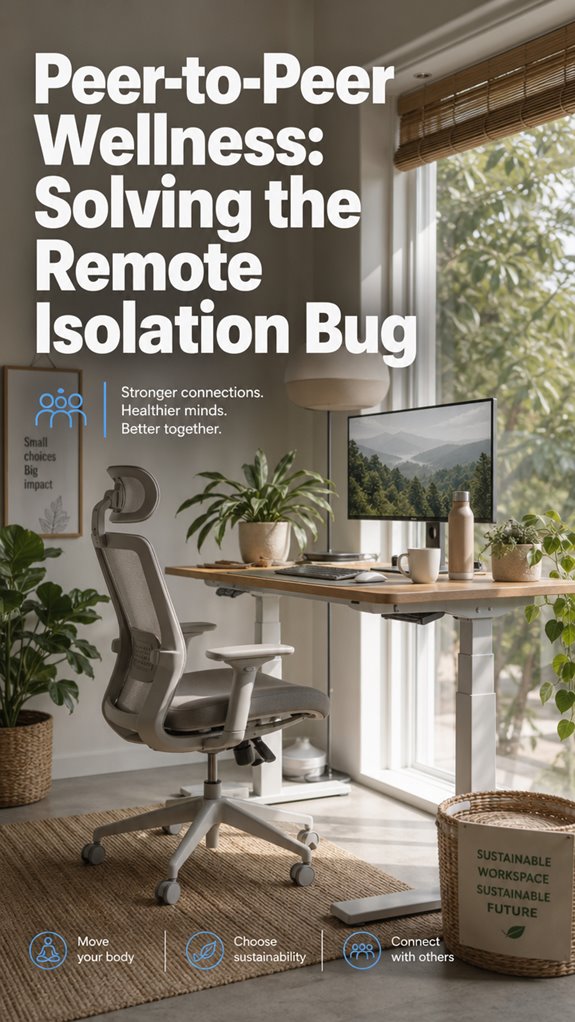
Ever wondered if your static posture and suboptimal ambient conditions could cause more catastrophic failures than a stack trace in production? As a senior dev, you recognize that systemic hardware degradation—like spine drift or wrist fatigue—can crash your productivity faster than a null pointer exception.
Implementing eco-conscious accessories isn’t just “green,” it’s essential for sustained uptime. Sustainable tech solutions, like adjustable desks and ergonomic peripherals, serve as the patches to your hardware’s latent bugs. Optimizing developer ergonomics is fundamental in maintaining your overall health and productivity. Additionally, creating an office environment that fosters collaboration and minimizes distractions can further enhance your workflow.
Think of it as debugging your bio-infrastructure—like Ghost in The Shell, your human hardware demands constant refactoring to prevent meltdown, not just code refactoring but physical re-engineering.
FAQ
How Can Peer Support Programs Be Tailored for Diverse Cultural Backgrounds?
You must prioritize cultural sensitivity and address language barriers by offering multilingual support, culturally aware training, and diverse peer matching, empowering individuals to share openly, feel respected, and foster inclusivity within your support programs, driving stronger engagement.
What Training Is Necessary for Peers Facilitating Mental Health Support?
Are you ready to lead change? You need role training that sharpens communication skills, empowers peers with mental health knowledge, and guarantees confident, effective support. Master these skills to command trust and foster authentic well-being conversations.
How Do Peer Networks Maintain Engagement Over Long-Term Remote Work?
You maintain engagement by leveraging virtual accountability through regular check-ins, setting clear goals, and celebrating peer recognition for achievements. These strategies reinforce commitment, foster a sense of community, and guarantee long-term motivation in remote work environments.
What Privacy Measures Ensure Confidentiality in Online Peer Support Platforms?
Envision you’re leading a remote team; you know confidentiality is key. You implement strict access controls and data encryption, ensuring only authorized peers access support sessions, empowering you with privacy that fosters trust and openness.
How Can Organizations Integrate Peer Wellness Initiatives With Existing HR Policies?
You secure leadership buy-in and allocate resources strategically, integrating peer wellness initiatives seamlessly into your HR policies. This empowers you to foster a resilient, connected workforce and reinforce your organization’s commitment to mental health and employee well-being.
Summary
In the endless compile cycle of remote work, where the OS of human interaction crashes before the kernel of trust loads, peer wellness systems are the patch updates we desperately need. Amidst the inevitable memory leaks of virtual chat lobbies and sandboxed small talk, building authentic connection is akin to debugging a ghost in the shell — elusive yet essential. Without these upgrades, the infrastructure of your team remains fragmented, forcing you to deploy emotional hotfixes on an unstable server.
References
- https://thepeernetwork.com/social-isolation-loneliness-peer-support/
- https://firstresponsemh.com/peerconnect/
- https://wellness.upenn.edu/wellbeing-initiatives/online-peer-support
- https://www.vantagefit.io/en/blog/remote-worker-wellbeing-platform/
- https://meditopia.com/en/forwork/articles/wellness-for-remote-employees
- https://bondedpath.com/support/remote-work-isolation-in-charlotte/
- https://www.weconnecthealth.io
- https://pmc.ncbi.nlm.nih.gov/articles/PMC10660210/
- https://www.televeda.com/posts/the-value-of-online-peer-support-groups-to-fight-loneliness-depression-and-other-mental-health-conditions
- https://www.tandfonline.com/doi/full/10.1080/02699931.2024.2392178
- https://www.vinhgiang.com/blog/how-to-make-small-talk/
- https://www.wondermind.com/article/small-talk/
- https://ggia.berkeley.edu/practice/small_talk
- https://hbr.org/2021/02/make-time-for-small-talk-in-your-virtual-meetings
- https://www.deathofsmalltalk.com