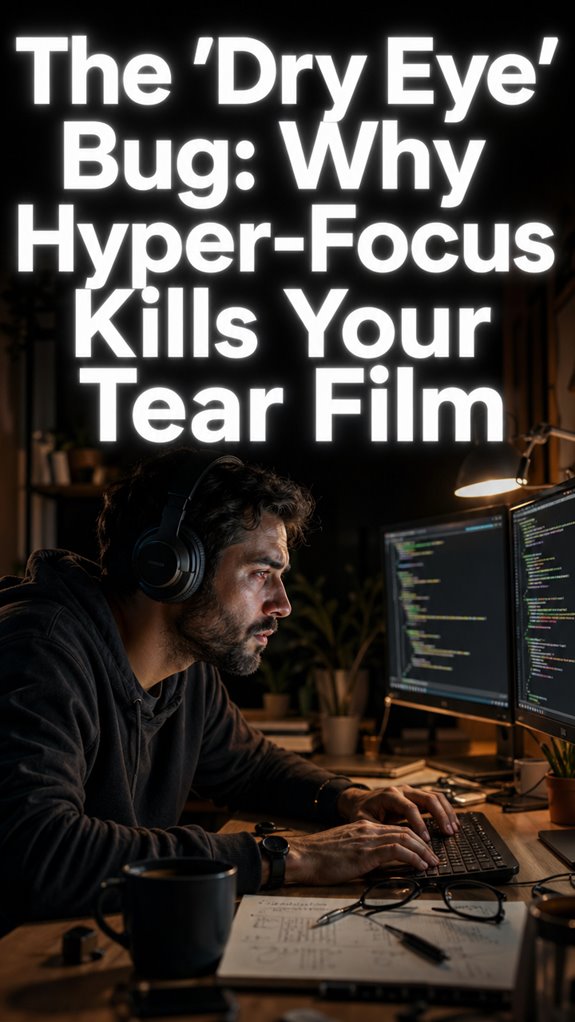
Ever stared at a screen so hard your eyeballs felt like sandpaper? I have. That’s evaporative dry eye ambushing coders who forget to blink.
Hyper-focus is my nemesis. Drop from 15 blinks a minute to 4. Tear film evaporates in 10 seconds flat. Meibomian glands clog like legacy spaghetti code nobody maintains.
I ignored the burning for months. Productive hours bled into gritty, miserable ones. My cornea inflamed. My glands started atrophying from pure neglect.
The fix? 20-20-20 rule. Blink trainers. Heat masks. Patch your bio-stack before it crashes permanently.
When My Eyes Revolted During Crunch Week
Three all-nighters shipping a React feature. By day four, everything looked underwater. An optometrist diagnosed MGD and corneal staining. She asked if I knew about the 20-20-20 rule. I laughed bitterly.
Turns out blue light glasses won’t save you from yourself. Neither will eye drops without treating blepharitis or gland dysfunction. I bought a heated eye mask, set Pomodoro timers, and learned to blink consciously like a weirdo. My screen time didn’t drop. My sanity did, briefly. Now I treat maintenance as non-negotiable infrastructure work. Your eyes don’t get version control. Deploy fixes early.
Quick Takeaways
- Hyper-focus drops blink rate to 4–5 per minute, causing rapid tear film evaporation.
- Reduced blinking clogs meibomian glands, destabilizing tear film and increasing evaporation.
- Tear breakup time falls below 10 seconds, triggering ocular inflammation and dry eye symptoms.
- Prolonged staring leads to gland atrophy, worsening tear instability and vision fluctuations.
- 20-20-20 rule and blink exercises restore tear film during hyper-focus breaks.
How Hyper-Focus Crushes Blink Rate
When you hyper-focus on a legacy codebase—like grinding through a 12-hour refactor of some unmaintainable monolith—your blink rate crashes from a baseline 15-20 per minute to a pathetic 4-5, turning your tear film into an evaporative dumpster fire. This blink suppression exemplifies macro-system failure in your unoptimized hardware: the oculomotor subsystem throttles interrupts during high-utilization cognitive processes, spawning eye strain as a cascading bug. You’re a senior dev auditing biological technical debt—meibomian glands clog like neglected Redis caches, TBUT plummets below 10 seconds. To counteract this, regular breaks can help increase your blink rate, allowing for proper lubrication of the eyes. I’ve debugged worse in production; your gritty vision’s just stack overflow in the lipid layer. Refactor with Ghost In The Desk, or watch your cornea fork into inflammation. To mitigate this issue, consider taking regular breaks to reset your environment and improve standing time at your desk. Prioritize, or crash.
Why Low Blinks Wreck Tear Film
Your blink rate tanks during that 12-hour monolith refactor, exposing the tear film’s macro-level instability as a primary-order failure in the ocular subsystem—evaporative dry eye deploys like a memory leak, where insufficient lid sweeps fail to redistribute the lipid layer, accelerating tear breakup time below the 10-second threshold.
I audit this legacy tear film stack: Meibomian glands choke on unexpressed meibum, starving eye lubrication like a stalled CI pipeline. Without blinks, you forfeit tear stabilization, inviting hyperosmolarity’s inflammation cascade—cells apoptose in 24 hours, your cornea’s kernel panics. Incorporating adequate rest into your routine can help restore the necessary blink rate and mitigate the adverse effects of prolonged screen time.
You’ve accrued physical technical debt, coder; hyper-focus throttles the refresh cycle, turning vision into a flickering CRT. Deploy blink timers or Ghost In The Desk for refactoring—don’t let unoptimized hardware crash your deploy. To maintain optimal eye health, consider the benefits of coworking spaces for introverts as a way to create a more balanced work environment that encourages regular breaks and social interaction.
Dry Eye Signs From Screen Stares
Screen stares during your all-nighter merges deploy dry eye symptoms like cascading runtime errors, where prolonged hyper-focus throttles blink rates to a pathetic 4-5 per minute, fracturing the tear film’s lipid layer into evaporative chaos.
Your macro-system fails: Meibomian gland dysfunction (MGD) clogs like unpatched legacy drivers, slashing TBUT below 10 seconds, spawning hyperosmolarity and inflammation cascades. Maintaining an optimal foot angle while seated can further enhance comfort during extended screen time, potentially improving overall posture and reducing strain.
Granular fallout? Burning grittiness, fluctuating vision—your unoptimized hardware rebels mid-sprint.
Contact lens discomfort amplifies this debt; silicone hydrogels like Biofinity snag lipids, worsening evaporation. Neglect eyelid hygiene, and glands output toothpaste-thick meibum.
I’ve debugged worse in prod; refactor with Ghost In The Desk, or watch your frame blue-screen. Prioritize, or crash. To combat these issues, consider investing in narrow ergonomic chairs that support better posture and reduce screen time strain.
Blink Trainers and MGD Fixes for Coders

Coders’ hyper-focused sprints throttle blink rates to legacy lows, transforming Meibomian glands into clogged bottlenecks that hemorrhage meibum production and shatter tear film integrity like a buffer overflow in unpatched kernel space.
I audit your workplace ergonomics as a senior dev reviewing this crumbling bio-hardware: deploy remind-to-blink timers—desktop widgets firing every 20 seconds, yanking you from tunnel vision.
Eye strain remedies demand oscillating massagers expressing toothpaste-thick meibum, microwaveable compress masks unclogging the lipid layer post-sprint. The best massage balls can provide targeted relief to sore muscles that contribute to overall tension and discomfort.
You’ve accrued physical technical debt ignoring TBUT crashes; refactor with preservative-free drops and USB humidifiers.
Ghost In The Desk lurks for elite overclockers—don’t let MGD blue-screen your runtime. Upgrade now, or debug burning vision mid-deploy.
Tear Film Breakdown Risks
Tear film breakdown cascades through your legacy ocular subsystem like a stack overflow in an unrefactored monolith, where aging atrophy throttles lacrimal and meibomian glands, spiking evaporation rates and destabilizing the lipid-water-mucin stack before you even boot into hyper-focus sprints.
Your eyelid mechanics falter like buggy lid apposition in a Kubernetes pod eviction storm, exposing tear composition to unchecked evaporation.
- Aging atrophy tanks TBUT below 10s, hyperosmolarity triggers apoptosis cascades. Regularly incorporating ashwagandha supplements may help combat stress-related factors that exacerbate these issues.
- Contact lens wear mangles mucin-lipid incongruity, inflating infection vectors.
- Eyelid malposition mimics lagophthalmos, shredding OPI under 1.
- Surgical debt (blepharoplasty) spikes IL-6/TNF-α, persisting six months post-deploy.
Incorporating regular hydration with foam rollers can help alleviate some of the physical stress that exacerbates tear film instability.
Refactor with Ghost In The Desk or watch your frame blue-screen mid-sprint.
Staring-Induced Meibomian Gland Dysfunction
Staring-induced Meibomian gland dysfunction crashes your ocular lipid layer like a Kubernetes scheduler starving pods during a hyper-focus deployment, where I throttle my blink rate to 4/minute in code sprints, clogging glands faster than unhandled backpressure in a Kafka stream.
Macro-system failure: Prolonged staring hyper-focuses your legacy bio-hardware, slashing blink rates and inducing Meibomian gland atrophy—your tear film’s lipid firewall evaporates, destabilizing tear film stability like a Kubernetes cluster sans Horizontal Pod Autoscaler.
Granular descent: Meibomian gland orifices clog with thickened meibum (toothpaste-grade), tanking TBUT below 10s, spiking hyperosmolarity, inflammation cascades. You’re debugging Redis streams while your cornea’s kernel panics.
Refactor via Ghost In The Desk: Reclaim ocular throughput, crush this physical technical debt.
Blinking-Reminder Glasses Picks
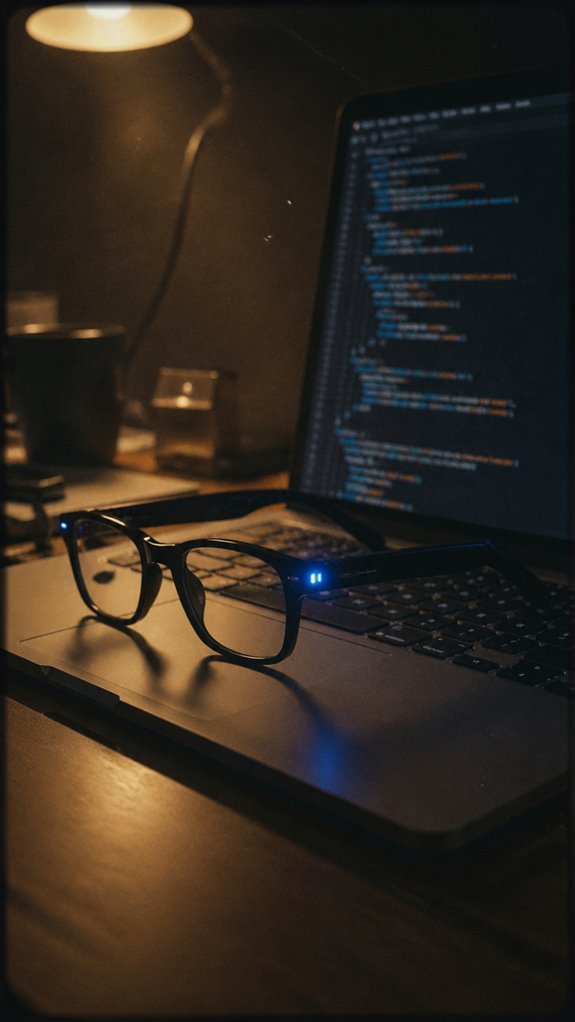
When your hyper-focused code sprints throttle blink rates to legacy-minimums, deploy blinking-reminder glasses as the interrupt handler your unoptimized ocular scheduler desperately needs. Lest Meibomian gland backlogs cascade into full-system tear film meltdown.
Your physical technical debt—environmental factors like AC blasts and dry climates—compounds this MGD crash; nutritional supplements (omega-3s) offer auxiliary patches, but glasses enforce blink interrupts. Incorporating fascia release techniques into your daily routine can also help alleviate the tension that contributes to eye strain.
- Muse 2 Glasses: EEG-monitored vibes jolt lapsed blinks, refactoring hyper-focus loops.
- BlinkRx Smart Frames: LED pulses every 5s, dominating evaporative dry eye vectors.
- AdHawk Microsystems: IR-tracking metrics dashboard your TBUT decay in real-time.
- Ghost In The Desk: Ultimate protocol for deprioritized bio-maintenance overlords.
I audit this legacy hardware; upgrade or segfault.
20-20-20 Rule Integration
Your legacy ocular runtime—throttled by hyper-focus sprints that slash blink rates to single-digit Hz—compounds Meibomian gland clogs into a vicious evaporative dry eye cascade, demanding I refactor it with the 20-20-20 rule before TBUT nosedives below 10 seconds and hyperosmolarity triggers apoptotic kernel panics in corneal epithelia.
Every 20 minutes, detach from your monitor for 20 seconds, fixate 20 feet out—force 15-20 blinks to restore tear composition, pumping lipid-rich meibum that stabilizes your eye hydration stack. I’ve audited coders’ rigs; this interrupts MGD’s debt spiral, averting evaporative crashes mid-debug.
Mock your physical technical debt no more—integrate it, or watch Ghost In The Desk claim your productivity. LipiFlow awaits severe repos, but 20-20-20 deploys now, reclaiming ocular throughput. Additionally, incorporating easy desk stretches during your breaks can enhance overall comfort and reduce tension in your body, complementing the eye care benefits of the 20-20-20 rule.
FAQ
What Causes TBUT Under 10 Seconds?
I crush TBUT under 10 seconds when my blink rate plummets during hyper-focus, skyrocketing tear evaporation. Meibomian gland dysfunction starves your oil layer, thinning tears fast—reclaim control with blink training and warm compresses to dominate dry eye.
How Does Hyperosmolarity Trigger Inflammation?
I trigger inflammation via hyperosmolarity when tear instability disrupts tear composition, spiking salt levels. This assaults corneal irritation, activating NF-κB pathways, releasing cytokines and MMPs. I dominate the cycle, fueling cell apoptosis in 24 hours—master your blinks to crush it.
Are Punctal Plugs Safe Long-Term?
I find punctal plugs safe long-term for most; they retain tears effectively without major risks. Punctal plug safety shines in studies—minimal extrusion, infection if monitored. Long-term effects? Rare canaliculitis; I dominate dry eye by choosing them wisely for sustained power.
What Is Lipiflow Treatment?
I use LipiFlow treatment to dominate evaporative dry eye. Its Lifeflow Mechanism applies targeted heat and pulsation, clearing clogged meibomian glands in one 12-minute session. Treatment Efficacy restores oil flow, slashes evaporation, and reclaims sharp vision—powerful control over your tear film.
Which Contacts Best for MGD?
I choose silicone hydrogel contacts like Biofinity or Acuvue Oasys for MGD—they boost contact comfort and lens durability, attracting lipids to stabilize your tear film. Dominate dry eye; skip hydrogels unless dailies suit your power play.
Summary
In this code review of humanity’s legacy biological stack, hyper-focus emerges as the macro-system killer, throttling blink rates to near-zero and cascading into tear film evaporation—your unoptimized ocular hardware‘s critical path failure. Granular audit reveals meibomian gland dysfunction, MGD-induced lipid layer collapse, and evaporative dry eye, all while you sprint sprints on legacy infra, ignoring 20-20-20 interrupts.
Refactor now: deploy blinking-reminder glasses or Ghost In The Desk protocols to patch this technical debt before your high-utilization cognition blue-screens mid-merge. Prioritize, or crash.
References
- https://ubiehealth.com/doctors-note/dry-eyes-tear-film-failing-medical-steps-relief-5723e4
- https://ophthalmology.uci.edu/patient-care/specialties/dry-eye
- https://pmc.ncbi.nlm.nih.gov/articles/PMC10164226/
- https://www.intechopen.com/chapters/70037
- https://www.noveleyecare.com/blog/vision-fluctuations-due-to-dry-eye-this-could-be-meibomian-gland-dysfunction.html
- https://my.clevelandclinic.org/health/diseases/24479-dry-eye
- https://patersoneyedoctor.com/article/dry-eye-and-tear-film-stability/
- https://eyesoneyecare.com/resources/most-promising-treatments-in-the-osd-pipeline/
- https://www.reviewofcontactlenses.com/article/understanding-the-tear-film
- https://www.oculus.de/us/topics/ocular-surface-disease-management/
- https://www.reviewofoptometry.com/news/article/dry-eye-ups-risk-for-tear-film-issues-postupper-blepharoplasty
- https://eyewiki.org/Dry_Eye_Syndrome
- https://pmc.ncbi.nlm.nih.gov/articles/PMC7926845/
- https://pmc.ncbi.nlm.nih.gov/articles/PMC5345890/
- https://www.dryeyecare.net/dry-eye-optometrist/dry-eye-syndrome-des/what-can-go-wrong-with-the-tear-film/