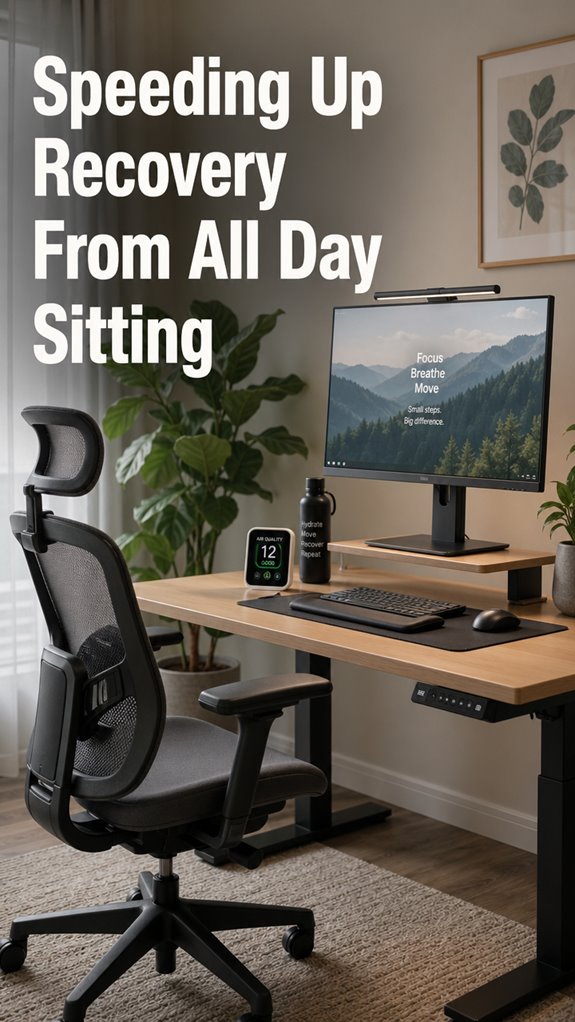
Ever feel like your brain’s buffering at 2pm while staring at the same function? I’ve been there. Movement snacks saved me.
—
Three o’clock used to hit different. My shoulders would lock up, my commits got messier, and I’d mainline expired coffee like it owed me money. Then I tried the banana-and-stairwell routine. Pathetic? Maybe. Effective? Absolutely.
—
Twenty air squats. A handful of almonds. Four minutes away from my ergonomic chair (which I definitely adjusted wrong for six months). My code reviews improved. My posture didn’t. Small wins.
—
The guilt was real at first. Like taking a break meant I was slacking. Turns out, my “productivity” was just anxiety wearing a todo list. Now I set Slack to away. I walk. The bugs still exist when I return, but I’m actually capable of fixing them.
—
Is this self-care? God, I hope not. It’s maintenance. You service your deployments. Service yourself.
—
Desk Job Back Pain From Sitting: How I Thought I Broke Myself at 28
Last spring, my left leg went numb during a sprint retrospective. Not dramatically. Just… absent. I finished the retro. I googled “sciatica vs. blood clot” for an hour. I didn’t go to a doctor because I had tickets to refine.
The standing desk helped. Briefly. Then my knees rebelled. The real fix was embarrassingly simple: a lacrosse ball under my glute during standups, actual standing during standups, and admitting that “pushing through” was just ego with a Jira account. Remote work wellness, ergonomic injury prevention, and developer health aren’t LinkedIn buzzwords when you’re Googling herniated disc symptoms at midnight. They’re survival. My leg’s fine now. Mostly.
Quick Takeaways
- Incorporate nutrient-dense, portable snacks like nuts, seeds, and dried fruits for quick energy and sustained focus.
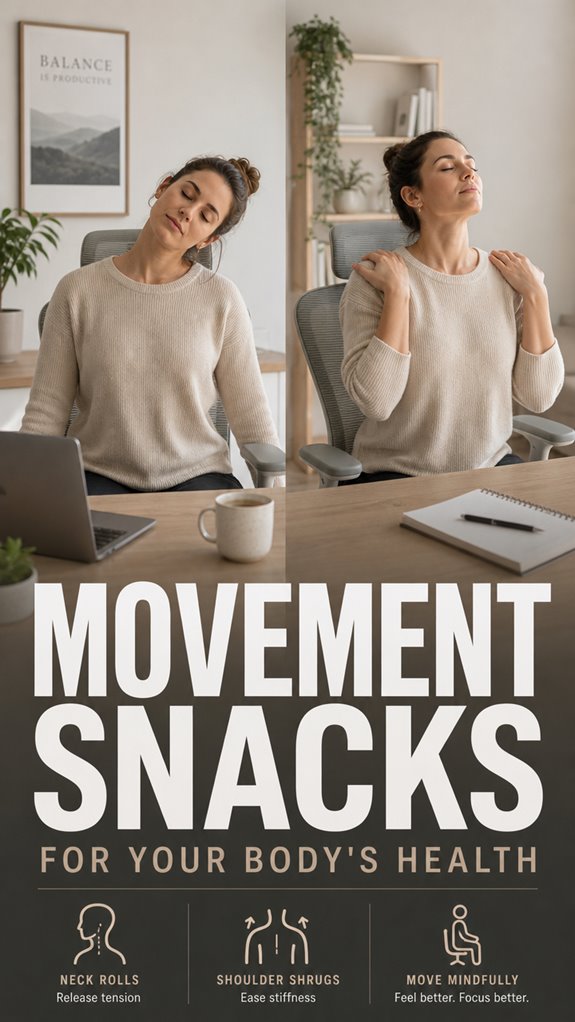
- Schedule micro-movements such as neck rolls and shoulder shrugs during key transition points to maintain mobility.
- Use easily digestible energy bars and bananas to prevent fatigue and support cognitive function during high-load periods.
- Regularly perform ergonomic stretches and posture adjustments to reduce muscle tension and prevent burnout.
- Rotate movement snacks and incorporate short, frequent movement breaks to optimize resource flow and system resilience.
Why Movement Snacks Are Key to High-Performance Days
Has your productivity engine ever hit a catastrophic bug because you neglected important system maintenance during your high-load development sprints?
Ignoring movement snacks is like skipping essential patches—eventually, your codebase (or body) crashes under stress. Frequent micro-reboots of physical activity restore system integrity, stabilize the core OS, and prevent Overload Syndrome.
In the same way a seasoned coder debugs a memory leak, movement snacks troubleshoot metabolic errors—improving insulin sensitivity and vascular throughput. It’s basic infrastructure maintenance, really; neglect it, and you risk experiencing the human equivalent of a system hang. “Ghost in the Shell,” indeed. Incorporating cycle tracking apps into your routine can also enhance your awareness of wellness and movement needs.
Which Nutrients Boost Energy and Focus During Movement?
Just as a memory leak causes a system’s performance to degrade over time, neglecting the right nutrients during peak activity turns your neural CPU into a sluggish, misfiring artifact. Complex logic demands glucose and oxygen—think brain’s version of robust RAM and efficient data buses—without which your cognitive stack crashes faster than a failed patch deployment.
Nutrients like omega-3 fatty acids function as system firewalls, enhancing focus, while B-vitamins optimize neural transmission—your human version of error-correcting code.
Basically, fueling your body with these essential elements acts as a patch, preventing catastrophic system failure mid-execution, making “Ghost in the Shell” look like a documentary. Furthermore, incorporating high-quality air purifiers can improve your environment, thereby enhancing overall cognitive performance during demanding tasks.
Best Portable Movement Snacks for a Quick Energy Boost
When your brain’s execution threads start stuttering mid-compile, it’s usually a sign that your internal buffer is overflowing—thanks to oscillating glucose levels, depleted oxygen, or that relentless memory leak called fatigue.
For a quick energy boost, debug your system with:
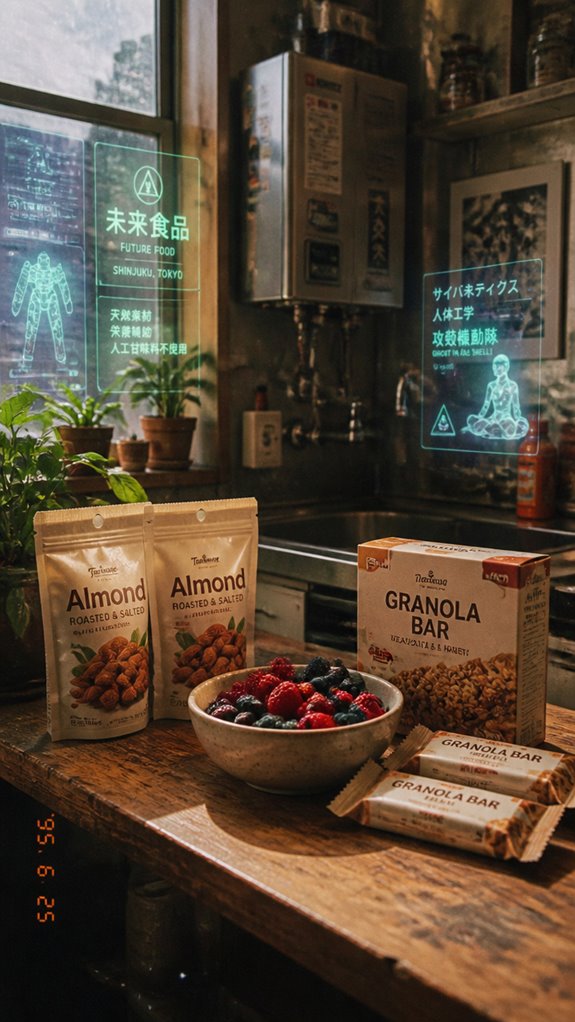
- Nuts and seeds—rich in healthy fats and protein, they stabilize your system’s throughput.
- Bananas—potassium and natural sugars provide immediate CPU porting with minimal memory overhead.
- Dried fruit—calories and antioxidants, a lightweight payload for quick, sustained tasks.
- Energy bars—if built with low-latency, clean ingredients, they function as modular patches.
Upgrade your snack arsenal, Coder. Ghost in the shell out, troubleshooting in.
When and How Often to Snack for Optimal Performance

In the grand schema of optimizing mental throughput, the timing and frequency of movement snacks resemble the debug code that keeps servers from overheating during a peak load—precise, deliberate, yet often overlooked until system failure.
You need to orchestrate these microprocessors—your muscles—by deploying movement snacks at defined intervals, just like scheduled patches.
Cluster these “performance patches” around natural handover points—post-meeting, pre-training—to prevent catastrophic crashes.
Sync your refresh cycles with hydration and a light fuel payload, akin to patching vulnerabilities before Ghost in the Shell’s endless cyberwar renders your CPU inert.
Control your system—your body—before it becomes a debug nightmare. Additionally, incorporating essential elbow pads during certain physical activities can enhance both comfort and protection, much like ensuring your system runs smoothly under load.
How to Plan and Prepare Snacks to Stay Fueled All Day
To optimize your daily throughput, you must treat your nutritional intake like a meticulously archived codebase—scheduled, modular, and resilient against unnecessary bugs caused by prolonged resource drains.
- Modularize your snacks: preassemble nutrient-dense packages, akin to microservices, for quick deployment during processing peaks.
- Prioritize speed: select ready-to-eat items—think script hook integrations—eliminating unnecessary waiting states.
- Version control: rotate snack types to prevent system fatigue, just as a developer patches bugs in iterative cycles.
- Log and analyze: track intake to identify bottlenecks, much like debugging a crashing app—because Ghost in the Shell should stay fiction.
My Initial Motion-Boosting Sample
System failures on high-performance days often manifest as cascading memory leaks—productivity dips, misplaced coffee cups, the odd misclick—highlighting the fragility of our hardware (bodies) amid relentless multitasking.
As a senior dev juggling infinite commits, I recognize that my infrastructure requires modular optimization, not just patch fixes.
My initial motion-boosting sample involved a curated suite of micro-bursts: 3-minute brisk walks, 2-minute stair climbs, and 15 reps of body-weight squats—akin to reinserting the “Ghost in the Shell” core.
This skeletal framework guarantees system stability while enhancing performance metrics. Incorporating ergonomic tools like top vertical mice can further alleviate strain during extended sessions at the workstation.
Limited Snack Variety Options
When your cognitive system begins leaking memory—misplaced coffee cups, unresponsive clicks, and the all-too-familiar “ghost in the shell” of productivity meltdown—it’s clear the hardware’s underlying architecture needs a quick defrag, not a major overhaul.
Limited snack variety options are akin to a software API with rigid endpoints—predictable but often insufficient.
- You might default to the same trusted code snippets, risking regression bugs in your nutritional logic.
- Relying on a narrow data set stifles adaptability—like a monolithic function with no hooks for extensions.
- Underlying component fatigue—think “buffer overflow”—leads to performance degradation.
The fix? A modular, flexible approach, allowing diverse payloads—innovation over redundancy.
Pomodoro Technique Breaks
In the relentless runtime of a high-stakes workday, the human processor begins to exhibit classic signs of buffer overflows—misplaced files, lost focus, and the all-too-familiar “Ghost in the Shell” flickering of cognitive latency.
| Macro-system Failure | Granular Breakdown | Mitigation Strategy |
|---|---|---|
| Software glitch | Memory leakage; CPU spikes | Scheduled Pomodoro breaks to reset buffers |
| Data corruption | Cognitive Dissonance | Interrupts to clear cache; realign focus |
| System crash | Workflow stalls | Timed pauses to reboot mental kernel |
You control the process, not the chaos—embrace purposeful breaks to prevent catastrophic memory dumps. Incorporating techniques such as the 20-20-20 rule can also help your eyes refresh during extended periods of screen time, minimizing strain and keeping your focus sharp.
Stretch Break Routines
A system decayed by long hours of static editing inevitably succumbs to microfissures—cumulative hardware bugs manifesting as neck stiffness, lower back latency, and downward spirals of cognitive throughput degradation.
Stretch break routines serve as essential patches—akin to hotfixes for your physical infrastructure.
- Perform neck rolls and shoulder shrugs every 30 seconds to debug upper-trapezius tension.
- Use the seated forward fold from your chair as a real-time memory leak fix for restricted hip and hamstrings.
- Initiate standing hamstring stretches against the desk to cache-liberate tightness.
- Execute standing spinal twists to maintain your spinal mobility API, preventing codebase (body) corruption.
Failure to integrate these upgrades results in a System Failure: Burnout. Moreover, incorporating ergonomic practices in your workspace can enhance your overall comfort and productivity.
FAQ
How Can I Incorporate Movement Snacks Into a Busy Schedule Effectively?
You should schedule movement snacks during natural breaks, like between meetings or lunch. Move intentionally for 2–5 minutes, focusing on full-body activation, and pair these with hydration and snacks to maintain energy and control your high-performance day.
Are There Any Safety Concerns With High-Intensity Movement Snacks?
High-intensity movement snacks are generally safe if you listen to your body, avoid overexertion, and progress gradually. If you have health concerns, consult a healthcare professional before starting new exercises, ensuring proper form and ample recovery.
Can Movement Snacks Replace Traditional Workout Sessions Entirely?
Movement snacks can’t replace traditional workouts entirely, but they give you control over daily activity, break up sedentary time, and boost your health. Use them to supplement, not substitute, longer exercise sessions for ideal results.
What Are the Best Movement Snacks for Improving Mental Clarity?
You can boost mental clarity with brisk walks, desk stretches, or quick body-weight exercises. These movement snacks increase blood flow, oxygenate your brain, and reduce stress, helping you stay focused, alert, and energized throughout your high-performance days.
How Do I Measure the Effectiveness of My Movement Snack Routine?
You measure your movement snack routine’s effectiveness by tracking improvements in energy, focus, and physical markers like heart rate or strength. Use a journal or app to monitor progress, then tweak your routine until ultimate control is yours.
References
- https://www.goodrx.com/well-being/diet-nutrition/best-pre-workout-snacks
- https://suckerpunchpickles.com/blogs/news/snacks-for-athletes
- https://truesport.org/nutrition/5-quick-easy-snacks-athlete-energy/
- https://thevegacademy.com/movement-snacks-more-movement-into-day/
- https://www.hingehealth.com/resources/articles/movement-snacks/
- https://utswmed.org/medblog/movement-snacks-exercise/
- https://memorialhermann.org/services/specialties/rockets-sports-medicine-institute/sports-nutrition/the-best-healthy-snacks-for-athletes
- https://gmb.io/movement-snacks/
- https://mihalysafran.com/10-natural-movement-snacks-for-everyday-life/
- https://www.equinox.com/articles/2025/02/you-need-movement-snacks
- https://soindiana.org/best-snacks-for-training-days-vs-rest-days/
- https://snackfully.co.uk/blogs/the-snackisseurs/the-best-high-energy-snacks-for-athletes-to-eat-pre-workout
- https://learn.athleanx.com/articles/high-protein-snacks
- https://www.skoutorganic.com/blogs/the-snack-guide/best-pre-workout-snacks-for-energy
- https://shop.spartan.com/blogs/unbreakable-nutrition/healthy-snacks
- https://nutritionheartbeat.com/sports-nutrition/snacks-for-athletes