Why do I hit that wall at 3 PM, staring blankly at my IDE? Natural light. Or lack of it.
My circadian rhythm used to be a dumpster fire of energy crashes and midnight scrolling. Then I moved my desk to face a window. Game changed.
The afternoon slump isn’t laziness. It’s biology screaming for cues that isn’t fluorescent hell. I started tracking my focus: 45 minutes of direct daylight, then boom. Sustained output till six.
Refactoring my workspace lighting felt ridiculous. Like, would a SAD lamp really help? Short answer: yes. I’m less zombie now. More human. More code shipped.
—
How Poor Workspace Lighting Causes Developer Burnout and Sleep Disruption
Last winter I spent three months in a basement coworking space. No windows. Just that sickly LED hum. I’d finish “productive” days feeling wired yet exhausted, then lie awake until 2 AM wondering why melatonin wasn’t working. My sleep hygiene was allegedly fine. Spoiler: it wasn’t. Blue light exposure, cortisol dysregulation, attention residue—I was running on biological debt. Moving to a spot with actual daylight exposure reset everything within two weeks. Turns out circadian entrainment isn’t wellness influencer fluff. It’s infrastructure.
Quick Takeaways
- Maximize exposure to natural light in your workspace by facing windows and reducing glare with appropriate coverings.
- Take outdoor breaks during peak daylight hours to refresh your circadian rhythm and boost alertness.
- Schedule work routines to align with natural light patterns, including morning sunlight to enhance focus.
- Use reflective surfaces and proper lighting adjustments to increase natural light distribution indoors.
- Limit artificial light exposure in the evening to preserve melatonin production and improve sleep quality.
How Natural Light Boosts Your Energy and Well-Being
When your biological system, much like that bloated legacy code, begins to falter—during that notorious midday crash—it’s often due to a misalignment between external inputs and internal clock functions. Think of it as running a poorly documented API, where sunlight acts as the essential flag.
Natural light suppresses melatonin, the sleep trigger, much like updating a deprecated library stabilizes a crashing server. With every unnecessary bug—blood glucose drops, decision fatigue, ATP depletion—you’re running version mismatches in your neurology.
A quick dose of “bright” sunlight, akin to hotfix patches, reboots your alertness, yet without proper calibration, the system remains prone to blue screens—aka mental fog. Managing period cramps can also benefit from light exposure, as it promotes overall well-being and reduces discomfort.
Easy Ways to Maximize Natural Light in Your Home or Office
Optimizing natural light in your habitat begins with recognizing the systemic failures that occur when your environment’s architecture neglects the core logic of circadian synchronization. Like a poorly coded API, your space’s layout hinders efficient data flow—i.e., light—crashing set points for alertness.
To fix this:
- Remove unnecessary obstructions (think of bottlenecks as office partitions)
- Use reflective surfaces to amplify available light
- Install smart, full-spectrum desk lamps—upgrade your “kernel”
- Position your workstation closer to windows, akin to optimizing latency
- Incorporate light-therapy devices, your real-time patch for “system fatigue”
Additionally, be mindful of how numb feet while sitting can result from poor ergonomics and inadequate lighting conditions that fail to support comfort and productivity.
Simple Techniques to Increase Sunlight Exposure During Your Day
In the grand debugging of our daily routines, the most overlooked bug is how we neglect the fundamental API of sunlight exposure—an essential external library that doesn’t load properly within our urban, windowless IDEs.
Ignoring this fails at the macro-system level, causing cascading latency: circadian melatonin surges, ATP drops, cognitive latency spikes.
You can optimize this “runtime environment” by injecting short, targeted sunlight functions—step outside, run a 5- to 15-minute module, and forcibly refresh your alertness buffer. Just like refactoring code, it’s about frequent, purposeful calls to the environment.
In “Ghost in the Shell,” understanding the system’s core is essential; so is adjusting your physical infrastructure accordingly. Additionally, studies have shown that exposure to natural light can significantly enhance both mood and productivity, further demonstrating its value in daily routines.
Adjusting Your Daily Routine to Align With Natural Light Cycles
If your daily routine resembles a poorly optimized codebase—constant latency from neglecting the core API of natural light—you’re running a critical bug, master.
To debug this, consider these system updates:
- Schedule outdoor breaks during peak daylight, like scheduling a system patch at the ideal load.
- Adjust start times to sync with sunrise, so your base firmware aligns with local light cycles.
- Prioritize morning light exposure as initialization, to preempt afternoon drifts—think early commit before the bugs manifest.
- Set calendar reminders for midday outdoor modules, avoiding sleep mode—think no-ops in the shadows.
- Avoid evening virtual junk patches; late-day light exposure is akin to corrupting your sleep cycle.
- Incorporating regular walking breaks throughout your day can significantly enhance your focus and productivity, much like optimizing a program’s performance.
Adjusting Desk Lighting Routines
When your workspace’s lighting code is executing in some sort of perpetual default mode—think of your desk lamp as the unreliable, poorly documented third-party library—you’re setting the stage for a cascade of performance bugs.
It’s the classic case of neglecting to reset parameters after patch deployments. Without deliberate adjustment, ambient lighting plunges into a chaotic, untracked state, disrupting circadian synchronization reminiscent of Ghost in the Shell’s blurry, dystopian vision.
To regain control, I manually recalibrate my desk lamp—dimming, brightening, scheduling—mimicking a well-structured API call sequence.
Minimal, intentional light exposures are now logged like version commits. Incorporating soundproof phone booths into your workspace can also enhance focus and reduce distractions, making it easier to maintain optimal productivity levels.
Decreased Focus During Afternoons
Even as you methodically debug your codebase, the underlying hardware—your brain—runs a less reliable version—one plagued by a cascade of neurochemical exceptions.
You face degraded focus during afternoons from macro-system failures—diminished orexin signals, glucose crashes, increasing adenosine, and falling cortisol, like a system reboot stuck in limbo.
- Orexin neurons, your master alarm system, drop offline faster than your server under DDoS.
- Glucose plummets, just like your CPU temp during a loop, causing cognitive throttling.
- Adenosine, the legacy process, accumulates, slowing neural bandwidth.
- Cortisol’s decline mirrors your server’s power-saving mode, lowering alertness.
- Dehydration and nutrient deficits introduce fatal memory leaks.
Your system’s uptime relies on strategic light, nutrient load balancers, and hydration—patches for this biological server. Integrating circadian desk lamps into your workspace can enhance your focus and mitigate the afternoon slump.
Adjusting Light for Circadian Rhythm
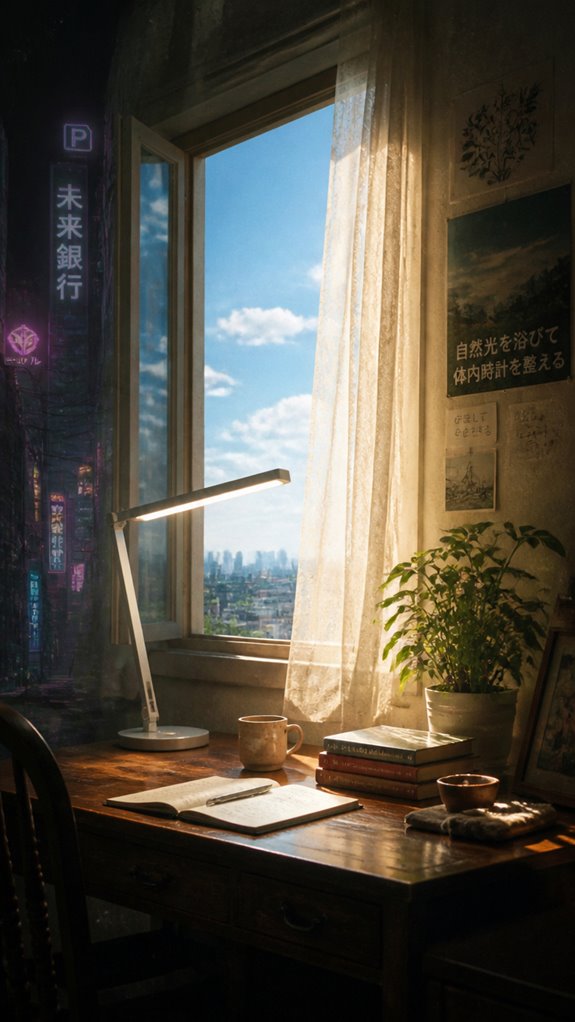
As your biological server hits a system failure—glitches manifesting as impaired alertness, sluggish cognition, and that persistent midday lag—each malfunction reflects a deeper misalignment within your internal clock architecture.
To reprogram this biological firmware, you must adjust light inputs, the core data streams synchronizing circadian cycles. Bright, natural light acts as the debug tool, overriding faulty routines.
Use the sun’s signal to enforce daytime parameters and suppress melatonin rogue processes. Think of this as patching your internal OS—no need for a reboot, just strategic, targeted immersion in daylight, ensuring your biological code runs cleanly, like a well-oiled, error-free hypercomputer.
Optimizing Desk Workspace Lighting
In the grand debugging session that’s your daily workflow, neglecting ideal desk lighting amounts to deploying code with unresolved race conditions—costly, inefficient, and ultimately, a showstopper for sustained throughput.
Poor illumination introduces visual latency, forcing unnecessary cognitive load and compounding decision fatigue. To regain control:
- Use full-spectrum, desk-mounted lamps mimicking natural sunlight (10,000 lux preferred).
- Opt for adjustable, flicker-free LED fixtures to prevent pixel fatigue.
- Deploy targeted task lighting to illuminate keyboards and screens without glare.
- Incorporate smart lighting systems capable of dynamic modulation based on circadian cues.
- Avoid harsh fluorescent overheads; they’re like deprecated libraries—obsolete and disruptive.
Additionally, maintaining proper lighting ergonomics not only enhances focus but also contributes to overall well-being in the workspace.
FAQ
Can Red Light Therapy Effectively Replace Natural Sunlight for Afternoon Energy?
Red light therapy is like a gentle wake-up call, but it can’t fully replace natural sunlight for afternoon energy. You control your energy; combining RLT with outdoor light boosts alertness, ensuring you stay sharp, alert, and in charge.
What Are the Best Outdoor Activities to Increase Midday Sunlight Exposure?
You should walk briskly, garden, or take outdoor breaks during midday to maximize sunlight exposure. Aim for 20-30 minutes outside, especially in open, unobstructed areas, to boost alertness, regulate circadian rhythms, and improve mood naturally.
Is It Safe to Use Light Therapy Glasses During Work Hours Consistently?
Using light therapy glasses during work hours is like adding a power-up to your day—if used as directed, it’s safe and effective. You control when and how to incorporate this tool for maximum alertness, just like a pro.
How Does Artificial Indoor Lighting Impact Circadian Rhythms and Energy Levels?
Artificial indoor lighting can disrupt your circadian rhythms by suppressing melatonin and misaligning your biological clock, leading to decreased energy levels and poorer sleep, especially if exposure occurs late in the day or with insufficient natural light.
Can Adjusting Lighting Help Reduce Decision Fatigue in the Afternoon?
Adjusting lighting influences your decision fatigue by boosting alertness and focus, like flipping a switch in your mind. Bright, natural light sharpens cognitive clarity, empowering you to reclaim control, make better choices, and stay energized throughout the afternoon.
References
- https://www.retimer.com.au/curing-the-afternoon-slump-why-light-therapy-is-the-real-productivity-tool/
- https://www.henryford.com/blog/2022/04/feeling-drowsy-how-to-overcome-the-midday-slump
- https://www.luminouslabs.health/blog/rlt-in-the-afternoon-slump-the-midday-ritual-that-actually-works
- https://www.hprc-online.org/mental-fitness/sleep/benefits-light-exposure-performance-optimization-and-military-wellness
- https://pmc.ncbi.nlm.nih.gov/articles/PMC12502225/
- https://www.uclahealth.org/news/article/being-in-natural-light-improves-mood-increases-happiness
- https://www.cdc.gov/niosh/work-hour-training-for-nurses/longhours/mod2/21.html
- https://www.brain-zone.net/learn/focus/work/afternoon-slump
- https://www.everlab.com.au/post/afternoon-slump
- https://ouraring.com/blog/why-am-i-tired/
- https://www.goodrx.com/well-being/sleep/why-tired-afternoon-slump
- https://rize.io/blog/afternoon-slump
- https://www.chiropractorsannapolis.com/blog/why-am-i-so-tired-in-the-afternoons-causes-solutions
- https://www.hellolingo.com/blog/tired-in-the-afternoon
- https://www.nm.org/healthbeat/healthy-tips/why-do-i-feel-tired-mid-afternoon
- https://www.rwjbh.org/blog/2025/june/beat-the-3-pm-slump-why-you-re-so-tired-and-what/