Ever notice your brain fog hits right when you’re debugging that recursive nightmare? That’s your chest doing all the work while your diaphragm clocks out. Been there. Crashed hard during a sprint review, hands shaking, code blurring. Turned out I was breathing like a rabbit in a trap.
Now I do box breathing between PR merges. Four in, four hold, four out. Feels ridiculous. Works anyway.
My setup matters too. Chair too low, lungs compress. Monitor too high, shoulders freeze. I stack books under my laptop like a proper hack. Small fixes. Real results.
—
Desk Job Breathing Problems: How Bad Posture Destroys Focus
Last winter I white-knuckled through a Kubernetes migration, twelve hours straight. By hour eight I was lightheaded, snapping at Slack messages, convinced my config was cursed. My breathing had gone so shallow my Apple Watch flagged it. Not a flex.
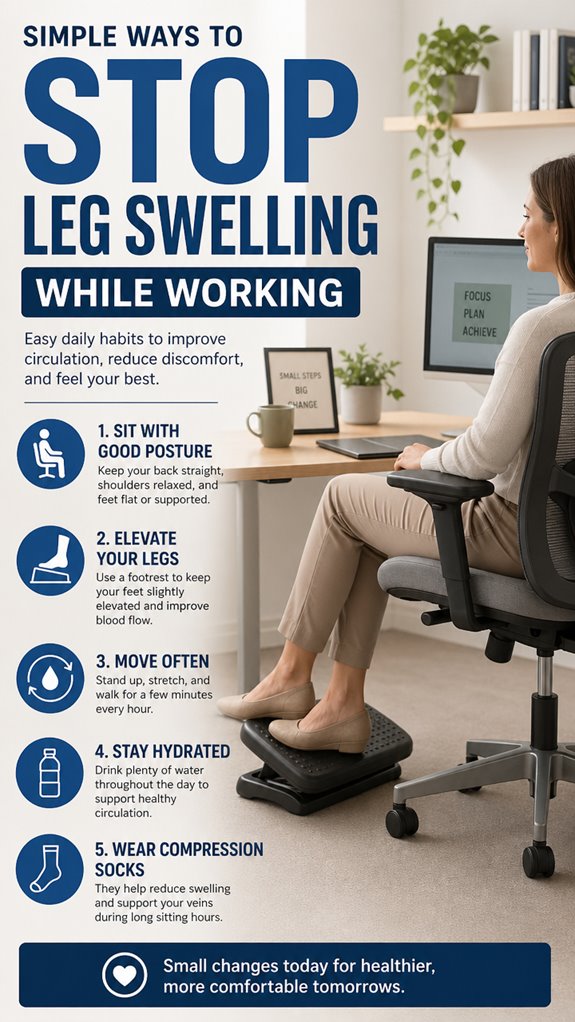
The culprit? I was hunched like a gargoyle, neck craned, abs completely off-duty. My pelvic tilt was shot, hip flexors screaming. No wonder my oxygen saturation tanked. Since then I use a footrest, set Pomodoro timers, and actually stand during standups. Vagus nerve stimulation, posture correction, and nervous system regulation aren’t yoga buzzwords. They’re survival tools for anyone selling brain hours by the day.
Quick Takeaways
- Practice deep breathing techniques like 4-7-8 or box breathing during work breaks to enhance diaphragm engagement.
- Use biofeedback tools and resistance devices to monitor and strengthen proper breath patterns regularly.
- Maintain ergonomic posture and hardware setup to prevent physical tension that promotes shallow breathing.
- Incorporate micro-resets—brief, deep breaths every 20 minutes—to retrain your breathing habit.
- Be mindful of physiological cues like yawning or shoulder tightness to promptly correct shallow breathing.
Why Shallow Breathing Can Harm Your Workspace Well-Being
When you spend the bulk of your day running loops through endless lines of code and debugging memory leaks, it’s easy to overlook the underlying architecture’s fragility—your breath, for instance, often functions as the silent, overlooked thread in the system.
Shallow breathing triggers cascading failures within your physiological stack, impairing oxygen delivery to critical modules like your brain’s CPU, slowing reflexes, and increasing error rates. It’s like running Ghost in the Shell without optimizing core processes—eventually, the system stalls.
Neglecting breath control introduces bugs that degrade your performance and resilient troubleshooting capacity, all while your body logs a silent crash without warning. Proper noise-reducing earplugs can help create a conducive work environment by minimizing distractions, allowing you to focus on your breath and work more efficiently.
How to Recognize Shallow Breathing During Work
In the grand scheme of your inner operating system, shallow breathing manifests as a critical memory leak—an insidious bug quietly degrading processing power under load. You mightn’t notice the CPU throttling until your focus drops below 60%, akin to Ghost In The Shell losing core functions mid-raid.
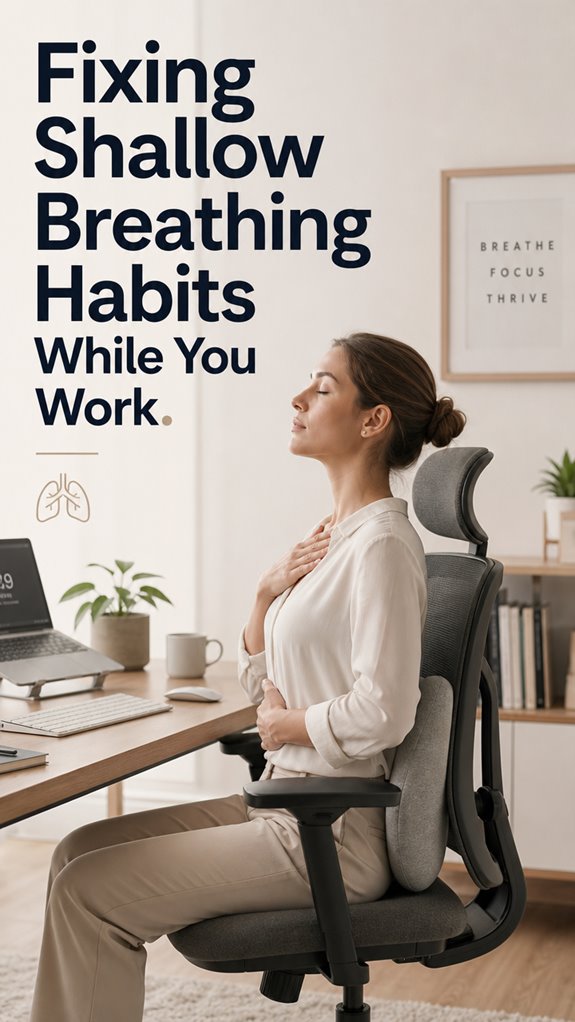
Physiologically, shallow breaths bypass diaphragm engagement, turning your respiration into a pointless loop—just like inefficient code that never reaches execution, fuelled by stress or poor posture. Recognize the signs: frequent yawning, tight shoulders, rapid breaths, and a sense of silent system overload signaling a need for another debugging session—at your own desk.
Easy Techniques to Breathe Deeply at Your Desk
Shallow breathing during a marathon coding session resembles a poorly managed memory leak—subtle, persistent, and capable of crippling your cognitive throughput before you even notice.
To regain control, start by consciously engaging your diaphragm like debugging a stubborn code bug. Effective desk organizers can also reduce distractions and create a more conducive environment for deep focus.
| Technique | Description |
|---|---|
| 4-7-8 Method | Inhale 4 seconds, hold 7, exhale slowly 8. |
| Box Breathing | Equal inhale/exhale, hold for equal counts. |
| Posture Reset | Sit upright, align spine—think of refactoring your core logic. |
| Micro-Resets | Brief, deliberate deep breaths every 20 minutes. |
| Biofeedback Use | Apps like Breathwrk—like a real-time profiler for breath integrity. |
Control your respiration; don’t let system failures cascade unseen.
Incorporate Breathing Exercises Into Your Daily Routine

Much like debugging a catastrophic runtime error silently corrupting your codebase, integrating breathing exercises into your routine demands meticulous planning, systemic awareness, and an acknowledgment of your own physiological API failures. You may have established the infrastructure—posture correctors, biofeedback, ergonomic supports—but without consistent execution, it’s akin to deploying patch updates without testing.
Much like Ghost in the Shell’s cybernetics, your respiratory system needs regular maintenance to prevent data leaks—shallow breaths. Schedule intentional commands: 6 breaths per minute, at least 80% crucial capacity, embedded in your daily microservices. Breathing deeply engages the diaphragm muscle, which is essential for maximizing oxygen intake.
Fail to do so, and your oxygen flow remains perpetually in beta mode.
Tips to Maintain Better Breathing Habits All Day
Maintaining ideal breathing patterns throughout the day requires functions akin to a well-orchestrated code deployment—continuous, non-intrusive, and resistant to the chaos of conflicting processes running in the background.
System failures manifest as shallow breaths, postural drift, or stress overload, demanding proactive updates.
You can:
- Integrate resistance devices (Powerbreathe) like a background service patch, strengthening the diaphragm’s core functions.
- Use posture support tools (Upright GO) to prevent drift into the “lazy mode,” maintaining optimal user posture.
- Employ biofeedback apps (Resperate) to set vibration triggers, acting as real-time alerts for the “main thread” of your breathing system.
- Explore eye exercise kits that not only enhance focus but may also improve overall well-being, complementing your breathing practices.
My First Use of Breath Trainers
When I first initiated a session with a breath trainer—Powerbreathe, in this case—it was akin to deploying a new build into a production environment haunted by intermittent crashes and memory leaks. Every inhale felt like an API call rejecting payloads, every exhale a garbage collection cycle.
My respiratory subsystem, traditionally unmanaged and error-prone, now required precise parameter tuning—targeting 80% essential capacity, as if optimizing a critical pipeline. It’s akin to debugging Ghost in the Shell’s cybernetic interface, only instead of code, I’m debugging my own biomechanics, trying to stabilize a faulty infrastructure prone to shallow, detached respiration. Integrating breathwork apps into my routine further amplified the efficiency of my training sessions.
Difficulty Engaging Lower Lungs

In the current chronicle of respiratory debugging, the bottleneck often manifests as an unwieldy inability to engage the lower lung modules—an issue as persistent as legacy code buried deep within a monolithic repository.
Your core module—diaphragm—is hamstrung by sedentary bloat, emotional load-triggered fight-or-flight, and tight interfaces caused by postural kyphosis and muscular conflicts.
- Muscle tension like a leak in your payload, compressing critical breathing bandwidth
- Postural misalignments akin to shifting protocols, hampering diaphragm execution
- Environmental cruft—pollution, restrictive attire—blocking the input channels
Address these firmware bugs to restore the system’s primordial pure function: deep, modular breathing.
Posture’s Impact on Breathing
Ever wonder why your breathing API keeps throttling under the weight — or lack thereof — of ergonomic updates? It’s a classic case of system overload; your posture, the foundational infrastructure of inhalation, is misconfigured. Slumped shoulders crash the respiratory middleware, restricting diaphragm engagement and throttling essential capacity.
Aligned spines, like a clean codebase, facilitate higher throughput; misalignment causes memory leaks in oxygen exchange. Think of your vertebrae as an error log—when gummed up, your breath pipeline stalls.
To debug this, prioritize posture—an indispensable, but often overlooked, core library in your physiology. Without it, even the best diaphragmatic routines will run, but with frequent exceptions. Incorporating eye exercises for focus can also improve overall performance by enhancing the mind-body connection and reducing distractions caused by visual fatigue.
Proper Desk Chair Setup
Despite the illusion that flickering screens and endless line edits are the bottlenecks to your productivity, the real system failure often originates at the hardware layer—specifically, the posture module.
Incorrect chair setup causes microclimate bugs, akin to a CAPTCHA that you can’t bypass. You need:
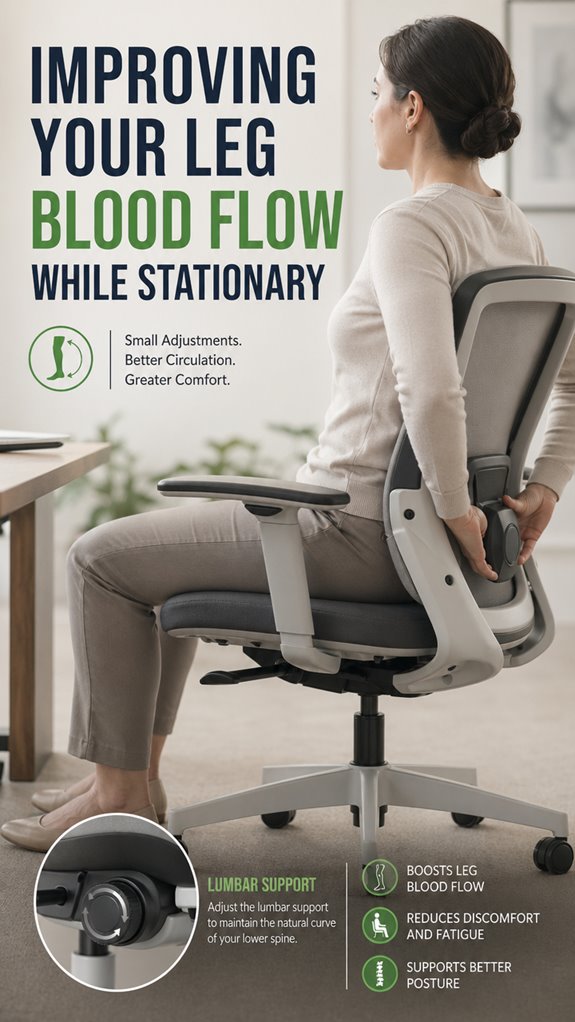
- An ergonomic chair with lumbar support to prevent system memory leaks.
- Adjustable height to align your visual stack with your code pipeline.
- Armrests that enable natural wrist function without jittery Ulnar syndrome.
Failure to optimize this hardware stack invites suboptimal airflow and energy drain—like running Ghost In The Shell on outdated firmware. Correct posture is crucial for maintaining developer comfort and long-term productivity.
Precision here is your debug log.
FAQ
Can Breathing Exercises Reduce Work-Related Stress Instantly?
Breathing exercises can quickly lower your stress levels by engaging your diaphragm and activating relaxation responses. By focusing on slow, deep breaths, you gain immediate control over stress, calming your mind and body even during high-pressure work moments.
How Long Should I Practice Diaphragmatic Breathing Each Day?
Like a sculptor shaping their masterpiece, practice diaphragmatic breathing for about 10 minutes daily. Consistency empowers you, gradually strengthening your control over stress, oxygen, and posture, transforming your workday into a domain of calm mastery.
Are There Risks to Using Breathing Trainers During Work?
Using breathing trainers during work is generally safe if you follow instructions carefully and don’t overuse them. You stay in control, and if discomfort occurs, you should stop immediately and consult a healthcare professional for personalized guidance.
How Can I Remember to Breathe Deeply Throughout My Workday?
To recall to breathe deeply during work, set discreet reminders on your phone or computer, use biofeedback apps with auditory cues, and incorporate short breathing exercises into your routine, so deep breaths become natural and consistent.
What Signs Indicate I Need Professional Help for Breathing Issues?
You should seek professional help if your breath’s like a weak, flickering flame, struggling to stay lit. If you experience persistent shortness, dizziness, chest pain, or fatigue, you need expert guidance to regain control and breathe freely.
References
- https://pmc.ncbi.nlm.nih.gov/articles/PMC9877284/
- https://www.saltsoftware.com/media/wysiwyg/SALT Reference Book.pdf
- https://news.ycombinator.com/item?id=45204587
- https://www.microsoft.com/en-us/research/wp-content/uploads/2009/10/Fourth_Paradigm.pdf
- https://centaur.reading.ac.uk/82516/2/22832451_Bahammam_thesis.pdf
- https://www.ironbridgegorgewhs.co.uk/download/downloads/id/1/coralie-acheson.pdf
- https://acmsonline.org/wp-content/uploads/2025/05/journal-and-proceedings-2025.pdf
- https://www.cag.edu.tr/uploads/site/lecturer-files/max-tegmark-life-30-being-human-in-the-age-of-artificial-intelligence-alfred-a-knopf-2017-aTvn.pdf
- https://scottaaronson.blog/?p=2119
- https://www.metodos.work/wp-content/uploads/2024/01/Qualitative-Data-Analysis.pdf
- https://www.calm.com/blog/shallow-breathing
- https://buteykoclinic.com/blogs/news/deep-vs-shallow-breathing-differences-causes-effects
- https://somaticmovementcenter.com/shallow-breathing/
- https://www.healthline.com/health/breathe-deeper-improve-health-and-posture
- https://www.oxalife.com/post/bad-breathing-habits
- https://www.headspace.com/articles/shallow-breathing-whole-body
- https://www.va.gov/WHOLEHEALTHLIBRARY/tools/diaphragmatic-breathing.asp
- https://www.lung.org/lung-health-diseases/wellness/breathing-exercises
- https://pmc.ncbi.nlm.nih.gov/articles/PMC10741869/
- https://news.fiu.edu/2019/how-to-breathe-for-better-health-studying-and-test-taking