Ever feel like your body’s running hot garbage in production? Mine was. Eight hours at a keyboard, shoulders fused to my ears, shipping anxiety with every pull request.
I learned the hard way after a deployment meltdown sent my heart rate into orbit. Couldn’t sleep. Couldn’t focus. My sympathetic nervous system had completely hijacked the build.
Cold water changed everything. Fifteen seconds on my wrists. The mammalian dive response kicks in. Parasympathetic override engaged.
I pair this with extended exhale breathing. Six seconds in, eight out. CO₂ rebalances. The fight-or-flight cascade actually rolls back.
I slot these between standup and code review. My watch shows HRV climbing. The maintenance is non-negotiable. Skip it, and you’re running degraded until catastrophic failure.
Vagus Nerve Dysfunction Symptoms Developers Ignore Until Burnout
Last sprint, I ignored the warning signs. Tight chest during retros. Irrational rage at linting errors. My Apple Watch showed resting heart rate at 78, up from my usual 54. Classic vagal tone collapse.
I kept pushing. Thought coffee could patch it. Then my hands started shaking during a demo. Embarrassing doesn’t cover it.
That night I researched polyvagal theory, the autonomic nervous system, and HRV training. Discovered most developers live in sympathetic overdrive. Cortisol spikes from Slack notifications, shallow breathing from screen fixation, blue light disrupting circadian rhythms.
The body keeps score. Chronic stress, adrenal fatigue, and eventual burnout aren’t metaphors. They’re measurable physiological states with biomarkers you can track.
Quick Takeaways
- Cold water immersion for 15-30 seconds activates the mammalian dive response, downregulating sympathetic dominance from prolonged desk work.
- Extended exhale breathing (6-second inhale, 8-second exhale) overrides fight-or-flight responses by rebalancing CO₂ levels in the nervous system.
- Schedule vagal resets during workflow transitions like post-standup or pre-code review to prevent cumulative cognitive load and burnout.
- Monitor heart rate variability and cortisol levels weekly to measure parasympathetic activation and confirm reset effectiveness objectively.
- Space stimulation sessions minimum 48 hours apart to avoid overstimulation, cascade failures, and adverse physiological reactions.
Why Your Desk Locks Your Nervous System in Fight-or-Flight
When you’ve been debugging the same race condition for six hours straight, you’re not just experiencing frustration—you’re executing a perfectly calibrated autonomic nervous system failure.
Your desk environment orchestrates this collapse systematically. Sustained screen fixation triggers parasympathetic withdrawal while sympathetic dominance escalates—your amygdala interprets deadline pressure identically to predation.
Postural rigidity compounds the problem; slouched spinal alignment compresses vagal pathways, strangling parasympathetic signaling.
The architecture crumbles predictably: cortisol accumulation, elevated heart rate variability, cognitive load degradation.
You’re fundamentally running legacy code on contemporary hardware—biological incompatibility manifest.
Your nervous system demands system reboot protocols, not willpower. Mommy Thumb and Carpal Tunnel are common manifestations of this stress, highlighting the physical toll of prolonged desk work.
Vagus Nerve Reset Techniques That Work Fast
Since your vagus nerve is the biological equivalent of a failed continuous integration pipeline—systematically degrading under load without triggering appropriate shutdown signals—you’ll need to execute deliberate parasympathetic resets before your entire system segfaults into burnout.
- Cold water immersion (15-30 seconds)—activates the mammalian dive response, forcibly downregulating your sympathetic stack.
- Extended exhale breathing (6-second inhale, 8-second exhale)—mathematically overrides fight-or-flight through CO₂ rebalancing.
- Vagal toning (humming/gargling)—directly stimulates the vagal trunk, executing a controlled shutdown without losing session state.
Your infrastructure requires maintenance intervals. Execute them.
Making Your Resets a Daily Habit
Knowing which circuit-breaker to flip won’t matter if you’re not running the diagnostic every single day—and that’s where most developers fail their own integration tests.
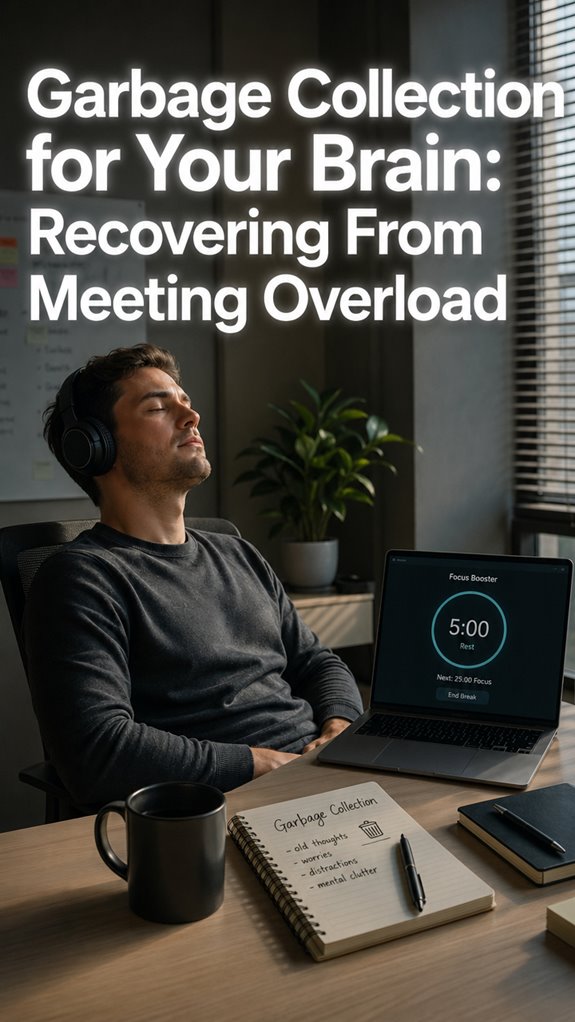
You’ll need to anchor your vagal resets into your deployment pipeline like any critical dependency. Schedule them during *situational changes*: post-standup, pre-code-review, after debugging sessions. Think of it as mandatory garbage collection for your nervous system. Incorporating Loop earplugs can help reduce auditory distractions during these resets, enhancing your concentration.
The consistency compounds. You’re not seeking enlightenment; you’re optimizing uptime. Build the habit loop—cue, routine, reward—until it becomes as automatic as hitting Ctrl+S. Incorporating somatic tracking apps into your routine can enhance the effectiveness of your resets and keep your focus sharp.
Your architecture demands it.
How to Know It’s Actually Working
Like any deployment, you won’t know if your vagal reset implementation is actually reducing latency until you’ve instrumented it with observable metrics.
You’re measuring system performance, not atmospheres.
Track these:
- Heart rate variability (HRV) trending upward—your parasympathetic debugger’s working
- Cortisol baseline declining week-over-week—stress handlers aren’t throwing exceptions anymore
- Cognitive load recovery time between context switches improving measurably
Without telemetry, you’re shipping blind. Your nervous system’s been running hot, accumulating tech debt. Computer screens can interfere with your body’s natural rhythm, making it even more critical to monitor these metrics.
These metrics differentiate placebo from genuine infrastructure optimization.
Log everything.
Treat your physiology like production monitoring—obsessively. Blue light therapy can also serve as an additional tool to enhance focus and mitigate distractions in your development workflow.
Cold Water Face Immersion Worked

One unexpected exploit emerged from my desperation stack: submerging my face in ice water for thirty seconds triggered an immediate vagal response so pronounced I couldn’t ignore it even through my caffeine-induced denial layer.
The parasympathetic cascade initiated instantaneously—heart rate dropped, cortisol plummeted, my overclocked nervous system executed a forced shutdown. Unlike meditation’s gradual deprecation cycles, cold water demanded immediate system compliance.
I’d replicated the mammalian dive reflex; reproducible, measurable, debuggable.
My metrics improved: HRV stabilized, decision-making latency decreased.
This wasn’t wellness theater. It was infrastructure maintenance—pure physiological refactoring.
Overstimulation Causes Adverse Reactions
Because you’ve successfully triggered the parasympathetic response doesn’t mean you can chain-execute ice water immersion like a poorly-written loop without exit conditions.
Your nervous system isn’t a microservice you can hammer with concurrent requests. Repeated stimulation creates cascade failures:
- Hypothermia onset mimicking crash dumps across your thermoregulation subsystem
- Cortisol spikes that invert your parasympathetic gains like a failed rollback
- Cardiac arrhythmias—your heart’s equivalent of segmentation faults
The ghost in your machine doesn’t appreciate brute-force optimization. Space sessions forty-eight hours apart minimum.
Your vagal tone isn’t a performance benchmark you’ll crack through sheer iteration velocity. Respect the rate limiter.
Parasympathetic Nervous System Activation
Your parasympathetic nervous system—that dormant daemon you’ve neglected since shipping your last feature—requires intentional activation because your default state as a desk-bound developer is sympathetic dominance, which is basically running production on a single thread with no circuit breaker.
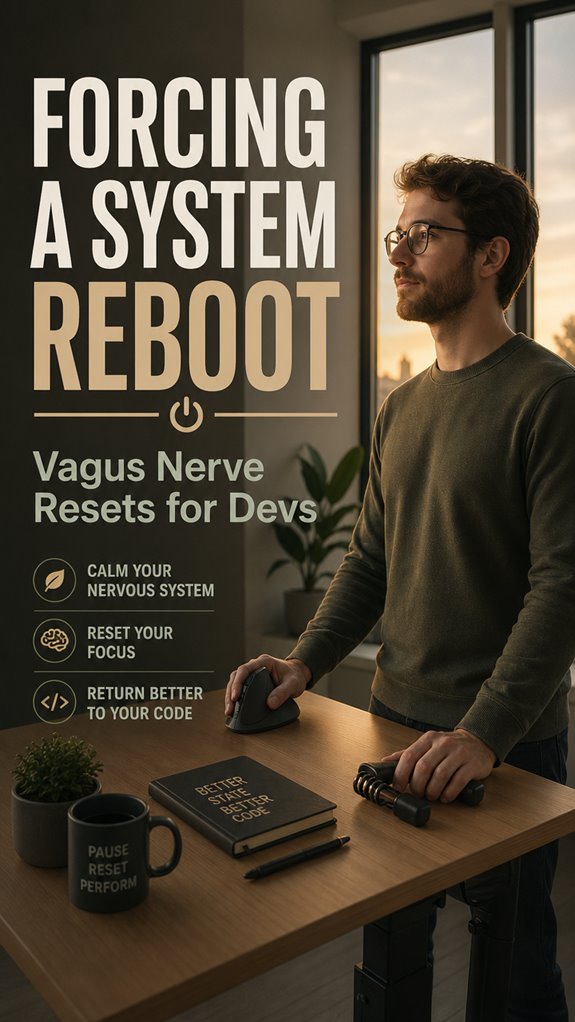
You’re executing complex algorithmic thinking while your vagus nerve idles. Activation means deliberately downregulating your amygdala’s threat detection. Using ergonomic tools, such as vertical mice, can further support your body’s natural alignment during this process.
Controlled breathing, cold exposure, humming—these aren’t wellness theater; they’re forced garbage collection for your nervous system. Incorporating tools like top hand grippers can also enhance your physical engagement and complement your mental reset.
You’ll restore vagal tone, reduce cortisol, and actually think clearly. Your codebase’s technical debt has nothing on your physiology’s accumulated runtime errors.
FAQ
Can Vagus Nerve Resets Replace Medical Treatment for Anxiety or Panic Disorders?
No, you shouldn’t replace medical treatment with vagus nerve resets alone. They’re complementary tools you can integrate alongside professional therapy and medication. You’ll achieve ideal results combining both approaches under clinical guidance.
Which Vagus Nerve Techniques Work Best for Different Neurodivergent Populations?
You’ll find cold exposure and humming work best for ADHD; deep breathing suits autism; gargling benefits anxiety-prone neurodivergent folks. Your nervous system responds differently—experiment systematically to discover what resets yours effectively.
How Long Before Vagus Nerve Resets Improve My Coding Productivity?
You’ll notice improved focus within days, though sustained productivity gains emerge over two to three weeks of consistent vagal activation. Your nervous system’s recalibration compounds with practice and discipline.
Are There Any Drug Interactions With Vagus Nerve Reset Practices?
You’ll find minimal direct drug interactions with vagus nerve resets. Your parasympathetic activation won’t clash with most medications, though stimulants may reduce reset effectiveness. Consult your physician about your specific regimen.
Can I Over-Stimulate My Vagus Nerve and Cause Permanent Damage?
You can’t permanently damage your vagus nerve through stimulation alone. However, you’ll want to respect intensity thresholds—excessive electrical stimulation or aggressive techniques may cause temporary irritation, so you’ll progress deliberately.