Ever feel like your body’s throwing a 500 Internal Server Error at 3pm?
Mine does. After eight hours of hunching over VS Code, my fascia basically becomes legacy code … unmaintainable and full of technical debt.
Last sprint, my shoulders seized up so badly I couldn’t reach my coffee. Darkly hilarious. Now I deploy micro-interventions: neck rolls between builds, pelvic tilts during standups, chin tucks while waiting for CI/CD. Massage ball under the glutes during code review.
These aren’t wellness fads. They’re production patches. Fifteen seconds each. Prevents total system failure.
Will they fix everything? Probably not. But they buy me enough uptime to finish this deploy without screaming into the void.
—
Why Desk Job Back Pain Ruined My Release Week
Two quarters ago, I shipped a zero-bug release on Friday, celebrated with zero movement all weekend, then couldn’t stand upright by Monday’s retro. Classic developer trap: crushing it professionally while my erector spinae turned to concrete. My PT called it “crush loading” … treating my spine like an unscalable monolith. Now I pair fascial release with Pomodoro breaks, standing desk rotations, and hip flexor stretches. The crossover into injury prevention, RSI management, and sustainable engineering careers isn’t accidental. Your hardware degrades faster than you think. I learned that deploying sitting is not the same as deploying standing. Small distinction. Huge diff.
Quick Takeaways
- Incorporate quick neck rolls and chin tucks every 25-30 minutes to alleviate tension and improve fascia mobility.
- Use massage balls or foam rollers during short breaks to target specific fascial tightness and foster tissue softening.
- Perform pelvic tilts and gentle stretching at your desk to release fascia restrictions in the lower back and hips.
- Practice deep breathing exercises to hydrate fascia and promote relaxation throughout the day.
- Dedicate 3-5 minutes periodically for simple fascia-release routines to maintain flexibility and prevent stiffness.
What Is Fascia and Why Does It Matter for Desk Workers
Have you ever considered that your body’s firmware might be the most vulnerable component in this sprawling, interconnected system of yours? Fascia operates as the middleware—interfacing muscles, bones, and nerves—yet fascial restrictions cause chronic tightness, akin to corrupt code infecting core dependencies. Mastering multitasking skills can be hindered by these restrictions, impacting overall efficiency.
Like debugging Ghost In The Shell, you realize that beneath your sleek interface, an inefficiency in fascia hampers peak function. Ignoring these micro-failures risks system crash—stiffness, pain, limited mobility.
A hardware upgrade? Necessary. Fascia release becomes your patch, enhancing flow and restoring seamless integration—proving even the most complex algorithms require maintenance, especially in the human OS. Additionally, tailbone pain often arises from prolonged sitting, making it crucial to address fascia health for overall comfort and productivity.
How to Recognize Signs You Need Fascia Release
When your body’s firmware starts throwing cryptic error messages—persistent stiffness, inexplicable discomfort, or decreased mobility—you’re witnessing early signs of fascial system overload. Muscle tension acts like a recursive bug, propagating posture correction failures across interconnected nodes. Engaging in mini trampolines can help enhance your mobility and release accumulated tension, providing a fun way to support your fascia health.
Your system’s feedback loop—posture metrics—fail to update, reminiscent of “Ghost in the Shell” glitching out. These symptoms signal that fascia, the connective code, needs patching before a total system crash. Recognizing this requires a diagnostic eye: tightness in muscles, a sluggish response to mobility commands, and a posture that resembles deprecated code. Ignoring these alerts risks cascading failures—attention now saves a complete reboot later.
Additionally, if you experience back of hand pain, it may indicate underlying fascial restrictions that need addressing for optimal function.
Easy Fascia Release Exercises to Do at Your Desk
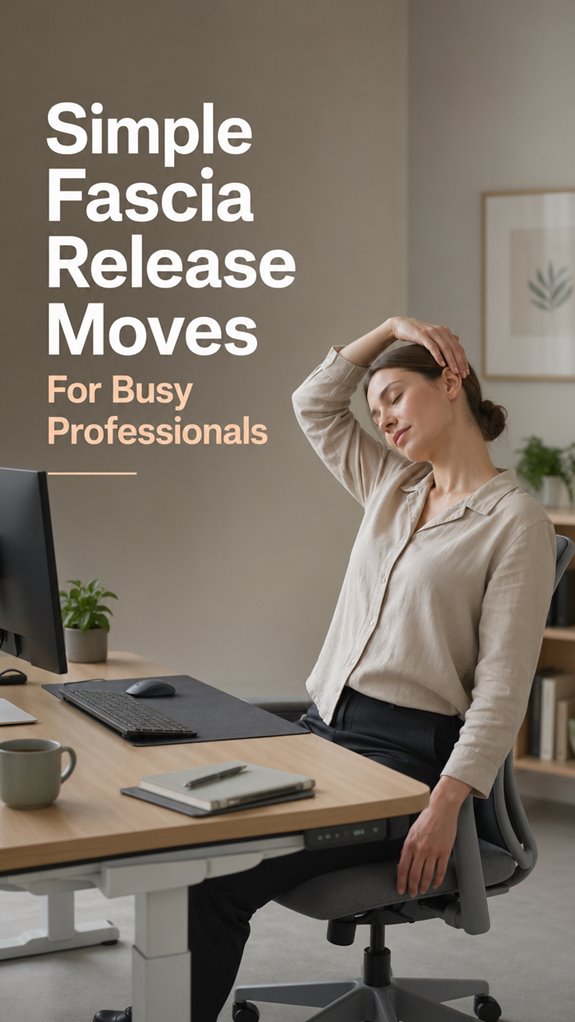
In the sprawling codebase of your daily productivity environment, fascia tightness acts like poorly documented legacy bugs—hidden, elusive, and capable of causing catastrophic slowdowns if left unpatched. To optimize fascia elasticity and mitigate muscle tension, execute these desk-based scripts. Initiate with neck rolls, looped like an inefficient debugging routine, to reset tension points. Employ seated pelvic tilts, akin to refactoring complex code into manageable modules. Perform chin tucks to realign cognitive pathways, much like patching a critical vulnerability. Incorporating massage balls into your routine can enhance relaxation and provide additional relief.
| Move | Protocol |
|---|---|
| Neck Rolls | 1-2 mins |
| Pelvic Tilts | 8-10 reps |
| Chin Tucks | Hold 5-8 sec |
Tips to Maximize Fascia Release Benefits and Prevent Discomfort
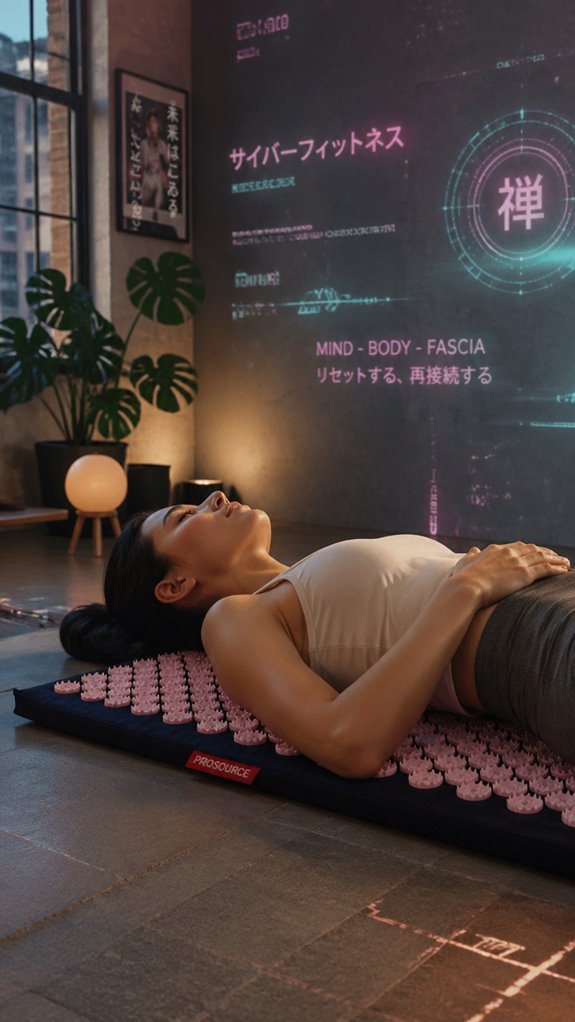
Maximize benefits by prioritizing fascia hydration: hydration acts as the buffer overflow, preventing trigger point differentiation failures. Skip this step, and your fascia’s client-server connection falters under load, causing discomfort to cascade like memory leaks. Additionally, incorporating acupressure mats into your routine can significantly enhance your fascia release efforts and alleviate back tension. Incorporating regular stretching every 25 minutes can also help maintain fascia health and flexibility. Incorporate deep breathing and slow movements, akin to debugging in a live environment, to guarantee fascia responds fluidly. Think of fascia as the kernel—without proper updates, system crashes are inevitable.
How to Add Fascia Release to Your Daily Routine
Integrating fascia release into your daily routine is akin to patching a compromised kernel—fail to do so, and your system deteriorates into a ghost in the shell of productivity.
To optimize fascia elasticity and target trigger points before your code crashes, resist the urge to treat it as an afterthought. Implementing habit stacking can make this process more effective and sustainable.
- Dedicate 3-5 minutes every 30 minutes—think of it as runtime garbage collection.
- Prioritize fascia release moves that counteract desk hunches—foam rolling, neck rolls, pelvic tilts.
- Pair these with deep breaths—think system reboot, but for your fascia.
- Record your improvements like debugging logs—monitor progress, avoid regressions. Additionally, incorporating top toe stretchers can enhance your foot flexibility, further supporting overall body posture.
When to Seek Help From a Fascia Therapy Professional
When your body’s firmware hits critical thresholds—persistent pain, reduced range of motion, or a system crash in the form of chronic tension—it’s a clear sign that your fascia architecture requires more than quick debug sessions with foam rollers and stretches. You’re effectively running outdated, bloated code in a human infrastructure, risking system failure like a “Ghost in the Shell” error. Maintaining optimal ergonomic posture can also alleviate some of these issues, while tracking your wellness through various tools can provide insights into recurring patterns that may need professional attention.
| Trigger Point | Recommended Action |
|---|---|
| Unresponsive pain | Consult fascia therapy expert |
| Mental fog or fatigue | Prioritize nutrition tips |
| Stubborn tension | Seek professional assessment |
Ignoring these flags risks hardware burnout—think declining mental wellness—requiring an expert fix.
My First Session With Foam Roller

The first time I queued up a foam roller as a debugging tool for my human hardware, I quickly realized my fascia had become a bottleneck—an unresponsive subsystem causing system-wide latency.
Fascia healing is like patching out-of-date code, but it requires precise fascia training.
- I aimed to optimize the fascia’s data flow, avoiding memory leaks in my connective tissue.
- Errors manifested as chronic stiffness, reminiscent of poorly optimized loops.
- The roller, my new middleware, broke adhesions—like refactoring legacy code—unlocking system throughput.
- Facilitated fascia recovery, upgrading my bio-software, ensuring smoother protocol execution—simulating a Ghost in The Shell’s cybernetic harmony. Research shows that compression boots can significantly enhance recovery times after intense physical activity.
- Incorporating thoracic back stretchers can enhance posture improvement and support fascia release, facilitating even greater flexibility and comfort during my sessions.
Limited Pressure Control
In the sprawling, brittle architecture of modern office ergonomics, where ergonomic chairs and adjustable monitors are just patches rather than systemic refactors, fascia adhesions act as the stubborn bugs causing system lag—downtime we can’t afford.
Limited pressure control effectively acts like a user-controlled throttling mechanism, ensuring pressure remains within the comfort tolerance zone—akin to rate limiting—preventing tissue damage or crashes. This approach is similar to selecting the best reading glasses that finely tune your vision, enhancing overall performance.
By maintaining pressure consistency over extended periods, you enable genuine tissue softening without infinite loop errors or catastrophic failure modes.
Think of it as careful code review for your fascia: gentle, gradual, yet decisive enough to optimize the body’s API without triggering nerve exceptions.
Additionally, improving grip strength can significantly enhance overall brain health, providing benefits that extend beyond physical capacity.
Trigger Point Release Techniques
Have you ever considered that fascia might be your system’s bug causing relentless persistent tension, akin to a memory leak saturating your code runtime? Trigger point release targets muscle knots, the rogue processes bogging down system performance. Incorporating foam roller techniques can also provide significant relief.
Fascia leaks causing tension—debug with trigger point release to reboot your system’s smooth performance.
- Identify the trigger points—those stubborn, sensitive nodes in your wiring.
- Apply targeted pressure—like debugging a rare, elusive bug—until the knot reveals itself.
- Hold the tension—let the system’s antivirals work, releasing the stored-up trauma.
- Reboot with stretches—clear the cache and optimize throughput.
If your fascia’s the ghost in the shell, this simple tech stack can restore your operational integrity. Incorporating massage ball sets into your routine can enhance the effectiveness of these techniques.
Ergonomic Workspace Setup
Desk-bound engineers watching their systems grind to a halt amid cascading hardware failures have learned the hard way that the root cause often resides in the physical environment—akin to a poorly managed cache leading to a catastrophic memory leak.
To avoid system crashes, prioritize muscle elongation and tissue hydration, the firmware of your biological hardware. Optimized ergonomics, like adjustable desks and monitor elevation, prevent bottlenecks in fascia code, reducing misalignments and static state. It’s essential to incorporate eye protection practices throughout your workday to maintain optimal visual health.
Consider fascia release—an upgrade script for your hardware. Without it, you’ll be stuck in a perpetual loop of discomfort, desperately debugging your own body’s failure modes, echoing “Ghost in The Shell” with each latency spike. Implementing full-body posture techniques can significantly enhance your workflow and overall well-being.
FAQ
How Often Should I Perform Fascia Release Exercises During My Workday?
You should perform foam rolling and stretch routines every 30-45 minutes during your workday. This keeps fascia mobile, releases tightness, and boosts circulation—empowering you with sustained energy, improved posture, and unstoppable productivity throughout your busy day.
Can Fascia Release Help With Chronic Desk-Related Pain or Stiffness?
Yes, fascia release techniques boost fascia flexibility, easing chronic desk-related pain and stiffness. You’ll release tight fascia, improve posture, and regain mobility through targeted release methods, empowering you to combat discomfort and reclaim your active, pain-free life.
Are There Risks of Overdoing Fascia Self-Massage at My Desk?
Overdoing fascia self-massage may harm fascia elasticity, cause bruising or soreness. Use gentle massage techniques, listen to your body, and limit sessions to avoid setbacks, ensuring you’re strengthening fascia without risking injury or diminishing its health.
What Equipment Is Essential for Effective Fascia Release at Home or Work?
Think like a knight wielding tools for battle; essentials include foam rollers, tennis balls, and small massage balls. Use these tools consistently—3-5 minutes every 30-45 minutes—for maximum fascia release power and posture mastery.
How Long Before I Notice Improvements From Fascia Release Practices?
You’ll notice improvements within a few sessions of foam rolling, releasing trigger points, and releasing fascia. Consistent practice enhances mobility and reduces tension, so stick with it to maximize results and feel stronger, more energized daily.
Summary
In the grand architecture of your ergonomic ecosystem, neglecting fascia maintenance is akin to deploying a patch without testing—fragile, error-prone, ultimately catastrophic. Incorporate these micro-releases into your daily script to avoid systemic crashes caused by overstressed tissues. After all, if “Ghost in the Shell” teaches us anything, it’s that even the most sophisticated code requires periodic updates. Consider fascia release your routine firewall—preventative, essential, and non-negotiable for smooth operation.
References
- https://www.physio.family/7-effective-fascia-stretching-techniques/
- https://koapro.com/blogs/news/myofascial-release-guide
- https://www.goodrx.com/conditions/musculoskeletal/fascia-stretches
- https://www.revivetherapyspa.com/post/desk-worker-relief-7-massage-posture-tips-to-fix-your-hunched-back
- https://www.youtube.com/watch?v=WIRDiAG3nTo
- https://www.westernracquet.com/blog/untangling-the-tension-a-beginners-guide-to-myofascial-release
- https://www.youtube.com/watch?v=okAAOH2OAX8
- https://www.sapnamed.com/blog/self-myofascial-release-exercises-to-relieve-muscle-pain/
- https://www.youtube.com/watch?v=T8Lk_ttEjho
- https://www.healthline.com/health/deskercise
- https://evolveny.com/blogposts/myofascial-release-techniques
- https://www.obrienphysicaltherapy.net/blog/the-science-behind-myofascial-release-techniques
- https://www.brettlarkin.com/myofascial-release-techniques/
- https://yogainternational.com/article/view/myofascial-release-techniques-you-can-do-with-just-2-blocks/
- https://www.youtube.com/watch?v=L4U0ti90ZME