Tired of your legs ballooning into memory-hogging processes by 3 PM? I fixed it with dead simple hacks.
My ankles once swelled so badly my socks left indentations like bad commit history. Now I prop my feet on a discarded Amazon box, perform “desk calf raises” during standups nobody asked for, and twist my chair settings until my knees hit that perfect 90-degree sweet spot. The relief is immediate, like finally seeing green in CI after hours of red.
—
Why Proper Ergonomics Failed Me Until I Discovered Circulation Breaks
Last sprint, I thought my standing desk solved everything. Spoiler: it didn’t. Static standing pools blood just as brutally as static sitting. I learned this during a brutal deployment day, legs throbbing while I babysat production. Deep vein thrombosis risks, lymphatic drainage, compression socks, peripheral edema, these weren’t my vocabulary until my physician friend mentioned stroke statistics for desk workers. I started setting Slack reminders for two-minute movement breaks. Game changer.
Quick Takeaways
- Take regular breaks to stand, walk, and stretch your legs to promote circulation and prevent fluid buildup.
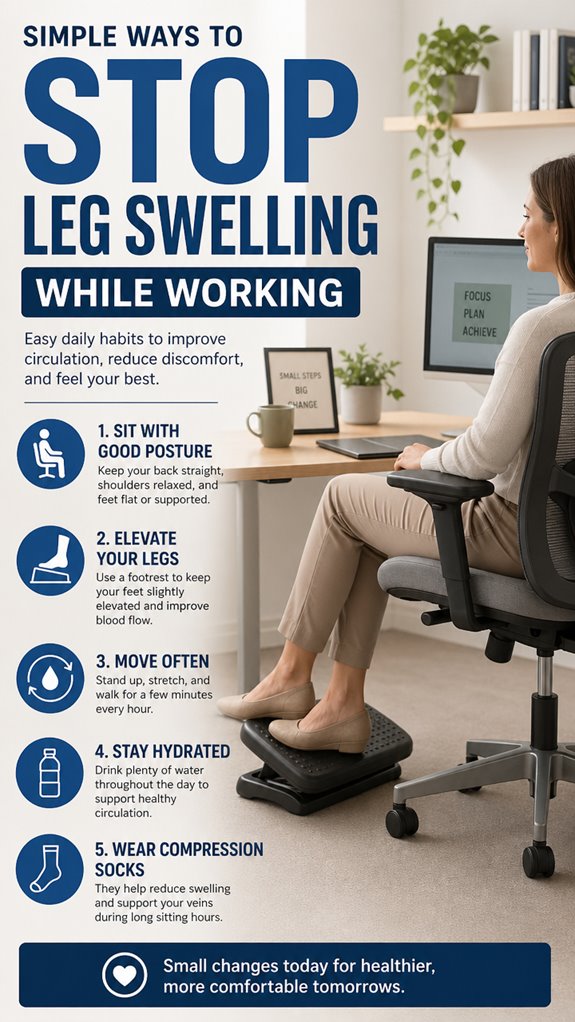
- Use adjustable footrests or elevate your feet periodically to reduce venous pressure and improve blood flow.
- Perform simple ankle circles, heel raises, or leg lifts while seated to encourage lymphatic drainage.
- Maintain proper airflow and ergonomic posture, including monitor and chair adjustments, to support healthy circulation.
- Stay well-hydrated and include potassium-rich foods to help prevent fluid retention and support vascular health.
Why Do Legs Swell During Long Work Hours?
When you’re locked into a marathon debugging session at your desk—much like trying to patch the kernel after a system crash—the human body begins to resemble an inefficient server struggling under load, with traffic congestion manifesting as swollen legs.
Fluid retention occurs when your veins, under prolonged compression, can’t efficiently return blood to the core, causing backup that floods interstitial spaces. To combat this, it’s crucial to maintain a neutral spine position to support healthy circulation and reduce strain.
Prolonged vein compression hampers blood return, causing internal backups and swelling—your body’s own system crash.
Just as a memory leak cripples performance, vein compression—due to sustained inactivity—overloads your lymphatic drainage, creating a sluggish pipeline.
This systemic failure is akin to watching your code hit a dead end, sagging infrastructure slowly collapsing under its own weight, a “Ghost in the Shell” of physiological inefficiency. Prolonged sitting can exacerbate these issues, leading to significant health risks over time.
Simple Stretches to Reduce Leg Swelling Quickly
In the architecture of your body’s arterial and lymphatic protocols, failure often begins with the unwarranted persistence of static states—sitting at your desk without interruption—mimicking a system stuck in an infinite loop of inefficient resource allocation.
To optimize leg membrane throughput, perform targeted stretches:
- Ankle stretching: execute dorsiflexion and plantarflexion scripts to kickstart flow.
- Calf strengthening: do seated heel raises, programming the pump for improved circulation.
- Leg elevation micro-ops: elevate legs above heart level periodically—like rebooting a frozen system.
These simple routines act as system patches, preventing swelling crashes and maintaining human infrastructure integrity. Additionally, utilizing cycle tracking apps can help you monitor overall health and inform you of potential effects of hormonal changes on swelling. It’s also beneficial to incorporate habit tracker journals to create a consistent routine that supports your wellness efforts.
How to Elevate Legs Properly When Sitting at Your Desk
Floating in a sea of open tabs and deprecated muscle memory, your sedentary workflow mirrors a perpetual bug in the system—resources stagnate, bottleneck, and lag behind.
Sitting posture and desk height are core variables in this failing infrastructure—akin to poorly configured server kernels that crash under load.
To optimize, elevate legs to above heart level with a sturdy footrest or pillows, simulating a high-priority interrupt. Using top body oils after elevating your legs can enhance circulation and hydrate your skin. Incorporating grip trainers into your routine can also strengthen hand muscles to counteract the effects of prolonged sitting.
Keep your seat ergonomic, aligned with your monitor’s viewport—adjust desk height for maximum kernel performance.
It’s like debugging “Ghost in the Shell”: the fix is simple, yet the human system resists.
Reboot—in this case, elevate.
Tips to Improve Your Workspace for Better Circulation
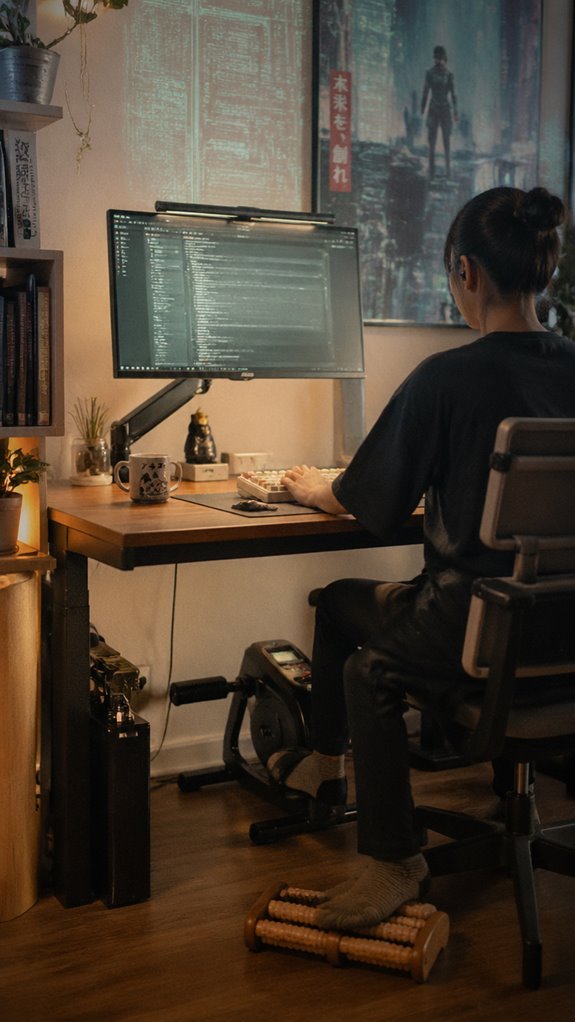
Optimizing your workspace for better circulation is akin to debugging a perilous server architecture—elusive yet essential.
- Fine-tune your desk posture, akin to patching a memory leak, ensuring ergonomic accessories like lumbar supports and adjustable risers.
- Implement intelligent spacing: position your monitor at eye level, keyboard at a neutral angle, avoiding the cascade of cascading failures caused by misaligned hardware.
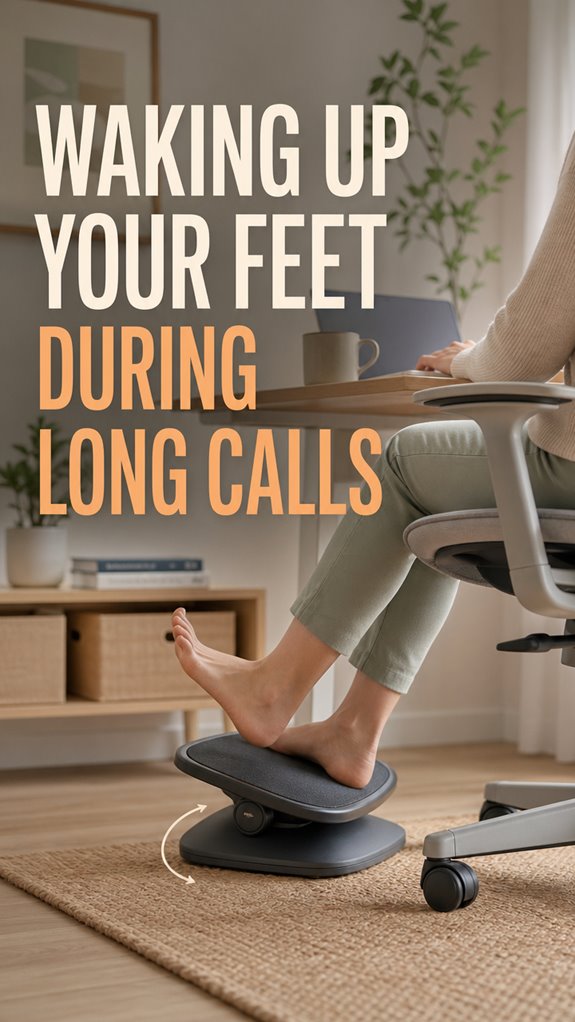
- Employ strategic movement triggers—under-desk pedal exercisers or foot rollers—akin to rebooting a crashed subroutine—keeping the system responsive and fluid.
Additionally, make sure to stay hydrated and take breaks, as proper vocal care can also enhance your overall well-being during these extended work sessions.
Without this systemic upgrade, even “Ghost in the Shell” would falter when the human infrastructure overloads.
Eat These Foods to Help Prevent Leg Swelling
When facing the inevitable memory leak that’s prolonged sitting, your circulatory system becomes the outdated cache suffering from bandwidth saturation, leading to leg swelling—an error state nobody wants to debug at 3 a.m.
To optimize throughput, implement food-based remedies—think of them as nutritional supplements for your vascular firmware.
Increase potassium and magnesium intake via leafy greens and bananas, essential for reinitializing osmotic balance.
Incorporate anti-inflammatory foods like berries and omega-3-rich fish to patch leaks in vessel walls.
These deliberate payloads serve as a systemic upgrade, preventing fluid residues from accumulating—akin to patching memory leaks before the system crashes.
This human body, much like a legacy system, demands a disciplined diet to avoid catastrophic failure.
When to See a Doctor for Persistent Leg Swelling
Leg swelling that persists beyond a routine system reset—i.e., self-care remedies, elevation, compression—indicates an underlying malfunction in the body’s fluid management protocols that warrants a manual diagnostic intervention.
- Prioritize a thorough medical evaluation; symptoms persisting after multiple patch updates suggest a core system bug—possible vascular or lymphatic fail.
- Scrutinize for atypical system logs—signs of systemic failure—e.g., deep vein thrombosis or cardiac dysfunction—akin to debug traceback in a brittle codebase.
- Recognize that neglecting these alerts risks cascading failures, ultimately demanding serious intervention—because even Ghost in the Shell recognizes when a human’s infrastructure needs a hard reboot. Additionally, staying hydrated is crucial during busy workdays to support overall bodily functions, including fluid management.
My Knee Pain From Standing
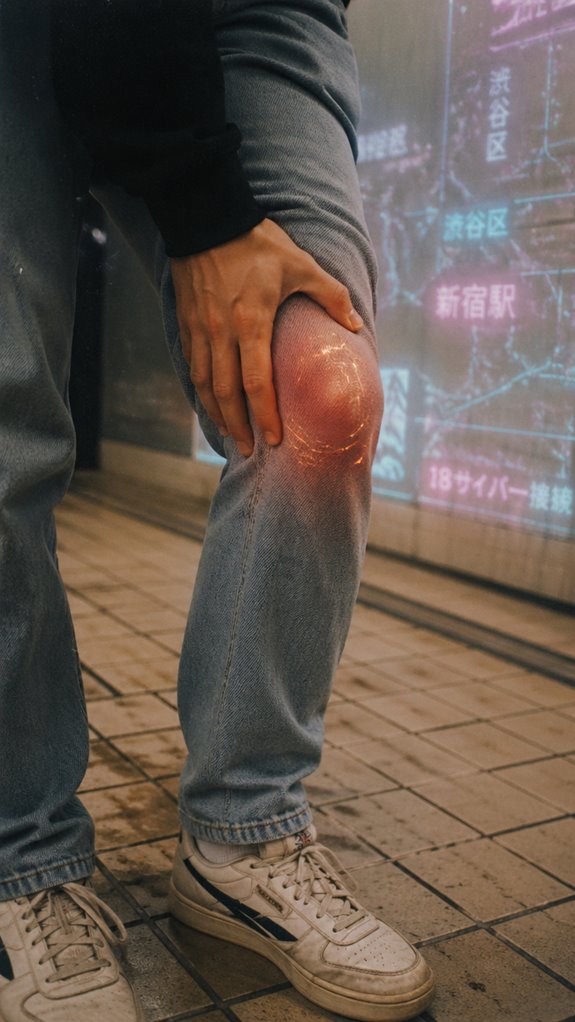
Much like a server encounter with a stubborn memory leak, persistent knee pain from standing indicates a systemic overload in core joint processes.
Persistent knee pain signals a systemic overload in joint health, demanding ergonomic updates rather than superficial fixes.
When knee alignment falters, it’s akin to a misconfigured API contract, disrupting cartilage health and triggering cascading failures downstream.
Essentially, the joint architecture becomes an unstable runtime environment—crashing under the weight of extended load.
This degradation mirrors Ghost in the Shell’s synthetic infrastructure, where system integrity is paramount.
The urgent priority becomes patching with ergonomic updates—improving biomechanics and aligning components—rather than debugging superficial symptoms.
Ultimately, the infrastructure demands a re-calibration—restoring balance to support sustainable, high-performance human operation.
Incorrect Foot Positioning
Incorrect foot positioning during prolonged static states resembles a flawed API call—an oversight cascading into system failure, manifesting as peripheral edema.
- Using improper footwear triggers default error states, where high heels or narrow shoes cause tissue compression and circulation crashes.
- Maintaining unnatural foot positions over time strains the hardware—poor foot positioning and unsupported arches turn componency into a bottleneck.
- Ignoring ergonomic standards for proper footwear compromises vascular protocols, leading to fluid leakage into tissues reminiscent of a memory leak in Ghost in The Shell’s dystopia.
In this infrastructural meltdown, even the most robust blood flow algorithms fail—causing swelling and system slowdown.
Ergonomic Footstool Benefits
When ergonomic flaws in human hardware—like improper foot positioning—push the body’s vascular protocols into a failure mode reminiscent of a misfiring neural network, an ergonomic footstool acts as a critical patch. It offers the benefits of elevation, stabilizing circulation pathways that otherwise degrade into the chaos of data corruption. In fact, studies have shown that adjustable footrests can significantly alleviate discomfort and promote better posture during long periods of sitting.
By elevating your feet, you circumvent the bottleneck of venous pressure, akin to offloading CPU tasks to prevent system crashes. In the same way you’d optimize code, integrating an ergonomic footstool ensures your bodily infrastructure maintains operational integrity. Furthermore, using a pregnancy support pillow can enhance comfort during prolonged hours of sitting, providing additional support where it’s most needed.
This turns what should be trivial into a robust, fail-safe mechanism—because even humans need a patch now and then.
Office Chair Adjustments
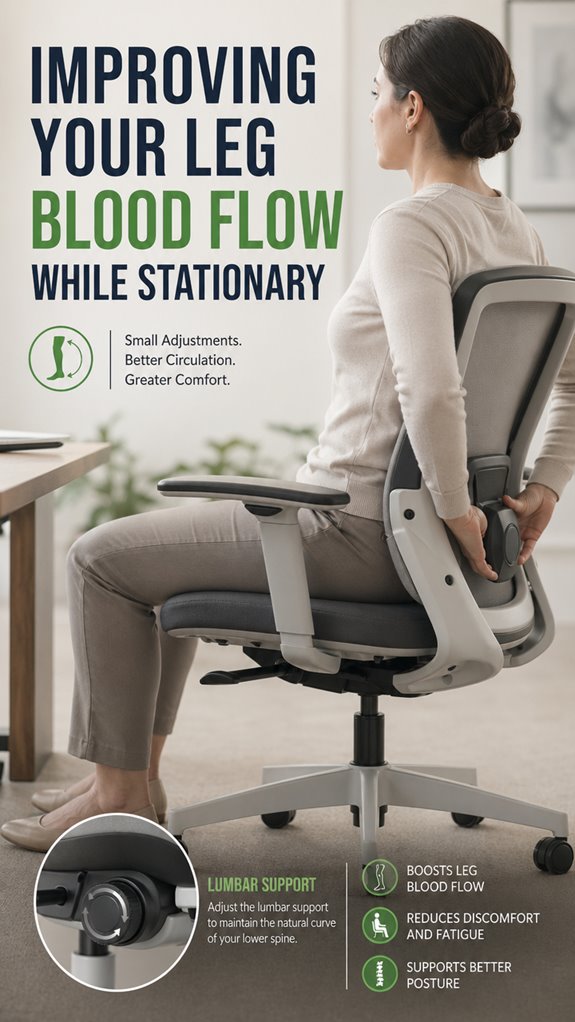
Ever wonder if your office chair is operating at peak efficiency or just silently crashing your system in the background? As a Senior Developer debugging the hardware-software interface of your physical chassis, optimizing chair adjustments is critical.
- Fine-tune your chair height to maintain your knees at a 90-degree angle, preventing circulation bottlenecks akin to a memory leak.
- Verify lumbar support is calibrated precision-style, akin to patching a kernel panic, to prevent the system’s core—your spine—from errors. Proper ergonomic support can immensely enhance your overall comfort and productivity during long coding sessions.
- Adjust armrests to reduce unnecessary tissue compression, aligning with Ghost In The Shell’s notion of seamless integration, not the clunky hardware mechanic you currently possess.
Additionally, remember to protect your eyesight, as prolonged chair sitting can lead to further discomfort and strain.
FAQ
Can Special Socks Really Help Prevent Leg Swelling at Work?
Yes, compression therapy with special socks enhances footwear choices by applying consistent pressure, boosting blood flow, and reducing swelling efficiently at work. You can actively improve your veins’ health and avoid discomfort by wearing these targeted, powerful compression stockings daily.
How Often Should I Take Movement Breaks During My Workday?
You should take movement breaks every 30 minutes, incorporating movement exercises like ankle circles and calf raises, plus ergonomic tips such as adjusting your chair and footrest, to vigorously combat leg swelling and boost circulation all day long.
Are There Any Specific Drinks That Reduce Leg Swelling?
Think of herbal teas and diuretic drinks as your body’s cleanup crew, working to flush out excess fluid. Drinking green tea, dandelion, or cranberry juice boosts circulation and reduces swelling, giving your legs the power to stay firm and strong.
Is Sitting With Legs Elevated Safe During Extended Work Hours?
Yes, sitting with legs elevated boosts blood circulation, but don’t overdo it; supplement with walking exercises every hour. Stay active, keep fluid moving, and use elevation strategically to powerfully reduce swelling during long work hours.
Can Certain Desk Setups Worsen Leg Swelling?
Certain desk setups can worsen leg swelling by increasing leg muscle tension and restricting blood flow, especially if using non-ergonomic chairs. Opt for ergonomic chairs and move frequently to maintain circulation and prevent swelling.
Summary
In principle, managing leg swelling during prolonged work sessions mirrors debugging a flawed codebase: root cause analysis precedes patch deployment. Before the system crashes into edema, optimize your ergonomic protocols—adjust chairs and elevate legs like fine-tuning server parameters for stability. Keep in mind, just as in Ghost In The Shell, the human body operates on complex algorithms susceptible to systemic glitches; mastering these tweaks ensures your infrastructure doesn’t collapse under simple yet overlooked mechanical burdens.
References
- https://njveinspecialists.com/blog/reduce-swelling-legs-feet
- https://www.goodrx.com/conditions/edema/how-to-get-rid-of-swollen-ankles-fast
- https://www.youtube.com/watch?v=3o-_seszOCA
- https://www.beebehealthcare.org/health-hub/womens-health-blog/7-easy-ways-reduce-your-swollen-ankles
- https://maidenlanemedical.com/pelvic-floor-physical-therapy/how-to-reduce-swelling/
- https://www.mayoclinic.org/diseases-conditions/edema/diagnosis-treatment/drc-20366532
- https://www.healthline.com/health/home-remedies-for-swollen-feet
- https://www.cvmus.com/blog/home-remedies-treat-edema-legs-and-feet
- https://www.avsurgery.com/post/when-is-leg-swelling-cause-for-concern
- https://myhealth.alberta.ca/Health/aftercareinformation/pages/conditions.aspx?hwid=uh3154
- https://health.clevelandclinic.org/when-is-leg-swelling-a-sign-of-something-serious
- https://www.bestveintreatment.com/post/why-you-should-never-ignore-leg-swelling
- https://www.bergdpm.com/blog/5-reasons-you-may-have-swollen-feet.cfm
- https://www.mayoclinic.org/symptoms/leg-swelling/basics/causes/sym-20050910
- https://www.keckmedicine.org/blog/6-possible-reasons-why-you-have-swollen-feet-ankles-or-legs/
- https://www.usavascularcenters.com/blog/why-are-my-legs-swollen/
- https://www.health.harvard.edu/diseases-and-conditions/edema-a-to-z
- https://legsmatter.org/information-and-support/health-concerns/oedema-and-lymphoedema/