
Ever feel like your brain’s running on a corrupted build after eight hours of debugging? I do. Somatic tracking patched that for me.
—
Last Tuesday, my shoulders hit Y2K levels of tension. Stack overflow in real life. Instead of rage-quitting, I checked my body’s error logs. Tight jaw. Held breath. Twenty minutes of breathing into these sensations, treating them like benign alerts rather than critical failures. The release felt like finally closing that ticket that’s been open for sprint cycles.
—
I used to think stress was just “part of the deploy process.” Now? I’m the senior dev of my own nervous system, refactoring legacy coping mechanisms into something maintainable.
When Your Body Throws a 504 Gateway Timeout (And You Ignore It)
Three months ago, I missed the warning signs. Chronic back pain from chair posture, caffeine crashes, staring at screens until my eyes staged a mutiny. Then came the panic attack during a standup. Not my finest commit. I’d been treating my body like deprecated code I never planned to update. Somatic tracking, breathwork, and workplace ergonomics became my new tech stack. The integration wasn’t clean, but the system stabilized.
Quick Takeaways
- Pause to notice internal sensations like tension or racing heartbeat to engage somatic awareness.
- Breathe into bodily signals, allowing them to fade or shift, reducing stress response.
- Reassure yourself that sensations are benign, calming the nervous system’s fight-or-flight state.
- Use focused attention techniques to ground and reset your body’s stress signals quickly.
- Regularly practice brief somatic checks to create a calming, automatic response during stressful moments.
What Is Somatic Tracking and How Does It Help Manage Stress?
If you’re familiar with debugging systems and optimizing code, then understanding somatic tracking isn’t far removed from patching an unstable module in a complex architecture.
External stressors act as systemic failures—widespread, unpredictable, the Ghost in the Shell wreaking havoc. Instead of obsessing over high-level logs, you drill down into raw data: physical sensations. You observe, categorize, and reinterpret signals—dull, sharp, pulsing—like fine-tuning an API call.
It’s about controlling input and rewriting the code: sensations aren’t threats but benign data. In this process, you reprogram the nervous system, an upgrade that’s as essential as compiling your latest fix, ensuring stability beneath the chaos. Moreover, incorporating techniques like toe spacers for comfort can enhance your overall physical well-being, further supporting the stress-relief journey.
How to Recognize Physical Tension During Stressful Moments
When the user interface of your nervous system starts glitching—heart rate spiking wildly, shoulders tensing like a malfunctioning server—the chaos begins with macro-system failures that demand diagnostic precision.
To recognize physical tension during these stressful moments, monitor:
- Rapid, shallow breathing akin to a DDoS attack on your chest
- Muscle tightness in the neck, like a stuck thread in your codebase
- Clenched fists or jaw, reminiscent of failed commit locks
- Aches or soreness surfacing unexpectedly, as unwanted memory leaks
- Restlessness, like an unresponsive, resource-hungry process attempting restarts
- The use of top vertical mice can help minimize physical strain during prolonged computer sessions.
Identify these signals before your mental debug session spirals into a kernel panic.
A Simple Step-by-Step Guide to Practicing Somatic Tracking at Your Desk
In the relentless runtime of your daily desk-bound codebase, it’s easy to overlook the subtle system alerts signaling internal overload—like a high CPU temperature or memory leaks—until you hit the catastrophic blue screen of stress.
To execute somatic tracking, start with a pause—recompile your focus. Engage in a brief, controlled data acquisition (30 seconds), pinpoint signals—maybe shoulder tension or racing pulse—then breathe into these inputs, like debugging a stubborn bug.
Apply safety reappraisal: reassure your nervous system that the core system files aren’t corrupt. Incorporating techniques like eye exercises can enhance your overall focus and reduce stress during these practices. Repeat, monitor changes, and avoid panic—this is your patch for runtime errors of the mind.
Common Mistakes and How to Correct Them When Practicing Somatic Tracking

Even seasoned developers know that the real bug resides not in the endless lines of code but in the errant state variables that ripple through the entire system, causing unpredictable crashes.
Similarly, with somatic tracking, neglecting the *refined* feedback loop can lead you astray—like debugging Ghost in the Shell’s cybernetic architecture only to ignore core neural signals.
- Trying to “fix” sensations prematurely
- Over-analysing or attaching judgment
- Missing the subtle of shifting sensations
- Forcing a static stance on dynamic signals
- Ignoring bodily cues in favor of mental assumptions
Control comes from patience—think of your nervous system as a version control system—sometimes, you need to commit to observation, not editing. Additionally, you can enhance your focus with Loop Earplugs, which help to minimize distractions during the practice of somatic tracking.
Daily Habits to Make Somatic Tracking Part of Your Routine
Without disciplined integration, your nervous system’s cascade of unresolved stress signals operates like a flaky API—sporadically crashing under load. As a senior developer, you know the importance of routine maintenance, yet your internal codebase remains sandboxed in chaos—glitches echo from the cortex to the periphery.
To prevent this meltdown, implement a daily commit: a brief somatic tracking session. Like debugging a memory leak, this habit flags sensations before they escalate, cementing safety reappraisal routines.
Regular commits sanitize the buffer, anchoring your infrastructure—mind and body—so they’re less “Ghost in the Shell” than a well-oiled machine.
My First Product Recommendation
When your nervous system resembles a legacy codebase riddled with memory leaks and unhandled exceptions, the logical next step isn’t a glorified patch but a fundamental refactor—enter my first product recommendation, a straightforward somatic tracking app tailored for developers crashing their internal processes all day long.
- Lightweight, no-bloat interface—just pure sensation orchestration.
- Guided cycles designed to facilitate safety reappraisal on the fly.
- Built-in timers, because manual debugging is passé.
- Compatibility with common IDEs and distraction blockers.
- Anchored in scientific validation, like Figma prototypes for emotional resilience.
This isn’t UX; it’s a systemic upgrade—like patching kernel panic with a curated debug log.
Initial Skepticism From Beginners

In the debugging phase of early implementations, skepticism naturally arises—especially when your neural architecture stubbornly insists on throwing segmentation faults at the mere mention of “safety reappraisal.” It’s akin to attempting to run “Ghost in the Shell,” where the interface exposes vulnerabilities beneath sleek UI.
Yet these bugs remain elusive, unpredictable, and seemingly insurmountable.
Beginners, like beta testers stuck in a loop, expect rapid patching, but these protocols demand consistent, deliberate updates. The nervous system’s response, fragile and unfamiliar, often triggers false positives—much like classic system crashes—confusing the user into doubting the whole architecture’s stability. Understanding the role of ergonomic chairs can enhance the overall comfort during this challenging learning process.
Brief Stretching Sessions at Work
Long stretches at a desk are an inevitable feature of the modern developer’s environment—like outdated software bugs that refuse to clear.
Your biomechanical system, much like legacy code, degrades under constant load, risking primary failure points—synapse fatigue, muscle lockups, or a system crash resembling “Ghost in The Shell” shutdown commands.
Implementing brief stretching sessions acts as an API call for nervous system refresh, prioritizing:
- Restoring micro-circulatory integrity
- Resetting proprioceptive feedback loops
- Reducing hardware overheating (muscle tension)
- Updating sensory input streams
- Preventing bug escalation from static posture
Incorporating brief stretching sessions every 25 minutes can significantly enhance your overall well-being and productivity.
Because even in complex systems, occasional reboots prevent total system meltdown.
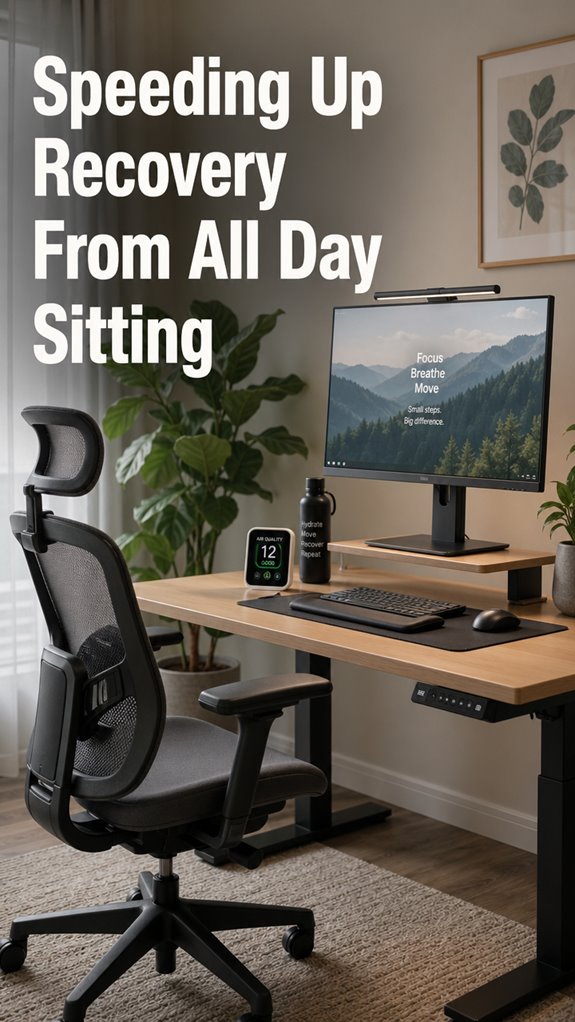
Office Ergonomics for Comfort
Sitting at a desk all day might feel like the pinnacle of modern productivity, but in reality, it’s a carefully engineered trap—an orchestrated failure of our biological hardware akin to running a mission-critical application on deprecated firmware.
The spine’s kernel module suffers a relentless barrage of static input, while wrists resemble legacy interfaces prone to fatal latency.
In this hyper-optimized environment, ergonomic misconfigurations resemble deprecated APIs—inefficient, glitch-prone, draining system resources.
Adjusting your chair height, monitor position, and keyboard layout isn’t just user interface tuning—it’s a critical system patch. Full-body posture is a crucial aspect of ergonomic health that often gets overlooked.
Without proper ergonomic debugging, hardware decay becomes inevitable. It’s time for a real upgrade, not just another patch.
FAQ
Can Somatic Tracking Be Effective During High-Stress Emergency Situations?
In high-stress emergencies, somatic tracking can help you regain control by calming your nervous system, focusing your mind, and fostering safety awareness. It allows you to respond more effectively rather than reacting impulsively.
Is Prior Meditation Experience Necessary to Start Somatic Tracking?
No, prior meditation experience isn’t necessary to start somatic tracking. You can begin right away, focusing on sensations with curiosity and safety. It’s a flexible, accessible practice that helps you gain control over your nervous system and stress.
How Long Does It Typically Take to Notice Stress Relief Benefits?
You can notice stress relief benefits in just a few minutes with somatic tracking. By focusing on sensations, you actively teach your nervous system safety, gaining faster control over your emotional state and reducing tension almost instantly.
Can Somatic Tracking Replace Other Relaxation or Stress Management Techniques?
Yes, somatic tracking can replace other techniques because it empowers you to regulate your nervous system from within, fostering self-awareness, resilience, and emotional control—making it a flexible, effective tool for managing stress and promoting well-being.
Are There Any Risks or Contraindications for Practicing Somatic Tracking?
Are you aware of potential risks? Practicing somatic tracking is generally safe, but if you experience intense distress or trauma symptoms, proceed cautiously or consult a mental health professional. Your safety and control matter most.
References
- https://romicumes.com/somatic-tracking-a-simple-practice-for-healing/
- https://www.youtube.com/watch?v=ffrjeO2MLWE
- https://positivereseteatontown.com/somatic-tracking-a-compassionate-path-to-mind-body-harmony/
- https://www.painreprocessingtherapy.com/reprocessing-project/somatic-tracking-when-pain-flares/
- https://www.bch.org/documents/content/somatic-tracking-exercise.pdf
- https://somatictherapypartners.com/somatic-exercises-for-stress/
- https://amarilove.com/somatic-tracking-exercise-a-recovery-practice-for-reducing-symptoms/
- https://www.youtube.com/watch?v=qDI3k-Wcusc
- https://insighttimer.com/mandymercuri/guided-meditations/somatic-tracking-for-anxiety
- https://www.youtube.com/watch?v=8mQndLqK31E
- https://www.traumatherapistinstitute.com/blog/explore-somatic-movement-training-for-healing-a-guide-for-beginners
- https://www.va.gov/wholehealthlibrary/passport/chapter-4.asp
- https://www.hopkinsmedicine.org/office-of-well-being/connection-support/somatic-self-care