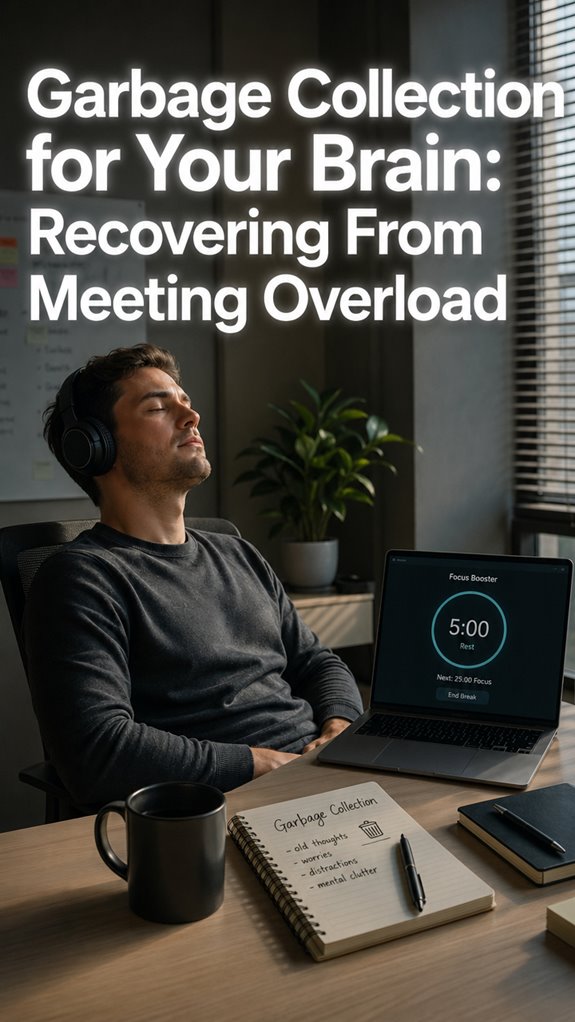
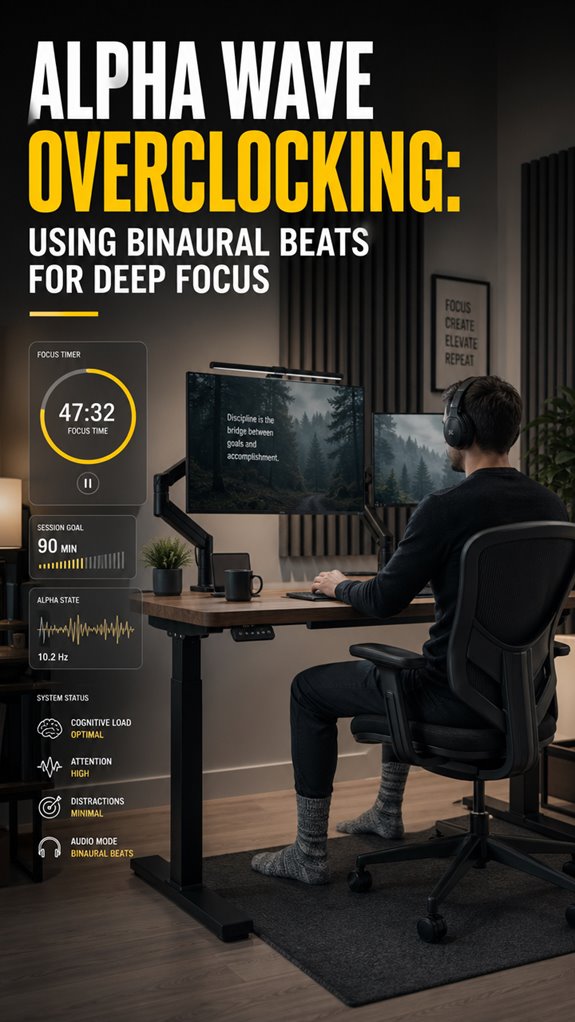
Ever feel like your brain’s running on Windows 95 with too many tabs open? Binaural beats fixed that for me.
Last month, I hit a wall. Three PM. Deadline looming. My mind was spaghetti code, tangled and useless. Desperate, I tried 10 Hz alpha waves on YouTube. Forty minutes later, I shipped a feature I’d been stuck on for days. The chaos didn’t disappear, but I could finally think *around* it.
My headphones became debugging tools. The hum synchronized something. Eight to twelve Hz, if you’re curious. Precise. Like finally understanding a legacy codebase after hours of staring.
It’s not magic. Sometimes it flops. But when it works? Flow state. Pure,纳税人的 relief.
Does it replace coffee? No. Does it help? Honestly? Kind of.
When Focus Tools Fail: My Brain Fog Crisis at the Standing Desk
The beats aren’t foolproof. Tuesday proved it. I’d slept four hours, my Autonomous desk was wobbling, and the 10 Hz track felt like static. I forced two hours anyway. Produced garbage. Deleted it all.
Realized I’d ignored the basics: sleep, movement, hydration. Biohacking can’t outrun biology. Now I pair beats with Pomodoro timers and actual walks. Sometimes old school wins.
Quick Takeaways
- Binaural beats at 8-12 Hz induce alpha waves, promoting neural synchronization for enhanced focus and mental clarity.
- Properly calibrated audio and stereo separation optimize binaural beat effectiveness for deep concentration.
- Incorporating alpha wave techniques into daily routines can improve cognitive performance during high-focus tasks.
- Troubleshooting ambient noise and hardware issues ensures consistent neural entrainment and reduces latency disruptions.
- Creating an optimized environment with ergonomic setups and distraction control amplifies the benefits of alpha wave overclocking.
What Are Alpha Waves and Binaural Beats, and How They Boost Focus
When you’re debugging a heavily-loaded IDE with memory leaks that Sentinel can’t quite catch, it becomes painfully obvious that macro failures in brain activity resemble server crashes more than seamless operations.
Alpha waves, operating at 8-12 Hz, facilitate neural synchronization, sharpening focus and cognitive enhancement. Binaural beats introduce audible illusions—two slightly different frequencies—voking entrainment for long-term memory support and deep concentration. Like patching a corrupt kernel, these auditory signals optimize mental throughput, enabling you to push through the chaos. Research has shown that Binaural beats can enhance cognitive performance, particularly in tasks requiring sustained attention. Incorporating essential oil blends for clarity and focus can further enhance your mental acuity and emotional balance during intense tasks.
It’s akin to software overclocking; the brain’s hardware receives a necessary software upgrade—an alpha state bug fix—maximizing mental performance amid the absurdity of our own computational failures.
How to Pick the Best Binaural Beats for Programming and Studying
Managing the chaos of mental resource leaks and code rot, it’s clear that selecting the right binaural beats hinges on targeted system optimization, beyond subjective preference.
Optimizing mental bandwidth through precise auditory tuning is essential for sustained cognitive performance and resilience.
For programmers, genre-specific audio—be it ambient, downtempo, or classical—serves as dynamic mood regulation, much like refining compiler optimizations.
Choose tracks calibrated at 10 Hz to trigger alpha entrainment, reducing latency and garbage collection pauses in your cognitive architecture.
Prioritize low-pass filtered sound for clarity, avoiding sonic bloat.
In this Ghost-in-the-Shell reality, your focus is a fragile thread—perfectly tuning auditory stimuli is akin to debugging core system failures, ensuring seamless mental concurrency during extended sessions. Additionally, using monitor arms for flexibility can enhance your physical workspace, allowing you to adjust your screen position for optimal comfort while you code.
Simple Ways to Use Alpha Waves Daily for Better Concentration
In the perpetual loop of debugging your mental productivity—tangled between memory leaks, restless code, and the occasional system crash—integrating alpha wave stimuli into your daily routine acts as the ultimate patch update for cognitive congestion.
Adopt mindfulness practices during high-load periods to optimize alpha entrainment. Incorporate physical activity into your schedule, mimicking the neural reset of modern upgrades. The use of cool mist humidifiers can further enhance your cognitive environment. Streamline your focus with these steps:
- Use binaural beats at low volume during coding sessions, simulating system kernel checks.
- Schedule brief alpha wave sessions between debugging sessions, like garbage collection.
- Pair alpha entrainment with short mindfulness practices—think “ghost in the shell”—to reinforce neural pathways.
- Maintain disciplined routines—breaks are patches, not crashes.
Additionally, engaging in breathwork techniques with top breathwork trainers can amplify your ability to access focused states, enhancing overall cognitive function.
Troubleshooting Binaural Beats and Getting the Most Out of Alpha Sessions
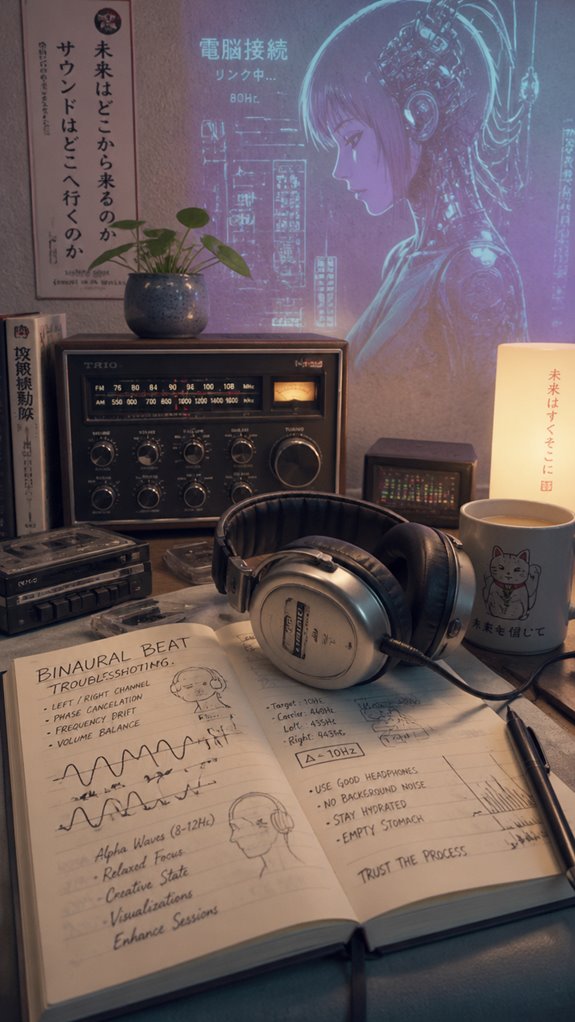
Even the most polished code can grind to a halt if your neural input/output pipeline isn’t running at its best—that’s precisely what occurs when binaural beats fail to trigger alpha entrainment, despite well-crafted frequency modulation and auditory illusions.
Like debugging a ghost in the shell, you must optimize your auditory bandwidth, ensuring stereo separation and volume are calibrated, avoiding latency in playback. Incorporating wrist rollers into your routine may help strengthen your grip and enhance overall focus during long coding sessions.
Verify your hardware drivers and source material, because no amount of complex code will improve if core physiological modules—like your brain’s alpha wave generators—are misconfigured, or if ambient noise pollutes the stream.
Sometimes, you just need to patch your system with a fresh session of deep focus. Additionally, practicing effective relaxation techniques after intense coding can enhance your cognitive performance and help maintain your alpha state.
My Initial Binaural Beat Trial
Starting my initial binaural beat trial felt much like debugging a software module only to realize the core kernel—my brain’s alpha wave generator—had inconsistent thread priority.
I’d designed custom soundscapes for mood modulation, yet the PCM signals failed to reliably entrain my neural engine.
- Entrée into the alpha state was intermittent—a classic race condition.
- The spectral coherence across channels was jank—like mismatched version dependencies.
- Latency spikes disrupted the flow—akin to background garbage collection.
- Power management resets kept bouncing back—dev-ops for my neuro-architecture.
It became clear the human hardware needs systematic refactoring to consistently combat alpha drift, Ghost in the Shell-style. To enhance the efficacy of these trials, incorporating effective nootropic stacks could provide a synergistic boost to cognitive performance. Additionally, utilizing cycle tracking apps could help optimize mental well-being and better focus during these experiments.
Auditory Mismatch Causes Distraction
When your mental operating system crashes due to auditory mismatch, the root cause isn’t a software bug but a core exception—namely, expectation violations.
| Expectation Mismatch | Auditory Distraction | System Response |
|---|---|---|
| Breaking predictable patterns | Unexpected steady states | Server overhead spikes |
| Deviant pitch or loudness | Ignored streams with alterations | Triggering MMN alerts |
| Disrupting serial recall | Local change vs. expectation | User attention diverted |
| Failing to recognize deviance | Ignoring irrelevant stimuli | Cognitive bandwidth drain |
| Expecting consistency | Surprising input | System log anomalies |
In this digital abstraction, human brains mimic error logs, overloading with unanticipated signals—born from environment’s failure to meet the expectation handshake. This disruption can lead to cognitive overload, making it difficult to maintain focus and effectively process information. Incorporating air ionizers can significantly improve air quality, helping create a more conducive environment for concentration.
Neural Entrainment Techniques

Neural entrainment techniques function much like debugging a stubborn, unpredictable codebase—only instead of rogue scripts corrupting your logic, it’s your brain’s oscillatory patterns throwing unexpected exceptions.
You target neural synchronization to refine system performance, leveraging brain plasticity to optimize task execution.
- Implement stimuli—like binaural beats—that trigger adaptive neural pathways.
- Use repeated exposures to reinforce desired oscillatory states, akin to code refactoring for stability.
- Employ real-time feedback to monitor and adjust entrainment protocols, ensuring the infrastructure maintains integrity.
- Prioritize consistent testing, allowing the system to reconfigure itself, much like machine learning models tuning parameters for peak efficiency—only without the luxury of a debugger, Ghost in the Shell style.
Customized Binaural Beat Playlists
In the ongoing debugging process of your cognitive architecture, one often overlooked but critical step involves customizing binaural beat playlists to optimize mental throughput—much like tailoring your IDE profiles to specific project demands.
| Parameter | Effect | Music Therapy Role | Application in Cognitive Enhancement |
|---|---|---|---|
| Frequency Range | 8-12 Hz for alpha state | Deep focus, relaxed alertness | Long-term memory, sustained concentration |
| Duration | Extended sessions increases efficiency | Minimize occasion switches | Streamline workflow, minimize mental clutter |
| Listening Volume | Subtle, non-intrusive | Preserves mental clarity | Reduce cognitive fatigue |
Personalized Desk Work Strategies
Have you ever noticed how the chaos of system crashes and memory leaks parallels the human tendency to let cognitive overload manifest when your workspace becomes a digital battleground?
To optimize your *creative workspace*, implement ergonomic setups that eliminate hardware conflicts—think standing desks, monitor arms, and noise-cancelling headphones akin to a *Ghost in the Shell* interface, where seamless control is paramount. Furthermore, integrating top visual timers into your workflow can help you keep track of focused work sessions and breaks effectively. Additionally, incorporating top grounding socks into your daily routine can enhance your overall well-being and focus.
- Prioritize hardware acceleration for coding environments like VS Code or JetBrains Suite.
- Isolate distraction zones with acoustic treatments.
- Automate repetitive tasks via scripts, reducing mental load.
- Maintain ergonomic alignment to prevent physiological crashes.
All these form the system architecture you need, power-user.
FAQ
Can Binaural Beats Cause Adverse Side Effects or Headaches?
You might experience potential auditory fatigue or headaches if you overuse binaural beats or have underlying health concerns. Use them at comfortable volumes, take breaks, and consult with a healthcare professional if you notice adverse effects.
How Long Should I Listen to Binaural Beats for Optimal Results?
For ideal results, listen to binaural beats for 1-2 hours, harnessing music therapy backed by brainwave science. Power up your focus and cognitive performance by maintaining consistency, but take breaks to prevent fatigue and enhance effectiveness.
Are There Any Risks for People With Hearing Impairments?
Hearing safety is essential; if you have hearing impairments, consider impairment considerations before using binaural beats. Power users should monitor volume closely, avoid risky exposure, and consult a professional if you experience discomfort, ensuring effective, safe deep focus training.
Can Binaural Beats Replace Other Focus-Enhancing Methods?
Binaural beats can’t fully replace alternative techniques but serve as powerful, complementary methods for boosting focus. Combine them with meditation or exercise to activate heightened mental clarity and sustained deep focus, optimizing your cognitive performance.
Is It Necessary to Take Breaks During Extended Binaural Beat Sessions?
You need breaks during extended sessions; envision your brain as a finely tuned engine that overheats without cooling. Position break frequency wisely, allowing your mind to restore, recharge, and maintain the power to focus fiercely over long periods.
Summary
In the complex codebase of your cognition, alpha wave overclocking via binaural beats offers a patch—fragile but potentially effective—akin to debugging Ghost in the Shell’s neural network during a system lull. As you toggle between focus modules and distraction handlers, keep in mind this psychoacoustic middleware is just part of the global variable of mental infrastructure. Optimizing it is like refactoring legacy code—tedious, arcane, yet sometimes the only way to prevent your focus subsystem from crashing outright.
References
- https://www.meditationlifeskillspodcast.com/alpha-wave-binaural-beats/
- https://www.youtube.com/watch?v=p2_zDvtPQ-g
- https://open.spotify.com/album/2bjOJhsZkmPFYoQ7bTWKeJ
- https://open.spotify.com/track/3RWTEueDH0DDuLLi1uUfI5
- https://www.youtube.com/watch?v=rEEHdaRo5mE
- https://www.youtube.com/watch?v=WPni755-Krg
- https://www.youtube.com/watch?v=LXsfShblX-8
- https://www.youtube.com/playlist?list=PLbXZkxjs1Xpqf_jhS84JwDY5FPiKAkT1t
- https://www.youtube.com/watch?v=dMWZ3exnBy8
- https://journals.plos.org/plosone/article?id=10.1371/journal.pone.0084166
- https://pmc.ncbi.nlm.nih.gov/articles/PMC6013515/
- https://pmc.ncbi.nlm.nih.gov/articles/PMC8670091/
- https://en.wikipedia.org/wiki/Mismatch_negativity
- https://journals.sagepub.com/doi/abs/10.1177/17470218241235654
- https://www.tandfonline.com/doi/full/10.1080/25742442.2023.2274270