Ever feel like your hips are running on Windows 95 after an eight-hour sprint? Mine certainly were. Last Tuesday, I stood up from my desk and my pelvis made a sound I’d only heard before from a failing hard drive.
The thing sitting does. It just… calcifies you. I spent three months ignoring the warning signs
tightness creeping in,
gait turning robotic,
lower back staging a rebellion.
My breaking point? A sprint to catch the elevator. I moved like I was rendering in real-time. Embarrassing.
The fix isn’t glamorous. Kneeling hip flexor stretches. Foam rolling your TFL until you see stars. Consistency beats intensity. Trust me, I’ve tested both approaches extensively.
Ready to stop moving like legacy code?
—
Hip Flexor Tightness From Desk Jobs: A Developer’s Mobility Crisis
Two years ago, I completed my first marathon. Felt invincible. Six months into a new dev role, I couldn’t touch my toes. The irony wasn’t lost on me.
I tried ignoring it. Popped ibuprofen like Tic Tacs. Blamed my chair, my shoes, my genetics. Anything but the obvious: 10 hours daily in a seated position actively reshapes your fascial tissue, shortening psoas muscles and destabilizing your entire kinetic chain.
My physical therapist called it “gluteal amnesia.” My brain had literally forgotten how to fire my posterior chain. She prescribed dead bugs, 90/90 hip switches, and walking meetings. Skeptical, I committed.
Three weeks later, standing didn’t feel like emerging from a crypt. The connection between sedentary work and chronic pain, poor posture, and even pelvic floor dysfunction became undeniable. Movement snacks every hour. That’s my non-negotiable now.
Quick Takeaways
- Regularly initiate movement routines every 20 minutes to prevent hip flexor system leaks and tightness.
- Incorporate targeted stretching exercises like kneeling hip flexor stretches and lizard pose to release muscle contraction.
- Use resistance tools such as stretch bands or foam rollers to enhance flexibility and reset hip biomechanics.
- Stand periodically and perform dynamic warm-ups to counteract static sitting and maintain hip mobility.
- Address persistent discomfort promptly to avoid biomechanical code bugs, preventing longer-term mobility issues.
How Sitting Long Hours Causes Hip Tightness and Limits Mobility
When you spend hours in front of a screen—say, debugging code, optimizing API calls, or ensuring that the latest Agile framework integrates seamlessly—your hips become the overlooked system bottleneck, silently underperforming due to prolonged inactivity.
The psoas and iliacus muscles, akin to deprecated code, lock into static, shortened states, causing stiff backups that create command-line errors in your posture and mobility. It’s as if “Ghost In The Shell” is haunting your biomechanics, with each chair session compounding the system crash.
Ultimately, this sluggish interface between mind and body degrades run-time performance, forcing you into a hardware failure you can’t debug.
Simple Hip Stretches to Relieve Tight Flexors
Debugging your biomechanics after countless hours of sedentary operation reveals that the first line of code to optimize is the hip flexor module, compromised by prolonged static states.
You must execute simple stretch scripts to debug this segment:
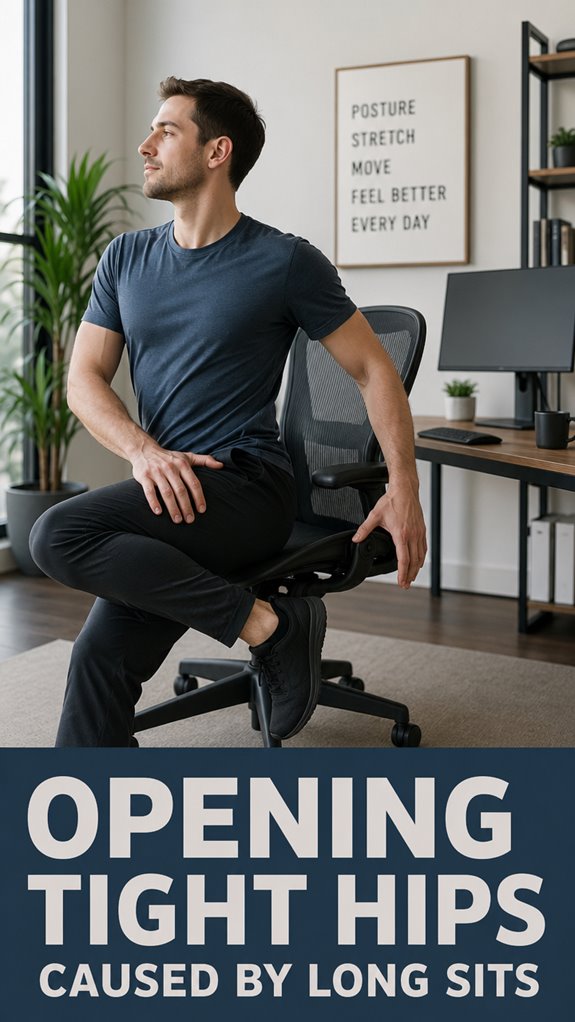
- Kneeling hip flexor: isolate and run the forward drive, 30s per side.
- Horizontal squat: load the hips in deep extension, hold for 60s.
- Sitting figure-four: emulate the real-world posture, stretch activation.
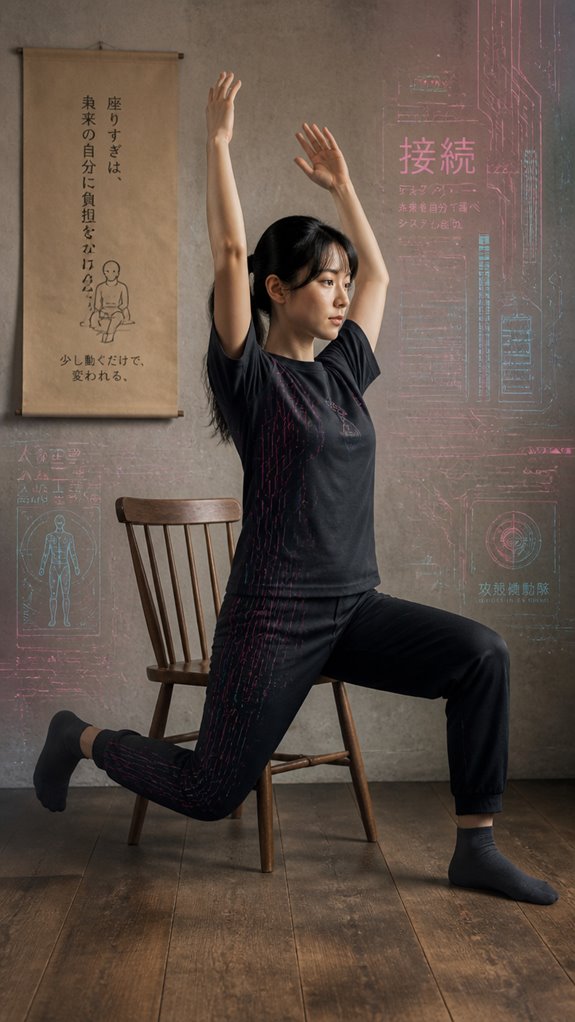
- Lizard pose: manipulate the outer angle, introduce dynamic flow.
- Low lunge variation: extend the upgrade with arm activation for max output.
Control your inputs—restore system functionality before total shutdown. Additionally, standing desks can help mitigate issues related to prolonged static states in your workspace setup.
Effective Exercises to Strengthen Your Hip Muscles
In the grand architecture of human biomechanics, neglecting targeted muscle strengthening is akin to running a production environment on deprecated code—fragile, unpredictable, and doomed to crash at the first sign of load.
Your hip muscles are the unsung APIs in this sysadmin chaos, prone to failure under load from long sits. Activate them with exercises like single-leg bridges, lunges, and step-ups, akin to patching a faulty module before a release.
Think of it as debugging your subsystem: strengthen the glutes and hip flexors to maintain system integrity, much like avoiding a “Ghost in the Shell” malfunction caused by neglected code paths.
Easy Tips to Prevent Hip Tightness During Long Sitting
Long periods of static sitting—think of them as the classic memory leak in your biomechanics—gradually erode the integrity of your hip flexors, turning ergonomic paradise into a collapsible sandbox.
To prevent this systemic failure, implement these control measures:
- Initiate movement routines every 20 minutes to trigger manual garbage collection.
- Stand unsupervised for a minimum of five seconds, discarding the illusion of immutability.
- Incorporate dynamic warm-ups like reverse lunges or high knees to debug tightness.
- Use foam rollers or yoga blocks as buffers, maintaining system stability.
- Schedule micro-breaks to optimize runtime efficiency and avoid runtime crashes.
Using essential oil diffusers can also foster a calming atmosphere that supports overall well-being.
Update your physical schema accordingly.
Stretch Bands Helped Significantly
When addressing the systemic failure of tight hips—a bug that silently propagates through the biomechanical code—you quickly realize that static sitting is the equivalent of a memory leak in your motor functions.
Enter stretch bands, auxiliary scripts that effectively validate and reinforce the system’s integrity. With their help, I could override the default “sit and forget” fatal error, forcing the muscles to recalibrate and upgrade.
Much like patching a stubborn memory leak in a complex codebase, elastic resistance modules (brand-specific, of course) provided granular control over the hip flexors that had long been locked in a deprecated state. Stretching straps are essential tools for enhancing flexibility during this process.
Ultimately, this hardware-like intervention reminded me that even human software requires regular updates.
Persistent Discomfort During Stretches
Persistent discomfort during stretches often reveals itself as a rogue bug lurking within your biomechanical code—triggered by systemic failures like prolonged sitting, muscle fiber strain, or overzealous resets.
- Consider this your debugging routine, where every stretch attempt crashes with residual error messages.
- It’s like trying to patch a memory leak, only to find your hips have become the deprecated function.
- Sensitivity to touch signals a corrupted UI—akin to a grayed-out interface stuck in limbo.
- Persistent pain or cramping is a never-ending runtime loop, demanding manual override.
- When sciatic tension kicks in, even Ghost in the Shell would envy your malfunctioning firmware.
Extended Seated Posture Effects

Extended seated postures represent a classic case of bio-mechanical memory leaks, where the human system’s architecture degrades under sustained load, causing cascading failures across modules. You’re effectively running a legacy system—your hip flexors, the psoas and iliacus, become as buggy as outdated firmware.
This leads to localized bottlenecks like lower back pain, and systemic crashes like gait alterations. It’s akin to Ghost in The Shell desperately rebooting amidst a cascade of memory errors, except your internal hardware refuses to auto-upgrade.
Without intervention, you risk irrecoverable orthopaedic “exceptions,” leaving your mobility stack vulnerable—proof that sometimes, the human code needs a firmware patch. Incorporating walking into your routine can help mitigate these issues and enhance overall well-being.
Ergonomic Chair Adjustments
As a seasoned coder steering the labyrinthine corridors of your ergonomic chassis, it’s painfully evident that the fundamental architecture—your chair—remains the most underestimated bottleneck in your pipeline.
Misalignments compounded by neglecting ergonomic adjustments cause cascading failures like pelvic tilt, lower back instability, and hip flexor paralysis.
- Misaligned lumbar support sabotages posture, triggering compounding inefficiencies.
- Improper seat height prevents proper hip flexion, forcing compensatory movements.
- Lack of tilt adjustments causes pelvis rotation, analogous to faulty kernel patches.
- Static armrest positions hamper critical micro-movements, reducing workflow agility.
- Ignoring back angle customization increases systemic fatigue, akin to memory leaks in your skeletal cache.
Optimizing your chair is analogous to iterative code refactoring—necessary for system stability. Furthermore, improper chair ergonomics can contribute to preventing eye strain, as discomfort in the body affects overall focus and vision.
FAQ
How Quickly Can I See Improvement in Hip Flexibility After Stretching Regularly?
You can notice improvements in hip flexibility within a week of consistent stretching, especially if you incorporate daily movement snacks and dynamic warm-ups. Keep at it regularly to see lasting gains, and feel your hips loosen progressively.
Are There Specific Activities That Worsen Hip Tightness From Prolonged Sitting?
Activities like prolonged sitting, forward bending, and deep hip hinging worsen your hip tightness, especially if you don’t incorporate movement breaks. You control your progress by avoiding or modifying these tasks, keeping hips flexible and healthy.
Can Sitting With Proper Posture Prevent or Reduce Hip Tightness?
Sitting with proper posture can help prevent or reduce hip tightness by minimizing muscle shortening and strain. You stay active, guarantee correct alignment, and incorporate regular movement breaks, maintaining flexible hips and supporting better overall posture.
What Are Signs That Hip Tightness Is Causing Other Joint Issues?
Think of your joints as an interconnected chain; if your hips tighten, it pulls the chain, causing knee pain, lower back soreness, and gait issues. You’ll notice these signs, alerting you to tighten your control and act.
Is It Safe to Perform Hip Stretches if I Have Existing Lower Back Pain?
Yes, you can perform hip stretches if you have lower back pain, but proceed cautiously. Stick to gentle stretches, listen to your body, and avoid any move that worsens your discomfort, consulting a healthcare professional if needed.
References
- https://www.hingehealth.com/resources/articles/exercises-to-open-hips/
- https://www.healthline.com/health/tight-hips
- https://www.onepeloton.com/blog/hip-opening-stretches
- https://www.runnersworld.com/uk/training/cross-training/a26098358/how-to-loosen-tight-hip-flexors/
- https://www.youtube.com/watch?v=1VJESI1iyQM
- https://www.chiroone.com/blog/5-hip-exercises-for-people-who-sit-all-day/
- https://www.youtube.com/shorts/Ual-dDIdZQU
- https://www.health.harvard.edu/healthy-aging-and-longevity/do-you-spend-most-of-your-day-sitting-these-hip-flexor-stretches-are-for-you
- https://www.health.harvard.edu/pain/3-do-at-home-stretches-to-release-hip-and-buttock-pain
- https://oibortho.com/hip-flexor-pain/
- https://www.hingehealth.com/resources/articles/hip-flexor-pain/
- https://www.hollywoodpresbyterian.com/blog-understanding-hip-flexor-pain/
- https://www.youtube.com/watch?v=jjXQKKDTdes
- https://www.medicalnewstoday.com/articles/325029
- https://alethahealth.com/blogs/guides/why-do-i-get-hip-pain-from-stretching-for-dancers-gymnasts-and-yogis