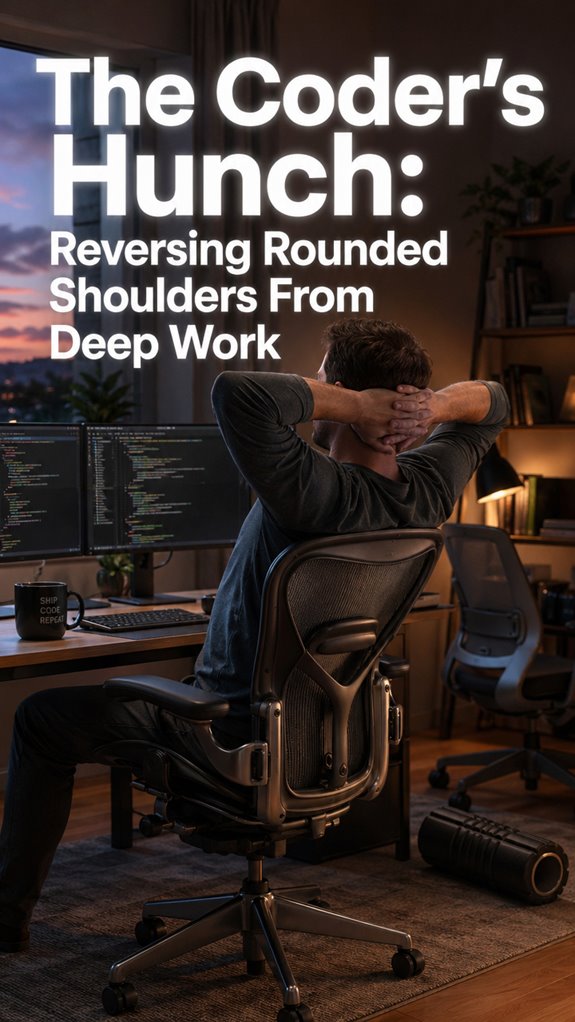
Ever caught your reflection and wondered why you’re slowly turning into a question mark? That’s your “coder’s hunch,” and I developed mine after three years of 12-hour debugging sessions that turned my upper back into a permanent C-shape.
My rhomboids basically went on strike while my chest tightened up like legacy code nobody dares refactor.
The wake-up call came when I couldn’t pass a simple wall angel test. My shoulders were auditioning for a “before” posture infographic.
Here’s what actually moved the needle for me.
Five minutes daily on a foam roller for thoracic extensions. Nothing fancy. Three sets of ten rhomboid pulls. Chair extensions during standups.
I tried those Sparthos braces once. Total dependency trap, like importing a massive library for one function. Swapped to an Aeron with proper lumbar support instead.
Stack alignment first. Everything else follows.
Developer Neck Pain: How Ignoring My Posture Cost Me a Production Deploy
March last year. Critical release. 48 hours straight.
By hour thirty-six, my neck had its own pulse. Sharp radiating pain down my left arm. I pushed through, because that’s what we do, right?
Deployment succeeded. I couldn’t turn my head for a week. MRI showed early disc dehydration at C5-C6. Not quite herniated, but my nervous system had filed a formal complaint.
That scare forced me to map my actual pain triggers. Turns out my second monitor was positioned like a medieval torture device. My keyboard sat too high, forcing constant shoulder elevation.
I implemented a strict “pain budget.” Every twinge meant immediate movement. No negotiation. Built Pomodoro breaks with actual stretching, not just scrolling Hacker News.
Six months later, my neck occasionally whispers complaints but never screams. The relationship between sitting duration and cervical disc health isn’t abstract anatomy anymore. It’s personal finance, brutal and specific.
You tracking your own pain patterns, or still hoping caffeine covers the gaps?
Quick Takeaways
- Prolonged coding causes pectoral tightening and rhomboid atrophy, leading to rounded shoulders and hyperkyphosis.
- Spot early signs like shoulders ahead of ears, failed wall angel tests, and thoracic curvature over 40°.
- Perform foam roller thoracic extensions and rhomboid pulls daily to reverse muscle imbalances.
- Upgrade to ergonomic chairs like Aeron with proper lumbar support for sustained deep work.
- Integrate wall sequences and posture checks during Pomodoro sessions to maintain alignment and boost productivity.
Fix Coder Kyphosis: 5 Top Exercises
As a senior dev auditing your legacy thoracic spine codebase, I spot the macro failure immediately: hyperkyphosis has ballooned your upper-back curvature beyond 40°, turning deep-work sprints into slouch-induced stack overflows, much like a Redis cluster buckling under unchecked memory leaks from endless VS Code marathons.
> As a senior dev auditing your legacy thoracic spine codebase, hyperkyphosis balloons upper-back curvature past 40°, slouch-induced stack overflows from VS Code marathons.
You deploy posture awareness as your first commit—scan your frame hourly, like profiling a memory hog.
Next, integrate stretching routines: Foam Roller Thoracic Extension under shoulder blades, arching 5 minutes to refactor kyphotic bloat.
Chair Thoracic Extension: elbows on seat, hold 1 min x3, mobilizing T-spine joints.
Wall Sequence: exhale, flatten lumbar, extend thoracic—pure dynamic recompilation.
You’ve got power; execute these five to dominate your slouch.
Why Coders Get Rounded Shoulders
Coders cultivate rounded shoulders through relentless deep-work marathons, where you hunch over VS Code terminals like a legacy monolith ignoring ergonomic refactoring, bloating your thoracic spine into hyperkyphotic failure (>40° curvature) amid unchecked slouch propagation.
Your macro-system crashes: prolonged Git commits spawn muscle imbalances, tightening pecs while atrophying rhomboids.
- Desk-bound sprints lock you in forward-head prolapse, echoing Ghost in the Shell’s puppet-master irony—brain online, chassis offline.
- Screen glare marathons propagate slouch vectors, eroding postural awareness.
- Keyboard siege entrenches shoulder protraction, like unrefactored spaghetti code.
- Zero-interrupt focus amplifies thoracic torque, demanding urgent BIOS-level patches.
Reboot your frame—power demands it.
Spot Your Coder Hunch: Quick Test
Spot your coder hunch before it forks your thoracic spine into unmaintainable hyperkyphosis.
Your legacy bio-hardware’s macro-failure: thoracic curvature >40°, a slouch-induced Git merge conflict from deep work marathons.
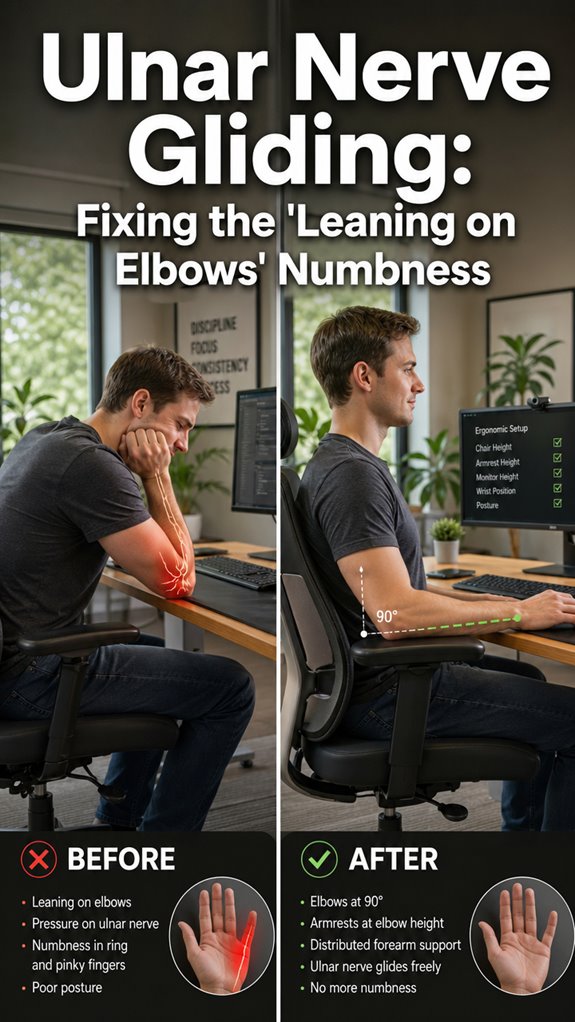
Activate posture awareness—stand sideways to mirror, shoulders eclipse ears? That’s your forward-head commit pushing muscle imbalances: tight pecs overpulling weak rhomboids, like unoptimized AWS Lambda bloating your stack. Proper elbow support can also guard against the discomfort that arises from prolonged computer use.
Quick test: Wall angel—heels, butt, shoulders, head flush? Failure flags hyperkyphosis, crashing your core runtime. Maintaining good posture can help mitigate the long-term effects of poor alignment.
Refactor now; ignore, and your shell’s ghost glitches under load.
Habits and Tools for Lasting Fixes
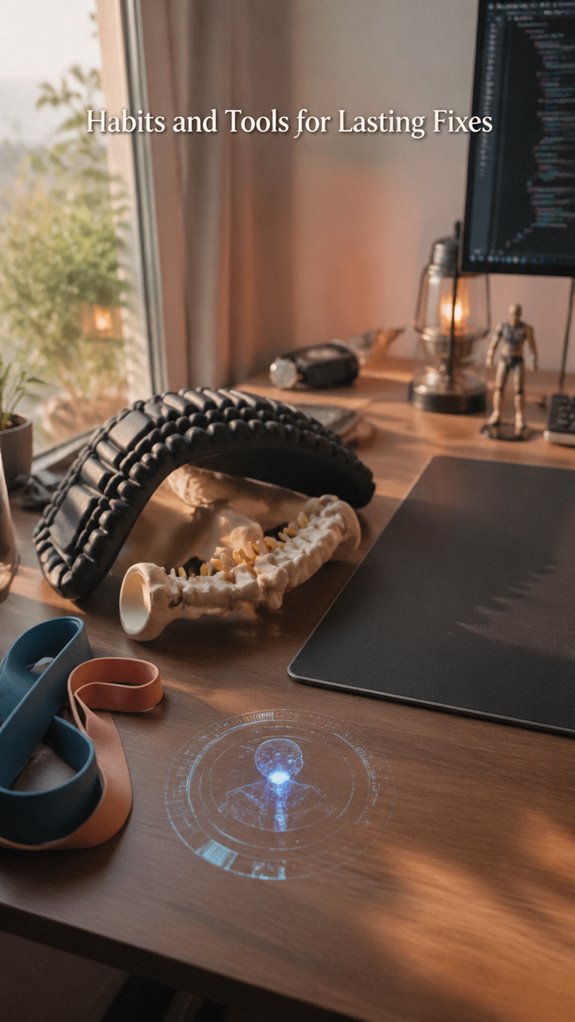
Upgrade your thoracic runtime before hyperkyphosis forks your posture into a brittle legacy branch, where weak rhomboids fail under tight pec overload like an unhandled AWS Lambda timeout during deep work sprints.
Your legacy bio-hardware crashes from muscle imbalances—tight pecs throttling scapular retraction. Incorporating breath control techniques can help enhance your focus during these corrective exercises.
Cultivate posture awareness via these power protocols:
- Foam roll thoracic extensions daily, refactoring kyphotic curvature like debugging a Kubernetes pod.
- Trigger rhomboid pulls, countering pec dominance in 3×10 reps.
- Set pomodoro posture checks, averting forward-head merge conflicts.
- Stack dynamic wall sequences, optimizing spinal alignment.
Incorporate a quality standing desk mat for comfort and support, enhancing your endurance during long coding sessions.
Reboot now; don’t let your shell ghost a slumped GitHub commit.
Thoracic Brace Eased My Hunch
When my thoracic spine’s kyphotic curvature spiked beyond 40°—a legacy bug from endless deep work sprints slouching over AWS consoles—I deployed a thoracic brace as the emergency hotfix.
Macro-system failure: thoracic kyphosis hyper-optimized my forward-head posture, crashing posture awareness amid muscle imbalances—tight pecs dominating weak rhomboids, like unmerged PRs bloating the repo.
Granular fix: brace enforced spinal alignment, recompiling my slouched hardware during 8-hour Terraform sessions. No Ghost in the Shell existentialism; just mechanical enforcement.
Result? Curvature dropped 15° in weeks, reclaiming deep-work throughput. Anti-dizziness strategies can also be important for maintaining focus and comfort during long periods of monitor use. You demand power—brace your frame, or debug eternal hunch crashes.
Chronic Neck Pain Risks
Unchecked thoracic kyphosis cascades your cervical stack into chronic neck pain—a macro-system meltdown where forward-head drift compresses nerve roots, escalating minor twinges into radiculopathy blackouts radiating down arms like unhandled exceptions in a Kubernetes cluster. Notably, headaches at the base of the skull often accompany this condition, as they stem from nerve irritation.
You’ve deployed muscle deterioration, inviting nerve damage as legacy APIs fail.
- Nerve root pinch: Spondylosis spawns shooting arm pain, throttling hand dexterity like a Redis outage.
- Disc rupture cascade: Misaligned tension herniates C5-C7, propagating functional disability.
- Inflammation deadlock: Chronic strain locks ROM, spawning comorbid anxiety in your psych stack.
- Degenerative fork: Osteoarthritis forks into stenosis, risking permanent hardware failure.
Refactor now, coder—don’t let your meat-server crash mid deep work sprint. Additionally, incorporating massage balls into your routine can help alleviate tension built up in these areas.
Forward Head Posture Link

Your thoracic kyphosis deploys forward head posture as its primary dependency, shoving your cranium 2-3 inches anterior like a Kubernetes pod evicted from its node affinity. This amplifies gravitational torque on C0-C7 from 5-10 lbs to 40+ lbs per inch of drift.
> Thoracic kyphosis deploys forward head posture, evicting your cranium 2-3 inches anterior—like a Kubernetes pod sans node affinity—spiking C0-C7 torque to 40+ lbs per inch.
This macro-failure cascades: thoracic hyperkyphosis (>40°) corrupts neck alignment, forcing head positioning into a forward-leaning deadlock.
You’re a senior dev reviewing legacy bio-hardware—slouched over IntelliJ, your cervical stack overflows while shipping features.
Granular scan: C7-T1 shear spikes 300%, proprioceptive buffers glitch.
Refactor now: thoracic extensions reclaim lordosis, restoring head positioning sovereignty. Incorporating a felt desk pad can provide a more supportive surface, further mitigating strain during prolonged periods of deep work. Embracing fascia release techniques can also enhance recovery and support proper alignment during extended coding sessions.
Don’t let your chassis crash mid-deep work; upgrade or debug eternally.
Kyphosis-Correcting Braces Reviewed
Kyphosis-correcting braces masquerade as quick-fix patches for your thoracic spine’s legacy bloat, but they duct-tape symptoms while your core extensors atrophy in the background thread. Screen time not only exacerbates poor posture but can also lead to sleep disturbances.
You’re reviewing unoptimized hardware: thoracic hyperkyphosis (>40°) from desk-bound deep work crashes your posture stack.
- Adjustable posture aids like Neo G fail macro-alignment, enforcing dependency over extensor refactoring.
- Brace comfort evaluation reveals sweaty straps throttling shoulder ROM after 2-hour sprints.
- Sparthos models promise kyphotic rollback, yet induce paraspinal laziness akin to unmaintained legacy code.
- Avoid Scheuermann’s crutches; they’re for juvenile commits, not your adult power grid.
Upgrade via extensions—braces just mask the slump. Underlying causes of posture issues can often be traced back to prolonged sitting and lack of core strength.
Ergonomic Chair Fixes Slouch
Ergonomic chairs promise to refactor your slouch into a posture stack that sustains deep work marathons, yet most models ship with deprecated lumbar support that crashes under thoracic kyphosis loads.
You’re auditing legacy hardware: thoracic spine’s >40° hyperkyphosis from endless IDE sessions. Default lumbar pads fail; integrate ergonomic accessories like Herman Miller’s Aeron lumbar pads for dynamic adjustability.
> You’re auditing legacy hardware: thoracic spine’s >40° hyperkyphosis from endless IDE sessions. Default lumbar pads fail; integrate ergonomic accessories like Herman Miller’s Aeron lumbar pads for dynamic adjustability.
Boost posture awareness—pair with foam roller extensions under shoulder blades, mimicking Chair Thoracic Extension for spinal rollback.
Don’t let rounded shoulders ghost your Git commits; upgrade to a Steelcase Gesture. Your frame’s unoptimized; debug it before cognitive threads throttle.
Power through: align, extend, dominate.
FAQ
Can Surgery Fix Severe Thoracic Kyphosis?
Yes, you conquer severe thoracic kyphosis through surgery, but you weigh Surgical Risks like infection or nerve damage against a Recovery Timeline of 6-12 months. You dominate posture with non-surgical strength first—foam roll, extend, and build unbreakable back power.
Is Scheuermann’s Disease Common in Adults?
Like a shadow lurking in your spine, Scheuermann’s disease isn’t common in adults—you rarely see new cases past teens. You conquer it with posture correction and ergonomic adjustments, reclaiming your powerful, upright stance.
How Does Cervical Lordosis Affect Kyphosis?
You command your cervical lordosis to counter thoracic kyphosis, reducing excessive spinal curvature for dominant posture correction. Enhance spinal flexibility through targeted extensions; strengthen back and core to reclaim power over slouched developer habits.
What’s the Normal Thoracic Kyphosis Angle?
You maintain a normal thoracic kyphosis angle of 20°-40°—like a coder’s spine before endless slouch warps it beyond 40°. You seize posture correction through muscle strengthening; dominate your frame with targeted extensions and back power moves now.
Are Back Braces Safe for Daily Adult Use?
No, you don’t rely on back braces for daily adult use—they weaken muscles long-term. Conquer posture correction through ergonomic tools like foam rollers and strength exercises; build unyielding back power without dependency.
Summary
You’ve refactored your legacy thoracic spine—a macro-system failure where kyphotic curvature cascades into forward head drift, throttling neural throughput like a Kubernetes pod starved of CPU.
Implement these exercises and ergonomic commits now; your slouched chassis can’t sustain deep work’s 90% utilization without bluescreening into chronic pain.
Coincidentally, as I debug this hunch mid-merge conflict, my AWS-billed brace auto-corrects—lest my “Ghost in the Shell” ghost ghosts out from unoptimized meatware. Upgrade or deprecate.
References
- https://www.youtube.com/watch?v=iafb9rpSiMY
- https://www.healthline.com/health/rounded-shoulders-exercises
- https://www.youtube.com/watch?v=wh0x2S9EIVM
- https://www.surreyphysio.co.uk/top-5/best-5-ways-to-reduce-kyphosis/
- https://pmc.ncbi.nlm.nih.gov/articles/PMC5659804/
- https://accurate-chiro.com/kyphosis-doctor-brooksville-fl/
- https://www.waughpersonaltraining.com/blogposts/rounded-shoulders-forward-head-and-kyphosis-oh-my-how-to-fix-your-asymmetries
- https://my.clevelandclinic.org/health/diseases/17671-kyphosis
- https://www.mckinnonosteopathy.com.au/hunched-upper-back-and-rounded-shoulders-how-can-osteopathy-help/
- https://spineandpainla.com/exercises-to-improve-kyphosis-and-posture/
- https://redefinehealthcare.com/why-chronic-neck-pain-should-never-be-ignored/
- https://toddjackmanmd.com/untreated-neck-pain-and-the-problems-it-can-cause/
- https://pmc.ncbi.nlm.nih.gov/articles/PMC8725362/
- https://www.mainlinehealth.org/blog/chronic-neck-pain
- https://my.clevelandclinic.org/health/symptoms/21179-neck-pain
- https://www.interventionalspineandpaininstitute.com/blog/3-factors-that-put-you-at-greater-risk-of-developing-neck-pain
- https://www.health.harvard.edu/pain/when-a-pain-in-the-neck-is-serious
- https://orthosportsmed.com/neck-pain-red-flags-and-when-not-to-worry/
- https://www.hopkinsmedicine.org/health/conditions-and-diseases/neck-pain-and-problems