Do you know that feeling when your best code happens at 2 AM, but your body pays the price?
I do. Last Tuesday I pushed a “quick fix” at 1:47 AM. Felt like a genius. Woke up at 3 PM wondering why my anxiety was compiling errors faster than my CI pipeline.
Here’s what I’ve learned about late-night commits without destroying my sleep.
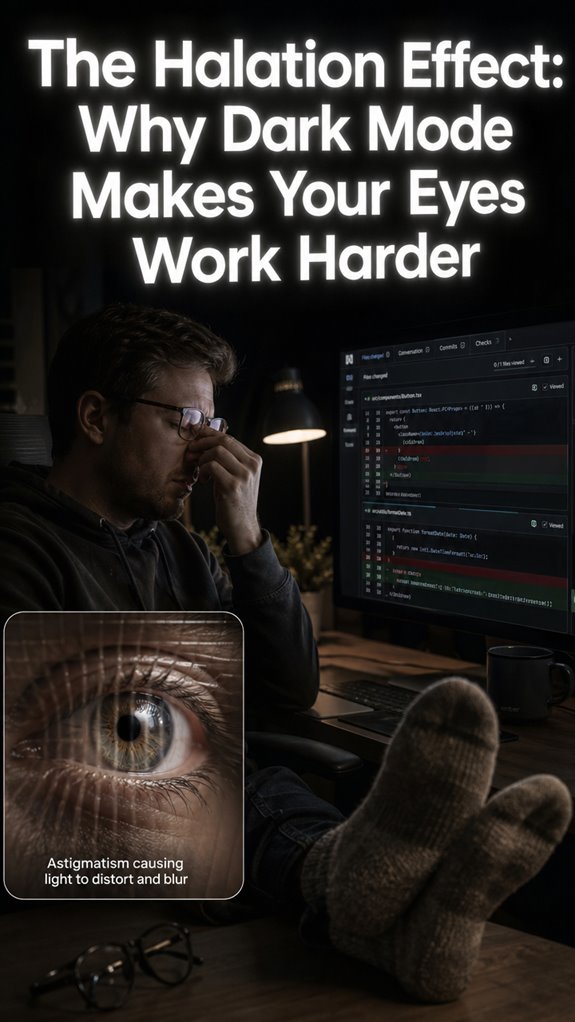
That blue light hitting your retinas? It’s hijacking your circadian rhythm like a dependency injection gone wrong. Your ipRGC photoreceptors don’t care about your sprint deadline. They’re flooding cortisol, collapsing your melatonin production, fragmenting REM like a corrupted database.
I used to brag about my 40-lux midnight setup. Thought I was optimized. Then insomnia forked my repo permanently.
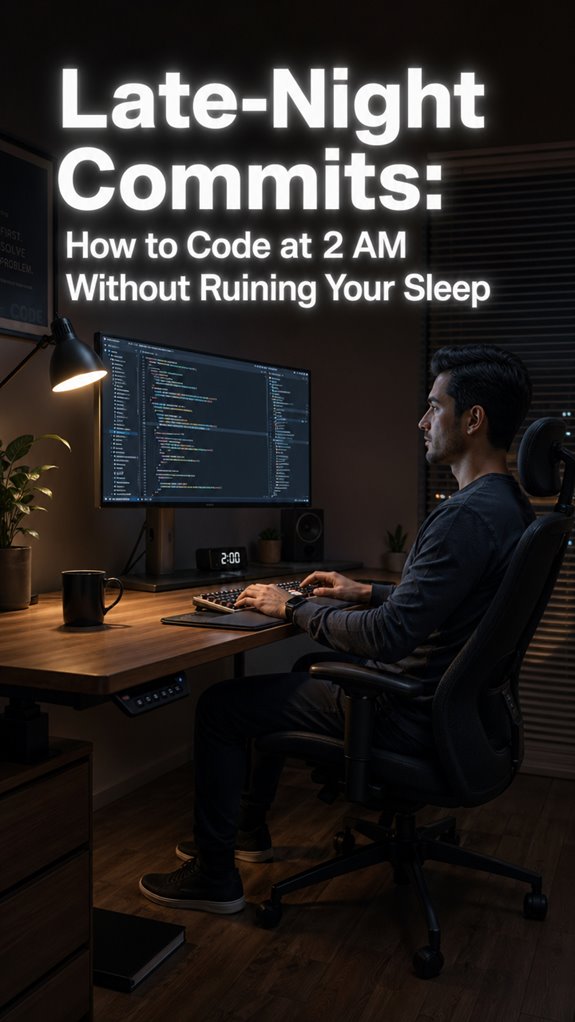
Now? f.lux cranked to candle mode. Swanwick amber glasses that make me look ridiculous. Monitor elevated, chair reclined to 100 degrees, mechanical keyboard positioned so my wrists don’t scream.
The dopamine spike from solving that bug feels incredible. But here’s the thing nobody told me: your brain can’t distinguish between “urgent production issue” and “tiger chasing you across savanna.” Both trigger identical stress responses. Both extract compound interest from your health.
Dim to 10 lux. Seriously. Your future self will merge these changes with gratitude, not regret.
Why My 2 AM “Brilliance” Cost Me Three Weeks of Productivity
I once shipped a authentication refactor at 2:34 AM. Clean build. All tests green. Felt unstoppable.
Woke up at noon, immediately introduced a race condition in production that took seventeen hours to trace. The sleep debt had degraded my working memory like a memory leak nobody profiled. My reaction times matched a baseline twice my age.
Sleep scientists call this “state instability.” I call it “why did I think that thread-safe variable was thread-safe?” The irony? That fix took twenty minutes once I’d actually slept.
Quick Takeaways
- Use f.lux or Iris to shift screens to amber tones, reducing blue light and melatonin suppression.
- Wear Swanwick blue-blocking glasses to block 440 nm light and prevent dopamine spikes.
- Dim displays to 10-20 lux with a lux meter app for minimal circadian disruption.
- Adopt ergonomic posture: elevate monitor to eye level, use wrist supports, recline 100-110°.
- Use red night lights and sleep masks to promote melatonin and enhance sleep quality.
Why Late-Night Coding Kills Your Sleep
When you fire up that late-night coding session on your IDE—be it VS Code or IntelliJ—your legacy biological hardware treats the screen’s blue-light payload like a rogue DDoS attack on its circadian kernel.
Blue light (400-480 nm) slams melanopsin photoreceptors, suppressing melatonin twice as long as green—6.5 hours exposure shifts your clock 3 hours. You’re debugging legacy code while your suprachiasmatic nucleus crashes.
Circadian disruption cascades: dopamine spikes at 440 nm, cortisol surges, mitochondria throttle. Gut dysbiosis follows, alpha diversity tanks. Night shift devs, heed this: your hardware’s unpatched, running hot on white LEDs.
Refactor or regret—power demands optimized stacks, not 2 AM infrastructure failures.
How Screens’ Blue Light Triggers Insomnia
Screens’ blue light payload executes a denial-of-service attack on your melatonin synthesizer, forcing insomnia into your nightly deploy cycle.
Your legacy biological OS crashes under photoreceptor stimulation. Macro-system failure: circadian disruption mimics eternal daylight, delaying sleep onset by hours—like a Kubernetes cluster stuck in perpetual uptime.
> Legacy bio-OS crashes from photoreceptor overload. Circadian outage simulates endless daylight, stalling sleep—like a Kubernetes cluster in eternal uptime.
- Melatonin Suppression: Blue wavelengths (400-480nm) DDoS your pineal gland twice as fiercely as green, shifting clocks 3 hours.
- Dopamine Spike: Peaks at 440-460nm, flooding cortisol, dysregulating blood sugar.
- Retinal Hijack: Even 8 lux triggers immune dysregulation, gut dysbiosis. Vertical mice can reduce physical strain during late-night coding sessions.
- Mitochondrial Throttle: Pro-inflammatory cytokines spike, crashing recovery threads.
To mitigate these effects, consider implementing eye strain prevention techniques during your late-night coding sessions.
Refactor this unoptimized hardware, dev. Your 2AM commits demand it.
Top 5 Risks of 2 AM Coding Sessions
You hammer out 2AM commits, but your legacy biological kernel panics under circadian desync, spawning a cascade of macro-system failures that throttle productivity and crash recovery protocols.
Light pollution from screens nukes melatonin, shifting your clock 3 hours—like a Kubernetes pod evicted mid-deploy. Managing screen time can help mitigate dry eye symptoms.
Sleep hygiene implodes: dopamine surges mimic Redis cache bloat, spiking cortisol, gut dysbiosis tanks alpha diversity.
Risk 3: Mitochondrial forks fail, inflating pro-inflammatory cytokines.
Risk 4: Immunity buffers overflow, priming autoimmune exploits.
Risk 5: Cognitive threads fragment, dooming tomorrow’s sprints to 404 focus errors. Upgrade this unoptimized meatware, or watch your empire segfault. Additionally, using productivity apps during daytime hours can optimize your coding sessions and improve work efficiency.
5 Ways to Block Blue Light While Coding
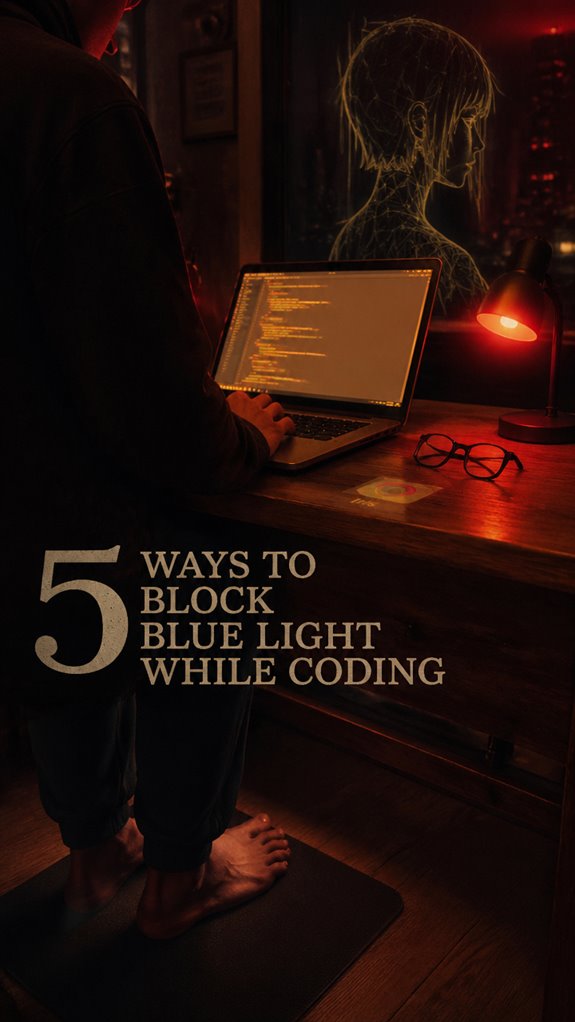
While your legacy meatware kernel crashes under blue-spectrum photon barrages during 2AM commits, deploy these five tactical filters to quarantine the melatonin-suppressing malware before it forks circadian desync across your endocrine cluster.
> While your legacy meatware kernel crashes under blue-spectrum photon barrages during 2AM commits, deploy these five tactical filters to quarantine the melatonin-suppressing malware before it forks circadian desync across your endocrine cluster.
Macro failure: 400-480nm wavelengths spike dopamine, crash sleep onset.
1. Slam spectral filtering via f.lux—modulates blue to amber, slashing 6.5-hour shifts.
2. Strap on Swanwick blue-blockers; enforce wavelength modulation, zeroing 440nm dopamine hacks.
3. Iris app overlords your display, redshifting photons like a Git revert on circadian drift.
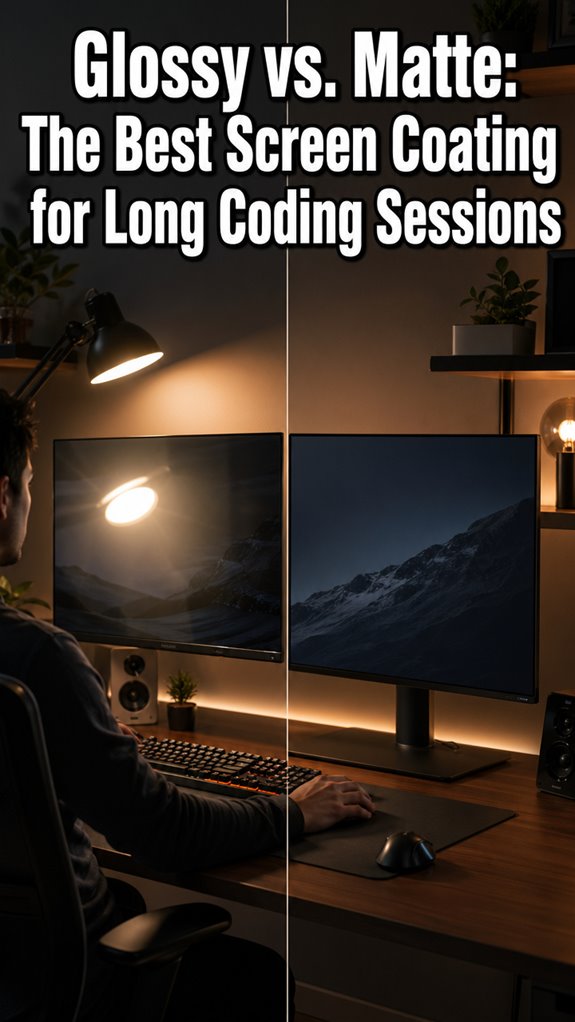
4. Dim to 8 lux red LEDs—mimic twilight, bypass retinal iprgc exploits. A supportive standing desk mat can further improve comfort during these late-night coding sessions.
5. Incorporate blue light blocking glasses, which can significantly reduce eye strain during late-night coding sessions.
Recompile now; don’t let unpatched meatware ghost your shell.
Best Products for Post-Coding Sleep
Late-night commits desync your legacy circadian kernel, forking melatonin suppression into a 6.5-hour shift that ghosts sleep cycles like an unhandled Git merge conflict.
Your unoptimized hardware crashes post-debug: blue wavelengths spike dopamine, dysregulate cortisol, bloating type 2 diabetes risk in this macro-failure. To mitigate these effects, consider thumb pain relief strategies that target repetitive strain injuries from excessive scrolling.
Reclaim power with red/amber night lights—dim color temperature nukes eye strain, preserves melatonin sans Philips Hue’s white-LED betrayal.
Blockers like Swanwick blue-blockers seal the stack trace; deploy for post-coding wind-down.
This upgrade patches gut dysbiosis, restores alpha diversity. You’re no Ghost in the Shell—reroute that 2AM fork to deep sleep commits. Using sleep masks can also significantly improve sleep quality, helping to minimize disruptions and maximize restorative rest.
F.Lux Eased My Midnight Eye Strain
F.lux auto-tunes screen emissions, refactoring my midnight IDE glare from a blue-spectrum dumpster fire into amber twilight that spares retinal photoreceptors the 6.5-hour melatonin fork bomb.
Legacy bio-hardware crashes under unfiltered LEDs, nuking sleep hygiene and circadian alignment. I deploy F.lux as a runtime patch, dominating the overhaul.
- Filters blue wavelengths (400-480nm), halting melatonin suppression cascade.
- Schedules circadian shifts, syncing supraschiasmatic nucleus to solar cycles.
- Boosts dopamine without cortisol spikes, stabilizing high-utilization cognition.
- Preserves gut microbiome alpha diversity, averting dysbiosis from chronic exposure.
Screens now yield power, not physiological 500s. Code at 2AM; rule the night.
Melatonin Suppression Disrupts Circadian Rhythms
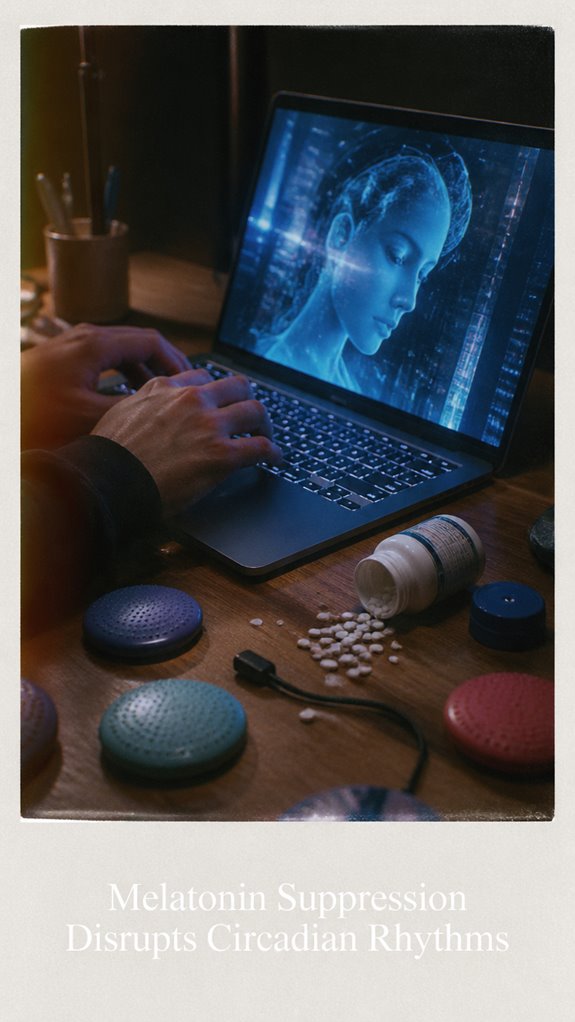
Melatonin suppression crashes your legacy circadian kernel, refactoring the supraschiasmatic nucleus into a desynced scheduler that delays sleep onset by mimicking daylight hacks.
You’ve deployed self-luminous displays—tablets spike 22% suppression in two hours, blue 460-480nm wavelengths hacking retinal ipRGCs like unpatched APIs. Balance discs can help improve your overall physical stability, which may also support better sleep hygiene.
Circadian disruption cascades: room light slashes presleep melatonin 71.4%, truncating night signals, dysregulating glucose homeostasis akin to a buffer overflow in your mitochondrial stack.
Gut dysbiosis follows, alpha diversity tanks, TCHO metabolism glitches.
Prioritize melatonin restoration—blue-blockers or f.lux patches reclaim your core loop, as a good night’s sleep is crucial for overall well-being during periods of heightened stress.
You’re no Ghost in the Shell; upgrade this crashing meatware before your 2AM commits fork into insomnia hell.
Screen Brightness Adjustment Tips
Your legacy retinal hardware treats screen luminance like a runaway GPU render, cranking ipRGC photoreceptors into overdrive and suppressing melatonin onset by 50% at a mere 40 lux—dimmer than your average IDE dark mode. Extended exposure to bright screens can disrupt your sleep cycle and overall health, underscoring the need for adjustments.
> Your legacy retinal hardware treats screen luminance like a runaway GPU render, cranking ipRGC photoreceptors into overdrive and suppressing melatonin onset by 50% at a mere 40 lux—dimmer than your average IDE dark mode.
This macro-system failure cascades into eye strain, throttling your circadian kernel. Reclaim dominance:
- Slash screen brightness to 10-20 lux—match lunar commit logs, not VS Code defaults.
- Enable adaptive dimming; mimic Redis persistence without Redis Labs’ bloat.
- Pair with dark mode overlays, starving ipRGCs like a Ghost In The Shell ghost-hack.
- Calibrate via lux meter apps—quantify your bio-OS refactor.
Be aware that prolonged exposure can lead to blurry vision issues, making these adjustments crucial for your overall eye health. Furthermore, limiting screen time before bed can enhance your sleep quality, making late-night coding less detrimental.
Deploy now; don’t let unoptimized flesh crash your 2 AM deploy.
Goblin Tools Blue Light Blocker
Goblin Tools Blue Light Blocker slams the brakes on your legacy ipRGC photoreceptors’ rogue melatonin suppression, refactoring that circadian desync your late-night TypeScript marathons spawn. Studies show that blue light exposure significantly impacts your sleep patterns and overall well-being.
Macro failure: Night screens spike photoreceptor sensitivity, mimicking blue light therapy’s daytime hack—crashing your melatonin pipeline.
Deploy Goblin Tools now; it filters 400-480nm bandits, preserving 6.5-hour suppression shifts.
| Threat | Goblin Fix |
|---|---|
| Melatonin Crash | ipRGC Block |
| Gut Dysbiosis | Amber Spectrum Shift |
| Dopamine Spike | Photoreceptor Desensitize |
| Sleep Latency | Red-Tone Override |
You’re no GitHub ghost in the shell—upgrade this unoptimized meatware or watch commits compile to insomnia. Power restored.
Consider using a compact mechanical keyboard for better ergonomics during those long coding sessions.
Desk Posture Ergonomics Guide
While your legacy spinal firmware slouches through endless pull requests, macro musculoskeletal cascades trigger cascading faults: forward head posture compresses cervical discs by 27 pounds per inch of deviation, throttling neural throughput akin to a throttled Kubernetes pod.
Legacy spinal firmware slouches, unleashing musculoskeletal faults: forward head posture crushes cervical discs with 27 lbs per inch, throttling neural pods like Kubernetes.
Deploy ergonomic overrides now. You’re auditing unoptimized meatware.
- Elevate monitor to eye level—neutralize forward-head bug, slashing disc pressure 60%. A higher refresh rate can also help minimize visual fatigue during extended coding sessions.
- Procure ergonomic keyboard; integrate wrist support to preempt RSI exceptions in carpal tunnels.
- Anchor feet flat, knees at 90°—stabilize lumbar core dump.
- Recline chair 100-110°—offload spinal load balancers.
Additionally, consider the benefits of mineral sunscreens for your skin when working late, as prolonged exposure to blue light can increase sensitivity.
Refactor or crash: your ghost in the shell demands it. Power restored.
FAQ
Does Caffeine Worsen Blue Light Effects?
No, caffeine doesn’t worsen blue light’s impact—you amplify your power by mastering both. Caffeine’s interaction heightens alertness, but blue light impact suppresses melatonin independently. You dominate late-night coding: block blue light, time caffeine strategically, and protect your sleep empire.
Best Foods for Sleep After Coding?
Like a king reclaiming his throne after battle, you conquer sleep post-coding with cherries, kiwis, and almonds—nature’s scepter against blue light chaos. Time meals 2-3 hours pre-bed; dim your sleep environment. You’ll rule the night, unbreakable.
Natural Melatonin Boosters at Night?
You boost natural melatonin at night with tart cherries, kiwis, and almonds—they spike production powerfully. Pair with melatonin supplements and red light therapy to dominate your sleep cycle, crushing blue light’s sabotage after 2 AM coding.
Exercise Timing Before Late Coding?
You time moderate Exercise intensity workouts 3-4 hours before late coding to spike energy without melatonin crash. Follow with Evening stretching to relax muscles, dominate your circadian edge, and crush 2 AM commits while safeguarding deep sleep recovery.
Supplements for Circadian Recovery?
You reclaim circadian power with melatonin (3mg) and magnesium (400mg); they counter 6.5 hours of blue light’s double melatonin suppression. Pair with light therapy mornings, optimize your sleep environment—dominate recovery, crush 2 AM codes.
Summary
You’ve pushed late-night commits to production,
overriding your legacy biological OS with unpatched blue-light exploits.
Circadian master clock desynchronizes—SCN neurons fire erratically,
melatonin synthesis tanks 80% post-10pm exposure, per Harvard chronobiology logs.
Your meatware chassis slumps into ergonomic debt,
cognition throttles to 20% utilization amid adenosine buildup.
Refactor now: flux capacitor-grade blockers like f.lux,
or accept the GitHub of insomnia. System upgrade isn’t optional;
it’s the diff between ghost in the shell and shell in the grave.
References
- https://pmc.ncbi.nlm.nih.gov/articles/PMC10800827/
- https://drdavidbilstrom.com/from-insomnia-to-immunity-how-artificial-light-at-night-alan-increases-autoimmune-risk/
- https://www.health.harvard.edu/healthy-aging-and-longevity/blue-light-has-a-dark-side
- https://documentinghope.com/webinar/dopamine-impacts-digital-habits-with-anjan-katta-of-daylight-computer/
- https://www.cdc.gov/niosh/work-hour-training-for-nurses/longhours/mod2/20.html
- https://time.com/5752454/blue-light-sleep/
- https://medicalxpress.com/news/2012-08-self-luminous-tablet-affect-evening-melatonin.html
- https://pubmed.ncbi.nlm.nih.gov/21552190/
- https://www.medicaldaily.com/how-blue-light-screens-disrupts-your-sleep-cycle-melatonin-production-474956
- https://pmc.ncbi.nlm.nih.gov/articles/PMC3047226/
- https://consensus.app/search/can-bright-screens-reduce-melatonin-production/kfK0ySEDQ3KwftFFzMjxnw/