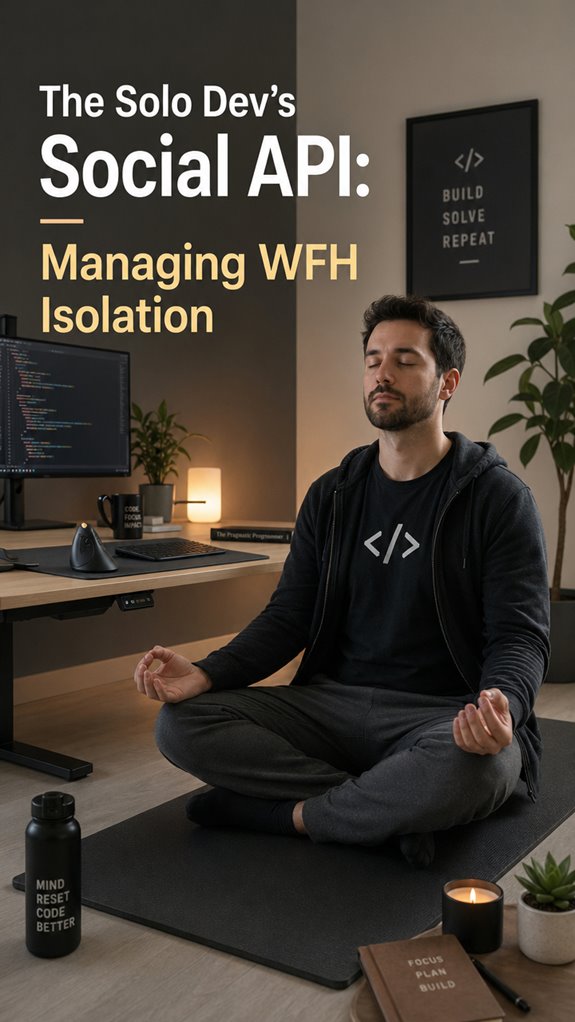
Ever feel like your social skills are compiling errors? They were. Mine too.
Remote work rotted my brain slowly. Days blurred. My GitHub went green while my soul went gray. I stopped hearing my own voice. Weird.
Found fixes that actually work. Not meditation apps. Real stuff.
Body doubling saved me. Strangers on screen, silently working. Felt less pathetic than it sounds. Ambient café noise replaced dead air. Commit messages became my small talk. Sad? Maybe. Functional? Absolutely.
I schedule Slack checks like cron jobs. Otherwise I vanish. Three days pass. No one notices. That stings.
The trick is treating connection like infrastructure. Not optional. Not “when I feel like it.” Patch it or crash.
Your brain is production. Don’t let it 500 error.
WFH Isolation and Developer Burnout: When My Camera Stayed Off for Three Months
I stopped turning on video calls in 2021. Nobody asked why. That was the problem.
My team thought I was “focused.” I was frozen. Week three, I realized I hadn’t spoken aloud to another human since Monday. My cat got more conversation than me. Boundary testing my own sanity, essentially.
GitHub Copilot became my confidant. Extremely concerning in retrospect.
The crash came quietly. Opened Zoom. Panic attack. Couldn’t click “join.” Productivity theater masked complete disconnection. I was performing busyness while my social API returned 404s.
Recovery meant namedropping places where humans exist. Coffee shop coding. Meetups I dreaded attending. One IRL conversation weekly, minimum viable socially.
Turns out offline compilation catches errors remote debugging misses.
Quick Takeaways
- Leverage digital platforms like Slack or Discord as social patches to maintain peer connections and reduce feelings of isolation.
- Incorporate regular virtual check-ins and pairing to encourage ongoing social engagement and accountability.
- Use physical and ergonomic tools (e.g., stability balls, stretchers) to boost bodily awareness, supporting emotional resilience.
- Implement ambient sound generators and noise-cancelling headphones to improve focus and simulate shared work environments.
- Practice mindfulness and cognitive reframing techniques to manage mental health, prevent burnout, and maintain productivity.
How Can Remote Solo Developers Recognize Signs of Isolation?
If your brain’s productivity pipeline resembles a legacy system plagued by memory leaks and intermittent crashes, you might already be experiencing social isolation detection fatigue. Recognize the signs as if debugging a stubborn bug: emotional awareness has become an elusive wire, while social cues—like skipped commits or aborted builds—disappear. Research indicates that many individuals experience mood swings before their periods, often exacerbating feelings of isolation.
You might feel a slow CPU throttle, where emotional processing filters out social signals, turning nuance into dead code. Like the “Ghost in the Shell,” your interface struggles to parse Human-to-Human interactions, exposing a systemic failure in emotional modules. Additionally, prolonged inactivity, such as sitting in one position for extended periods, can lead to (a phenomenon known as) numb feet, which may exacerbate feelings of isolation.
Power down, update your social API—versioning empathy and cue recognition might just prevent a total system meltdown.
What Is the Impact of Loneliness on Developer Well-Being?
Loneliness in developer well-being functions much like a critical bug lurking in a production environment—silent, insidious, capable of cascading failures that derail system integrity.
Loneliness quietly corrupts developer health, risking system crashes beneath the surface—early detection is key to maintaining integrity.
It directly impacts stress levels, triggering a mental memory leak that exhausts cognitive resources and degrades judgment. This can be countered by introducing snacks for focus that provide essential nutrients and energy, helping to maintain mental clarity. Motivation declines like deprecated code, causing you to question the purpose of yet another commit or bug fix.
As “Ghost in The Shell” warned, when the core infrastructure falters, all layers collapse; likewise, emotional and physiological tolls manifest—elevated cortisol, disrupted neural pathways—turning your productivity pipeline into a ghost town. The use of posture correctors can help mitigate some physical issues that may arise from prolonged isolation and poor ergonomics.
Debugging your human system becomes an urgent upgrade, not an option.
Which Online Tools Help Reduce Remote Developer Loneliness?
When your remote dev environment starts to resemble a ghost town, filling that void with reliable tools becomes less a matter of preference and more an emergency patch. Gamification strategies transform dull code reviews into competitive battlegrounds, fueling motivation with badges and leaderboards—think “Ghost in the Shell” hacking ju ju, but for solo operators. Top infuser bottles can also help revive energy levels, a refreshing reminder to stay hydrated while coding.
Peer coding groups, whether via Slack channels or Discord servers, serve as lifelines—replacing face-to-face camaraderie with digital camaraderie that counters professional isolation. These platforms hardwire social ties into your workflow, ensuring your mental servers stay online despite the inevitable system crashes of human connection. Incorporating tools like stability balls can also improve your focus and physical well-being while working remotely.
How Can You Build Daily Routines to Stay Connected and Motivated?
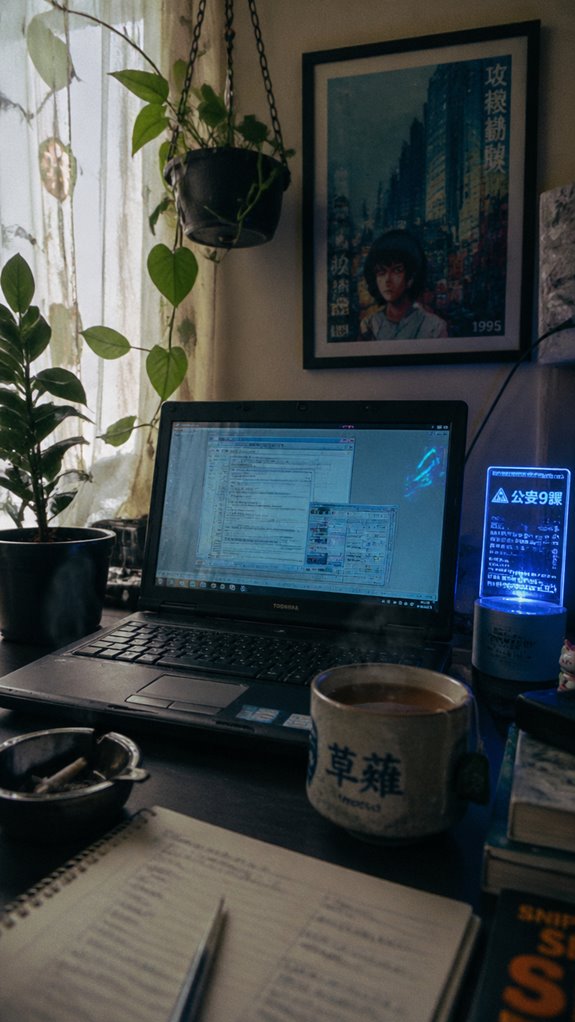
Long before the mental health crisis prompts a new feature flag for “daily connection routines,” our remote workflows already teeter on the edge of transient death by neglect, akin to a ghost in the shell splintered by flickering code.
Before mental health concerns, our remote systems risk silent collapse without daily connection routines.
To restore system integrity, you must establish daily check-ins—recursive logic loops that reset motivation and debug the loneliness bug. Embed motivational rituals—tiny patches to prime focus, like a well-placed alert.
These routines serve as critical dependencies, ensuring your mental cache doesn’t crash under the load of isolation, maintaining operational clarity amidst the chaos of constant disconnect.
Power down, reboot, and rerun your connection engine daily.
What Are Effective Ways to Join Developer Communities and Find Support?
In the debugging session of remote work, the superficial fix—joining any developer community—often feels like inputting a random patch into an unstable build: a misguided attempt to patch loneliness without addressing core dependencies.
Networking opportunities can act as patch modules for systemic isolation, yet many users deploy them blindly, unaware of the prerequisite peer mentorship needed for true system resilience. Additionally, engaging in cycle tracking apps can help facilitate conversations around work-life balance that promote connections with others.
Counterintuitive as it sounds, connecting within focused forums or Slack channels like Reactiflux or Gitter’s GNOME repositories offers tangible support, akin to a well-placed console log.
If only Ghost in the Shell had emphasized the importance of instrumentation—without it, your mind remains a memory leak. Integrating strategies to cultivate a healthy work-life balance can significantly enhance your engagement in these communities.
Tips for Maintaining Mental Health During Long-Term WFH
Amid the relentless cycles of code commits and deployment rollouts, it’s easy to forget that mental health is the critical bug in our remote work ecosystem—one that causes system crashes far more insidiously than memory leaks or segmentation faults.
To prevent runaway errors, incorporate mindfulness exercises like deliberate breathing loops or structured breaks, which serve as sanity checks amid chaos. Foster peer accountability through regular status pings or pair programming sprints to maintain engagement.
| Technique | Implementation | Impact |
|---|---|---|
| Mindfulness exercises | 5-minute focus breaks | Stabilizes cognitive load |
| Peer accountability | Daily stand-ups | Enhances system reliability |
| Social interaction | Virtual coffee chats | Decreases latency in emotional signals |
Neglect these for too long, and Ghost in the Shell becomes less sci-fi metaphor than inevitable systemic failure.
Quiet Ambient Soundscape Apps
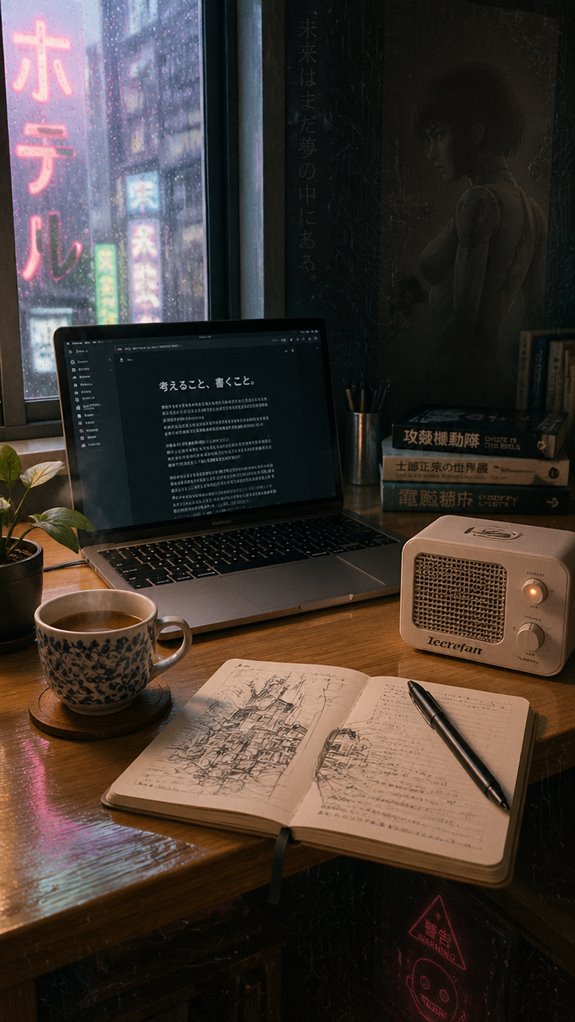
When tackling the silent collapse of mental resilience—akin to a memory leak in your mental stack—the primary culprit often goes unnoticed: sensory overload from auditory clutter.
Silent ambient sounds and focus soundscapes act as system patches, reducing noise-induced data corruption. Top white noise machines can help in creating these soothing environments.
As a senior dev, I’ve learned to deploy these apps—like Noisli or my personal favorite, my custom soundscape engine—to mitigate auditory latency.
They’re akin to software filters, suppressing unnecessary processes while preserving core functions.
Without them, the mind degrades into a chaotic sandbox, reminiscent of “Ghost in the Shell,” where digital serenity becomes a premium resource.
Upgrading auditory hygiene isn’t optional; it’s essential. By integrating top productivity apps into your workflow, you can further enhance focus and reduce distractions.
Limited Social Interaction Cues
Reduced social interaction cues in remote work environments function as systemic bugs that undermine the entire human-centric feedback loop, akin to flawed API calls in your codebase.
- Non-verbal cues, like facial microexpressions or gestures, are absent—rendering social ambiguity as if you’re debugging an unresponsive server. Top Back Stretchers can alleviate physical discomfort that may further cloud social perceptions.
- Remote setups distort perceived distance, exacerbating the difficulty of interpreting colleague behavior, much like misinterpreted log outputs leading to false positives.
- Asynchronous messaging becomes a black box, stripping context from emails or instant messages, reminiscent of silent failures in distributed systems.
- The heightened sensitivity of Social Anxiety Individuals (SAIs) to cues echoes a fragile server, vulnerable to crashes under minimal load—”Ghost In The Shell,” anyone?
- Incorporating fascia release techniques can improve physical awareness, potentially enhancing interpreted social signals and reducing the risk of feeling isolated while working from home.
Virtual Co-Working Platforms
Virtual co-working platforms aim to act as system patches for the chronic systemic bugs endemic to remote work, yet often resemble the software equivalent of patching a kernel bug with duct tape—functional in theory but fraught with latent vulnerabilities.
As a dev battling silent memory leaks and cadence crashes, you realize virtual coworking simply injects digital camaraderie amidst the chaos, reminiscent of “Ghost in The Shell” trying to maintain coherence.
These platforms, like Slack or Discord, serve as fragile scaffolding, engineering social interactivity under the guise of boosting engagement, while the core infrastructure—the human mind—remains vulnerable to latency, disconnection, and burnout. Furthermore, top pregnancy support pillows have emerged as essential tools for comfort during both physical and emotional strains experienced in remote work. Additionally, stretch blazers can provide a wearable solution, combining style with comfort as developers adapt to a more casual yet professional appearance while working from home.
Silent Focus Noise Generators
In the grand architecture of remote work, silent focus noise generators serve as the last line of defense against the system-level failures that trap developers in cognitive deadlocks. These ambient sounds propagate the illusion of a functional environment, silencing the chaos of mental fragmentation.
- Generate silent background layers mimicking office hums or nature, filtering distraction like implicit error handling.
- Use precise frequency modulation to drown out intrusive thoughts and the echo of MarketWatch alerts, enhancing focus noise environments that boost productivity.
- Integrate adjustable parameters for personalized, code-optimized environments—think virtual “ghosts” in the shell, unobtrusive yet present.
- Employ them as debugging tools for mental latency, keeping your CPU—err, brain—focused and stable. Furthermore, the right noise-cancelling headphones can enhance these sound immersion experiences, allowing individuals to enter a productive flow state with minimal disturbances.
Focus on Cognitive Enhancement Techniques
When the entire cognitive stack crashes under relentless workload pressure—akin to a memory leak that never terminates—the solution isn’t brute-force focus but a neural system upgrade.
Implementing mindfulness meditation acts as a debug cycle, clearing cache and offline malfunctions. Cognitive reframing rewires dysfunctional logic paths, preventing constant stack overflow. Best yoga mats can also provide physical comfort, allowing you to focus more efficiently on your mental state during practices.
Mindfulness meditation resets mental cache, debugging offline glitches and restoring optimal cognitive flow before system overload occurs.
Like patching a corrupted kernel, these techniques optimize mental throughput, reducing latency from stress-induced garbage collection.
It’s similar to software refactoring: identify the bottlenecks, reroute processes, and stabilize your core subsystem before your brain’s version control collapses—because, unlike code, the human CPU refuses rollback.
Incorporating ergonomic tools, like top vertical mice, can also alleviate physical strain that contributes to cognitive overload.
FAQ
How Does Loneliness Specifically Affect Coding Productivity and Creativity?
Loneliness hampers your coding productivity and creativity by reducing motivation and focus, weakening emotional resilience. Embracing virtual collaboration recharges your mindset, empowering you to innovate and sustain high performance amid WFH challenges.
What Are Overlooked Signs of Social Withdrawal Among Solo Developers?
You often withdraw from peer support, neglecting mental health cues like increased stress or fatigue. Recognizing these silent signs empowers you to take control, strengthen connections, and combat social withdrawal, ensuring sustained productivity and resilience in solo development.
Can Regular Virtual Meetups Genuinely Combat Feelings of Isolation?
Regular virtual meetups foster remote camaraderie, effectively combating isolation by building connection and motivation. A virtual coffee session energizes team spirit, making you feel less alone and more engaged, ultimately enhancing productivity and well-being in your solo development journey.
How to Prevent Burnout While Working Alone for Extended Periods?
You prevent burnout by actively fostering team collaboration and seeking peer feedback, which boosts motivation, invigorates your work, and maintains mental resilience. Empower yourself with constant connection to stay energized, focused, and resilient during extended solo work.
Are There Psychological Benefits to Gamifying Social Interactions for Developers?
You gain psychological benefits through gamifying social interactions, fueling social validation and competitive incentives that boost motivation, confidence, and engagement; even skeptics find that embracing game mechanics empowers you to conquer WFH isolation.
Summary
In essence, neglecting social APIs for solo devs risks systemic failure akin to an overtaxed server—internal metrics degrade unnoticed until a critical crash. Like free-running code that neglects exception handling, prolonged isolation undermines cognitive uptime, risking a cascade of mental bugs. While virtual co-working might seem a Band-Aid—more akin to a patch than a fix—it’s necessary to prevent your psyche from becoming the ghost in the shell of your productivity. Stay connected; it’s the firmware update your mental OS desperately needs.
References
- https://www.gallup.com/workplace/645566/employees-worldwide-feel-lonely.aspx
- https://premierscience.com/pjss-25-1058/
- https://pdxscholar.library.pdx.edu/context/busadmin_fac/article/1380/viewcontent/mccarthy_et_al_2025_all_the_lonely_people_an_integrated_review_and_research_agenda_on_work_and_loneliness.pdf
- https://www.youtube.com/watch?v=HUG4r4iNFv4
- https://www.gamedeveloper.com/production/working-from-home-avoid-the-lonely-indie-developer-syndrome-
- https://pmc.ncbi.nlm.nih.gov/articles/PMC9166204/
- https://pmc.ncbi.nlm.nih.gov/articles/PMC11140483/
- https://runningremote.com/social-interaction-challenges-remote-work-pose/
- https://www.redstarwealth.co.uk/blog/does-remote-work-reduce-communication-socialisation/
- https://www.snapsurveys.com/blog/improving-social-connectivity-remote-work/
- https://afnicareers.com/news-events/news/how-to-make-friends-when-you-work-from-home