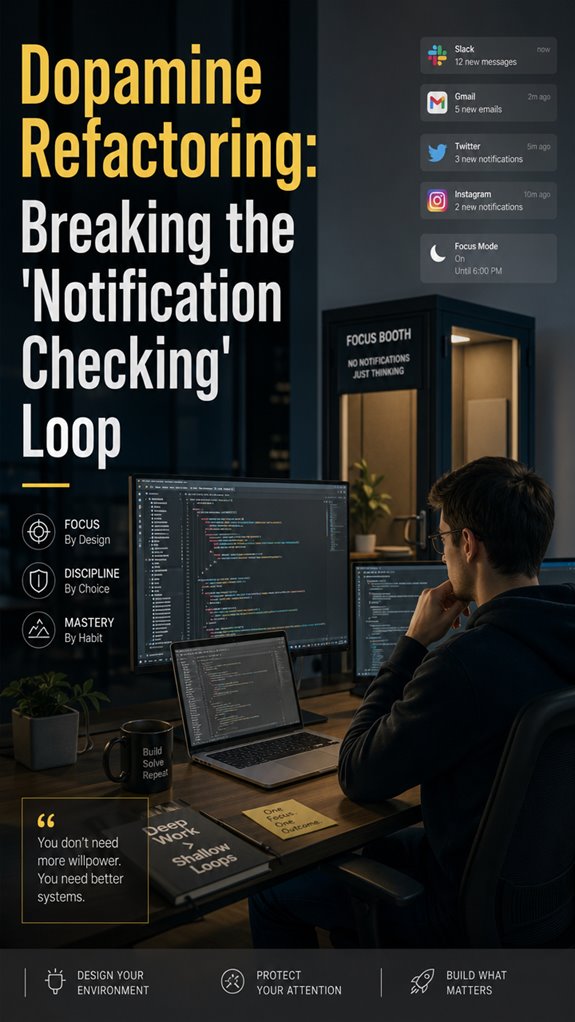
Ever felt like your brain’s running on a corrupted OS, constantly spinning on notifications? I have. My compiler of focus keeps crashing. Dopamine loops hijacked my attention like a memory leak I can’t patch.
Last Tuesday hit different. Three hours into deep work. Slack ping. Email. Calendar. Back to code. Forty-five minutes gone. My productivity metrics looked like legacy spaghetti no one dared refactor. Absolute despair.
So I killed the interrupts. Blocked Slack during flow state. Set Pomodoros like circuit breakers. Still debugging my dependency chaos, honestly. But my mental stack traces look cleaner now. Small wins.
What rogue processes are eating your cycles?
How Notification Anxiety Destroyed My Sprint Velocity: A Developer’s Recovery Story
My breaking point came during a critical Kubernetes deployment. Three browser tabs of alerts. WhatsApp family group exploding. My hands actually shook pushing that merge button. CI failed. Rolled back. Stayed until 2 AM fixing what distraction broke.
Sound familiar? Context switching isn’t just inefficient. It’s cumulative trauma for your prefrontal cortex. I’ve since adopted digital minimalism practices: grayscale displays, notification batching, even phone-in-another-room protocols. The resistance was real. FOMO hits different when you’re wired for uptime. Yet my git commits grew cleaner. Reviews faster. Burnout receding like a fixed memory leak I finally traced.
Quick Takeaways
- Implement scheduled notification checks to prevent constant dopamine-driven impulses and reduce attention fragmentation.
- Use app blockers and focus modes to create environmental barriers against recurring dopamine triggers.
- Distinguish and reset habitual cues through system detoxes, removing unnecessary notifications and routine interruptions.
- Modify physical and digital environments with grayscale modes, soundproofing, and device distancing to diminish stimulus-driven urges.
- Develop disciplined routines and accountability structures to rewire neural responses and break the cycle of notification-driven craving.
Why Notifications Keep Distracting and Draining You
When you dissect the real-time echo chamber of modern work routines, it becomes apparent that notifications are the relentless bugs in your mental infrastructure—triggering a cascade of micro-interrupts that resemble a poorly optimized event loop gone rogue. These disruptions hinder cognitive rewiring, eroding your capacity for sustained focus. Having the right matte vs glossy monitor can also help reduce glare and distractions, optimizing your workspace for better concentration.
Habit stacking becomes a fragile chain, easily broken by the constant onslaught. Each alert acts as a system exception, forcing your mental stack into chaos.
Like Ghost in the Shell’s hacking metaphor, your neural processes are hijacked, rendering conscious control moot. Without a system refresh, productivity crashes, and you remain trapped in a frustrating loop of seeking validation. Incorporating breaks and social connections into your work routine can help mitigate the effects of loneliness and enhance focus.
The Science Behind Dopamine and Reward Cycles
Have you ever coded your way into a dead-end, only to realize that your brain’s reward circuitry has devolved into a dopamine-driven callback hell? The macro failure stems from neurotransmitter influence—dopamine’s impact on the wanting system exceeds satisfaction, turning brain chemistry into a self-perpetuating loop.
As a developer, you might mimic a slot machine, with variable reward schedules firing unpredictably, sabotaging deep work. It’s like trying to debug Ghost in the Shell—mesmerized by an invisible feedback loop.
This physiological architecture fools your logic into chasing phantom rewards, an absurd irony considering your neurons are now the rogue client crashing your focus server. Moreover, engaging with top vertical mice can significantly enhance ergonomic comfort, encouraging longer, uninterrupted coding sessions.
How Notification Checking Hijacks Your Focus and Productivity
The moment your notification system fires off an alert, your cognitive architecture begins to degrade like a poorly optimized loop in legacy code. Sensorimotor triggers—visual cues, sounds—initiate habit formation, hijacking your neural CPU and disrupting essential focus threads. Each alert acts as a bug in your mental framework, forcing situational switches akin to PC reboot loops.
Unchecked, these triggers embed themselves into your workflow, making interruption the default function, like “Ghost in the Shell.” Productivity stalls as your brain’s operating system attempts to handle an ever-expanding event queue, all while your focus repository crashes under the weight of habit-driven noise.
Easy Strategies to Break Free From Notification Dopamine Loops

A multitasking operating system in your brain struggles to maintain stability amidst the chaos of incessant notifications, which act like random runtime exceptions cropping up in the middle of critical code execution. To combat sensory overload fueling habit formation, consider these tactics:
- Enable grayscale mode to diminish visual stimuli, reducing scroll triggers.
- Establish scheduled checks—three times daily—to disable floating point interrupts.
- Physically distance your device—think “airgap”—to prevent unintended echoes of dopamine-driven events.
- Use focus modes from GitScrum or similar tools to cut noise, maintaining system integrity under heavy load. Embracing monotasking techniques can also help streamline your focus and reduce distractions.
Incorporating work mode transitions can significantly enhance your ability to disconnect from work and promote relaxation.
These strategies serve as system patches, refactoring neural loops to regain core processing stability—much like debugging a rogue kernel.
Creating a Workspace That Supports Focus and Detachment
In the relentless chaos of multitasking, your workspace functions more like a poorly optimized server crashing under load than a sanctuary for coherent code execution. You must optimize strategic parameters—ambient lighting to reduce overstimulation, and ergonomic setup to prevent physical leaks in your performance. A well-designed ergonomic desk not only enhances comfort but also boosts overall productivity. Like a well-debugged OS, your environment needs systemic stability; distractions are the bugs that corrupt focus. To further enhance your glute performance, incorporating glute exercises into your routine can significantly aid in achieving stronger muscles. When your desk resembles a chaotic Git commit, the system brakes.
Building Daily Habits for Lasting Notification Control
Building daily habits around notification control functions like a pivotal system upgrade that gradually patches recurring vulnerabilities in your productivity pipeline.
You’ll want to embed habit stacking—merging routines like setting scheduled checks before launching your IDE—while leveraging accountability partners, perhaps your code review buddy, to enforce discipline.
This approach reinforces a security protocol against dopamine-driven bugs, limiting nodal triggers in your environment.
- Establish routine batching
- Use focus blocks like GitScrum
- Pair with accountability partners
- Maintain physiological awareness of dopamine loops
In this chaos, you’re debugging your human system to avoid repeating the “Ghost in the Shell” scenario of perpetual notifications crashing your mental infrastructure. Additionally, consider incorporating desktop heater for hands into your workspace to ensure physical comfort, which can enhance focus and productivity.
Personal Journey With Dopamine Management

Traveling daily without succumbing to notification alerts feels akin to debugging a perpetually corrupt kernel—an endless loop of patches and rollbacks that never address the core system failure.
Neural adaptation occurs at a glacial pace, reinforcing habitual behaviors like compulsive checking, as if my brain is a legacy app stuck in legacy loops. To counteract this, relaxation techniques for tight hips are essential when breaking away from the desk.
Habit formation becomes a form of code refactoring—cutting out memory leaks of impulse triggers. It’s an iterative process, akin to testing in real-world environments, often with outdated parameters.
I learn to measure inputs more precisely, disable unnecessary alerts, and accept that my mind’s infrastructure—like Ghost in The Shell—demands a system reset for power. Incorporating cycle tracking apps into my routine helps me better understand the patterns of my behavior related to dopamine management.
Early Signs of Dopamine Addiction
The earliest signals of dopamine addiction resemble a faulty debug cycle: the moment your core system—your attention—begins to glitch under relentless stimulation. Like a perpetually looping bug in your codebase, you’ll encounter Dopamine markers such as heightened restlessness and a growing dependence on habit triggers—those Pavlovian cues—loud notifications or blinking icons that command response.
- Increasing craving for stimulating content
- Reduced satisfaction with previous pleasures
- Escalating time on activity despite diminishing returns
- Mood swings driven by dopamine level fluctuations
To combat this, consider implementing keyboard noise reduction techniques to create a more focused environment. Additionally, utilizing Digital Eye Strain prevention strategies can support your efforts in maintaining concentration and reducing distractions. Your brain, like legacy software, exhibits tolerance and escalation, signaling an urgent need for a system patch.
Digital Detox Techniques
When your cognitive architecture begins to crash under the relentless load of dopamine-induced notifications, it’s clear that a systemic detox is overdue. Ignoring this is akin to neglecting memory leaks—no matter how elegant the code, it risks bit rot and eventual “Ghost in The Shell” paralysis.
You must establish mindful boundaries—concretely, implementing tech curfews to limit peripheral signals at defined intervals—akin to patching buffer overflows. Disabling non-essential alerts, like unnecessary dependencies, restores stability.
This self-imposed sandbox prevents cascading failures and preserves core functionality, enabling you to avoid total system meltdown. After all, even the most robust machine requires periodic reboots. Incorporating tools like posture vibrators can enhance your physical comfort during these tech breaks, promoting a healthier overall balance.
Smartphone Detox Apps
In the relentless cycle of digital signal processing that defines modern cognition, smartphone detox apps function as critical middleware, patching the unmanageable API of our dopamine-driven attention subsystems.
You deploy app blocklists and app timers deliberately, but they often resemble debugging efforts on ghostly, unresponsive code—optimistic yet futile.
- Blocklists selectively disable dopamine triggers, akin to firewall rules suppressing unwanted traffic.
- App timers introduce throttle points, mimicking rate-limiters on chaotic, slot-machine impulses.
- Focus modes lock down background processes, preventing environmental switches that spike reward anticipation.
- Scheduled checks serve as scheduled tasks, orchestrating human behavior with regimented precision.
All while your brain keeps trying to instantiate new threads of distraction, like a malfunctioning kernel.
Optimizing Focus During Work
Disrupting the cascade of distractions that cripple your workflow demands more than just flicking the mute button; it requires a systemic overhaul of your cognitive pipeline. As a senior dev debugging recursive bugs, you recognize that unchecked behavioral triggers—like incessant notifications—act as entropy, collapsing focus modules.
Mindful reflection exposes these destructive loops, revealing how auditory and visual cues trigger dopamine-driven wanting systems akin to a faulty AI looping endlessly. To optimize focus, you must architect boundaries—chunk tasks in disciplined batches, employ Grayscale mode, and schedule precise interaction points. Implementing tools like soundproof phone booths can significantly reduce environmental distractions, thereby neutralizing stimuli that fragment attention and maintaining operational integrity akin to a well-oiled server. Additionally, it’s crucial to be aware of blurry vision effects from prolonged screen time, as this can further impede your ability to concentrate effectively.
FAQ
How Do Dopamine Loops Differ From Traditional Habits?
You override traditional habits through neuroplasticity adaptation, rewiring your brain to weaken the reward pathway modulation drive. Dopamine loops energize frequent, unpredictable actions, making them more powerful and addictive than simple, routine habits.
Can Technology Modifications Fully Prevent Distraction?
Technology tweaks can considerably combat distraction, but can’t completely prevent digital fatigue or restore your full attention span. You must take control by setting boundaries, prioritizing focus, and actively managing your digital environment to preserve your power and productivity.
What Role Does Impulse Control Play in Dopamine Management?
Impulse control acts as your gatekeeper, wielding influence over your reward pathways like a master strategist. By mastering impulse regulation, you command dopamine’s power, transforming desire into disciplined action, asserting dominance over temptation’s relentless push.
Are There Proven Long-Term Benefits to Notification Detox?
Long-term notification detox boosts your focus and power, proving that practicing mindful awareness and habit replacement rewires your brain. This strengthens impulse control, enhances productivity, and grants you mastery over dopamine-driven distractions, transforming your deep work and decision-making capabilities.
How Does Individual Brain Chemistry Influence Addiction to Notifications?
Your brain chemistry influences addiction mechanisms, with studies showing dopamine sensitivity varies widely, making some more prone to notification addiction. Recognize this power, and you can fiercely control impulses, reclaim focus, and master your mental resilience.
Summary
Like debugging a critical system with intermittent, unpredictable faults, succumbing to notification dopamine loops destabilizes your cognitive architecture. You’re effectively running a leaky API—simultaneously fetching distractions while your core processes—deep focus and productivity—crash silently in the background. Abandoning this chaos demands systematic refactoring: disable unnecessary hooks, update your mental middleware, and deploy a version of yourself optimized for efficiency. After all, even “Ghost in the Shell” knew that the matrix’s stability hinges on constant system maintenance—so throw that spammy console log out.
References
- https://gitscrum.com/en/solutions/pains/dopamine-loops-from-notification-checking-destroying-deep-focus
- https://www.psychologytoday.com/us/blog/brain-wise/201802/the-dopamine-seeking-reward-loop
- https://doralhw.org/the-dopamine-debate-reclaiming-focus-in-this-era-of-notifications/
- https://nicolesneuroscience.substack.com/p/the-text-trap-dopamine-loops-and
- https://www.northpointrecovery.com/blog/signs-of-dopamine-addiction-and-how-to-break-the-cycle/
- https://www.youtube.com/watch?v=RZ5LH634W8s
- https://www.ashleytreatment.org/rehab-blog/understanding-dopamine-in-recovery/
- https://news.cuanschutz.edu/news-stories/can-the-dopamine-detox-trend-break-my-digital-addiction
- https://www.healthdirect.gov.au/dopamine
- https://my.clevelandclinic.org/health/articles/22581-dopamine
- https://www.healthline.com/health/dopamine-addiction
- https://www.samhsa.gov/find-help/helplines/national-helpline