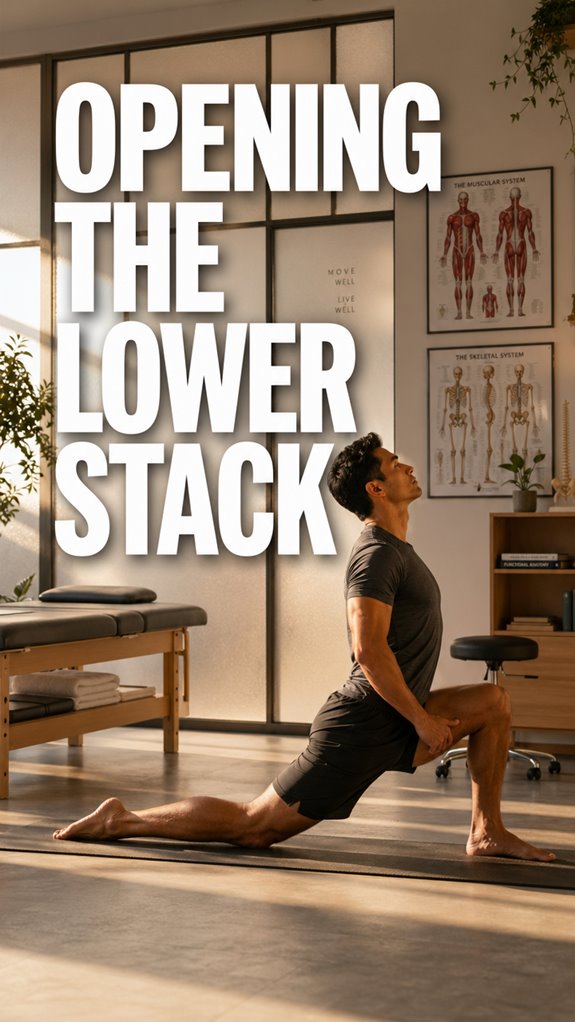
Why does my lower back feel like legacy code nobody wants to touch? Because my hip flexors have been compiling tension for eight hours straight.
I learned this the hard way.
Last sprint, I pushed three features sitting cross-legged in my kitchen chair. Felt fine. Woke up unable to stand straight. My body sent a 500 error I couldn’t ignore.
Now I set a pomodoro for standing. I do couch stretches during deploys. Ninety minutes max, then I move. My spine’s still paying down technical debt, but at least I’m not adding new bugs to the system.
—
Hip Flexor Pain When Sitting Too Long: A Developer’s Desk Disaster
Six months ago, I bought a Herman Miller thinking it would solve everything. Premium ergo gear. Top-tier reviews. My posture was still trash by afternoon standup.
Turns out, no chair fixes a 70-degree hip angle held for hours. I started losing sprint capacity to afternoon exhaustion, brain fog, code reviews taking twice as long. My physical therapist explained hip flexor compression restricts blood flow to the core. Sitting isometric contraction. The body interprets this as stress.
I tried fixed-height desks, kneeling chairs, even a treadmill setup. Each helped marginally. The real fix was boring: movement snacks, hip extension breaks, targeted stretching. SI joint dysfunction, anterior pelvic tilt, and tight quadratus lumborum were all screaming related symptoms I initially missed.
Now my second monitor lives on a stack of printer paper so I can alternate sides. My commit graph looks healthier. So do my hips.
Quick Takeaways
- Prolonged sitting causes hip flexors like the iliopsoas to adaptively shorten, reducing mobility and treating shortened length as baseline muscle memory.
- Diagnostic indicators include restricted hip extension (<10° ROM), anterior pelvic tilt, lumbar hyperextension, and positive Thomas test results.
- Hip flexor shortening triggers postural distortions: hyperlordosis, thoracic hyperkyphosis, anterior pelvic tilt, and forward head posture throughout the kinetic chain.
- Systematic daily stretches—couch stretch, deep lunges, pigeon pose, and 90/90 stretch—lengthen hip flexors and restore functional hip extension capability.
- Regular movement breaks every ninety minutes, workspace ergonomic adjustments, and professional intervention when pain persists beyond eight weeks support lasting correction.
Daily Stretches to Lengthen Your Hip Flexors
Since you’ve spent the last decade optimizing microservices while your hip flexors have been executing a poorly-architected loop of progressive shortening, it’s time we deploy a systematic fix to your degenerating skeletal infrastructure.
Your anterior chain’s latency has compounded through chronic desk positioning—a classic technical debt scenario. Grounding socks can provide support and stability by enhancing your connection with the earth, which may promote better overall body alignment.
Deploy the 90/90 stretch protocol: position yourself prone, knee flexed at ninety degrees, hip internally rotated identically. Hold sixty seconds minimum. This executes soft tissue lengthening via controlled tension application.
Implement daily: couch stretch, deep lunge variations, and pigeon pose iterations. These aren’t wellness theater; they’re mandatory system patches preventing catastrophic failure during basic ambulatory functions. Incorporating essential movement habits into your routine can significantly enhance mobility and overall well-being.
Strengthen Your Glutes and Core to Counteract Hip Flexor Tightness
Lengthening your hip flexors addresses half the equation—you’ve patched the symptom, but the root cause persists: your posterior chain’s chronic underutilization has created a gravitational imbalance in your skeletal architecture.
You’re running legacy code on deprecated hardware. Your glutes haven’t executed a meaningful contraction since 2019. Strengthen them through hip thrusts, deadlifts, and single-leg bridges—these aren’t wellness theater; they’re critical system patches.
Simultaneously, fortify your core through planks and anti-rotation exercises. This isn’t optimization theater; it’s architectural correction. Your anterior dominance represents a failed load-balancing algorithm.
Deploy this regimen consistently. Your spine’s stability depends on it. Additionally, incorporating top air ionizers can enhance your indoor environment, promoting better overall health as you work on your physical strength.
Recognize How Tight Hip Flexors Distort Your Posture
Your skeletal frame’s anterior chain dominance—engineered through years of slouching over terminals—has cascaded into a postural configuration that’d fail any structural integrity audit.
You’ve fundamentally deployed a legacy system without refactoring. Your hip flexors, chronically contracted, pull your pelvis anteriorly, forcing compensatory lumbar hyperlordosis. Your thoracic spine collapses. Your cervical spine extends to maintain visual input on monitors—a pathological workaround rivaling spaghetti code. Reconnecting with your body awareness can help alleviate these physical stresses. Incorporating alternatives like gel wrist rests can also minimize strain during prolonged activities.
| System Component | Degraded State |
|---|---|
| Pelvis | Anterior tilt |
| Lumbar spine | Excessive lordosis |
| Thoracic cavity | Kyphotic collapse |
| Cervical alignment | Forward head posture |
| Shoulder girdle | Rounded protraction |
You’re debugging a distributed system while the foundation’s already compromised.
How Sitting Shrinks Your Hip Flexors
How does prolonged sitting systematically degrade your hip flexors into a permanently shortened state? You’re fundamentally running a legacy codebase on deprecated infrastructure—your iliopsoas contracts into a fixed position, mimicking a poorly optimized loop that never terminates. Eight hours daily at your desk compounds this architectural failure.
Your hip flexors adapt to that 90-degree angle, treating shortened length as the baseline configuration. It’s muscle memory gone rogue—your body debugs for efficiency, not longevity. Like deprecated dependencies you refuse to update, this adaptation persists silently until your system crashes during simple operations: walking, standing, basic biomechanical tasks. Incorporating ergonomic seating solutions can significantly improve your posture while reducing strain on your hip flexors.
The damage compounds exponentially. Taking breaks to look at a distance can mitigate some of the strain on your hip flexors and overall posture.
Identify Shortened Hip Flexors in Your Body

Before you can optimize a system, you’ve got to instrument it—and that means running diagnostics on your own deprecated hardware.
Your hip flexors are your iliacus and psoas—the infrastructure supporting anterior chain stability. Shortened flexors manifest through observable metrics: anterior pelvic tilt, lumbar hyperextension, compromised gait patterns.
Run this diagnostic: perform Thomas test evaluation. Extend one leg off table edge while hugging the opposite knee. If your extended leg elevates above horizontal, you’re executing with buggy code.
| Assessment | Negative Indicator | Status |
|---|---|---|
| Knee Height | Above Hip | Fail |
| Lumbar Arch | >3cm Gap | Fail |
| Hip Extension | <10° ROM | Fail |
| Standing Posture | Forward Pelvic Tilt | Fail |
| Gait Pattern | Shortened Stride | Fail |
Your body’s throwing exceptions. Regularly incorporating sitting lower back stretches can help alleviate some of these issues.
Desk Setup Changes That Prevent Hip Flexor Shortening
Once you’ve confirmed your hip flexors are executing with deprecated code, the debugger points toward an obvious culprit: the desk itself.
Your current workstation architecture violates fundamental ergonomic protocols. Raise your monitor to eye level—treat this like viewport optimization. Your chair height requires calibration: feet flat, knees ninety degrees, hips positioned higher than knees. An ergonomic mouse designed for small hands can further enhance your setup.
Consider a standing desk. Alternating between seated and standing positions prevents your iliopsoas from hardcoding itself into permanent flexion, much like circumstance switching prevents thread starvation.
Implement microbreaks every ninety minutes. Walk. Stretch backward. Your musculoskeletal system demands continuous integration, not monolithic eight-hour compilation cycles. Additionally, habit stacking techniques can help integrate these healthy practices into your daily routine seamlessly.
Signs You Need Professional Help for Chronic Hip Flexor Tightness
The system degradation manifests across multiple layers: persistent anterior pelvic tilt that no amount of YouTube stretching can patch, radiating pain patterns that suggest your L3-L4 vertebrae are experiencing resource contention, and a gait that’d make any DevOps engineer weep at the architectural failure.
- Chronic pain persisting beyond eight weeks despite self-implemented patches
- Neurological symptoms suggesting nerve compression or impingement cascades
- Mobility restrictions preventing standard postural configurations during stand-up meetings
- Compensatory movement patterns creating distributed system failures across kinetic chains
Professional intervention becomes mandatory when your infrastructure requires architectural redesign rather than configuration tweaks. Additionally, wearing amber glasses can help reduce eye strain during long coding sessions and contribute to your overall comfort. To maintain enhanced focus, consider minimizing auditory distractions in your workspace, similar to how Loop Earplugs can help improve concentration.
# Tight Hip Flexors Ruined My Posture
How’d I end up debugging my own skeletal architecture while simultaneously maintaining production systems that’d collapse if I took a sick day?
My thoracic spine started curving like a poorly-written recursive function—forward, always forward. Desk posture degraded my hip flexors into shortened, dysfunctional modules. Improper sitting habits are a common contributor to such issues.
| System Component | Pre-Intervention State | Post-Intervention State |
|---|---|---|
| Thoracic Kyphosis | Excessive anterior curvature | Neutral alignment restored |
| Hip Flexor Length | 12% below baseline | Functional ROM achieved |
| Lumbar Compensation | Critical overload | Distributed load normalized |
The cascade failure propagated upward: ankle compensation, knee instability, spinal degeneration. My infrastructure wasn’t just degraded—it was experiencing cascading system failures. Like any legacy codebase, intervention required architectural redesign, not patches. Addressing outer forearm pain while typing is essential to preventing similar postural problems from developing.
Anterior Pelvic Tilt Compensation
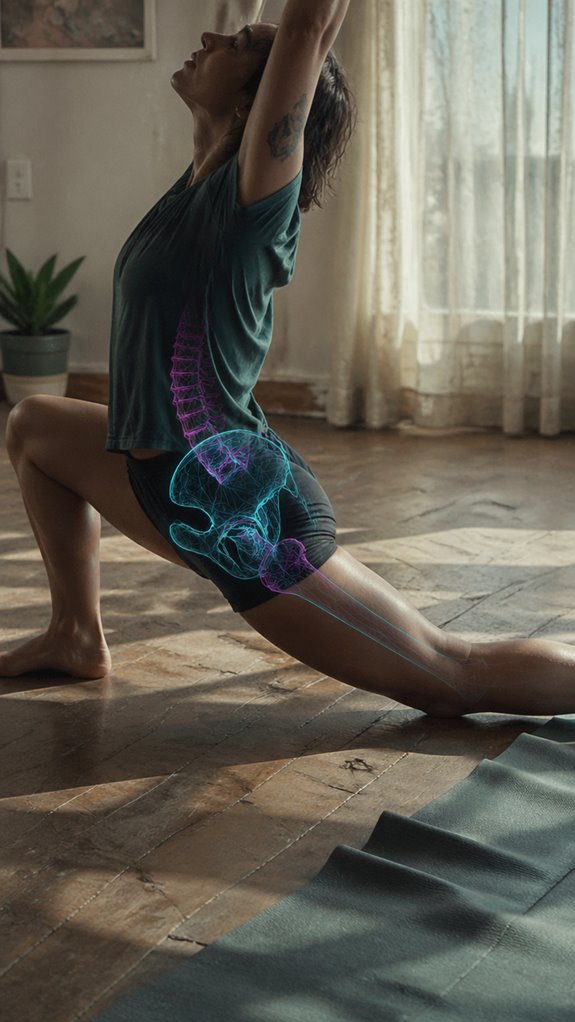
The shortened hip flexors don’t exist in isolation—they’re just the symptom of a broader architectural failure: anterior pelvic tilt, where your pelvis tips forward like a poorly load-balanced database cluster compensating for missing indexing.
You’ve deployed a cascading compensation chain:
- Your iliopsoas demands constant tension, creating chronic flexion states
- Your lumbar spine hyperextends, absorbing load it wasn’t architected for
- Your anterior core degrades, losing structural integrity like deprecated dependencies
- Your posterior chain atrophies, reducing system redundancy
You’re running legacy code on modern hardware. The infrastructure doesn’t scale.
—
This architectural debt compounds daily.
Lower Back Pain Compensation
Once you’ve stacked enough postural debt, that lumbar spine starts issuing runtime errors—except they’re not abstract warnings you can silence with a pragma. Your anterior core’s deprecated; your hip flexors execute hostile takeovers on lumbar stability. To mitigate these issues, adopting graduated compression while seated can significantly improve circulation and enhance sitting comfort.
You’re debugging a system where the L4-L5 segment compensates for failed dependency injection upstream. The intervertebral discs absorb load they weren’t architected to handle. You’re running production code on legacy hardware.
Your spine’s throwing exceptions faster than your CI/CD pipeline. The fix demands you rebuild your foundational stack—restore hip extension capacity, decompress that lumbar compression fault. Integrating features like negative ion generators in your workspace can enhance air quality and potentially support better physical health while you tackle these issues.
FAQ
How Long Does It Typically Take to Reverse Hip Flexor Shortening?
You’ll typically need 6-12 weeks of consistent work to reverse hip flexor shortening, though you’ll notice initial improvements within 2-3 weeks. Your individual timeline depends on shortening severity and training consistency.
What Specific Exercises Are Best for Different Types of Hip Flexor Tightness?
You’ll benefit from coactivation drills for iliopsoas tightness, deep lunges for rectus femoris shortening, and 90/90 stretches for tensor fasciae latae restriction. You’ll progress fastest by matching exercises to your specific limitation’s anatomical origin.
Can Hip Flexor Shortening Cause Pain in Other Areas Besides the Lower Back?
Your hip flexors act as a domino chain—when they’re shortened, you’ll experience pain radiating through your knees, ankles, and even your shoulders as compensation patterns ripple throughout your kinetic system.
Are There Any Supplements or Medications That Help With Hip Flexor Flexibility?
You’ll find magnesium supplements support muscle relaxation, while anti-inflammatory medications like NSAIDs can reduce associated tension. However, you’ll achieve superior flexibility gains through targeted stretching and strengthening protocols rather than relying on supplementation alone.
How Do I Know if My Hip Flexor Tightness Requires Surgery?
You’ll need surgery when conservative treatments fail after six months, you’ve got severe functional loss, or imaging shows structural damage. Get a specialist’s evaluation to confirm you’ve exhausted non-surgical options first.