
Ever felt like your shoulder’s screaming “404: Support Not Found”? That’s your scapular stabilizers ghosting you after years of desk death marches. Mine did. I spent eighteen months shrugging off a burning knife in my rhomboids while cranking out commits, convinced Ibuprofen was a viable architecture.
It wasn’t.
My upper traps had gone full diva, compensating for middle and lower traps that basically rage-quit. The kinetic chain? Total spaghetti code.
Band pull-aparts rebuilt my foundation. Face pulls became my daily deploy. But real stability demanded ergonomic refactoring, a standing desk, and finally accepting that my meat suit needs maintenance too.
—
Why Your Standing Desk Alone Won’t Fix Scapular Instability: A Developer’s Posture Disaster
Three months into my “optimized” WFH setup, I discovered the cruel truth: I’d elevated my monitor but never retrained my patterns. My shoulders still rounded like parentheses around bad code. I’d upgraded hardware without patching the firmware, me. The breakthrough came pairing elevation with deliberate scapular retraction exercises between Pomodoros. My trap dominance didn’t vanish, it migrated, then slowly, cautiously, resolved. T-spine mobility, serratus anterior activation, breathing mechanics, these became my actual stack.
Quick Takeaways
- Poor ergonomics and forward head posture destabilize the thoracic spine, causing scapular dysfunction and sharp shoulder pain.
- Upper trap hyperactivity compensates for atrophied middle and lower traps, masking deeper muscular imbalances and instability.
- Band pull-aparts, face pulls, and prone Y-T-W raises strengthen scapular stabilizers and restore proper shoulder mechanics.
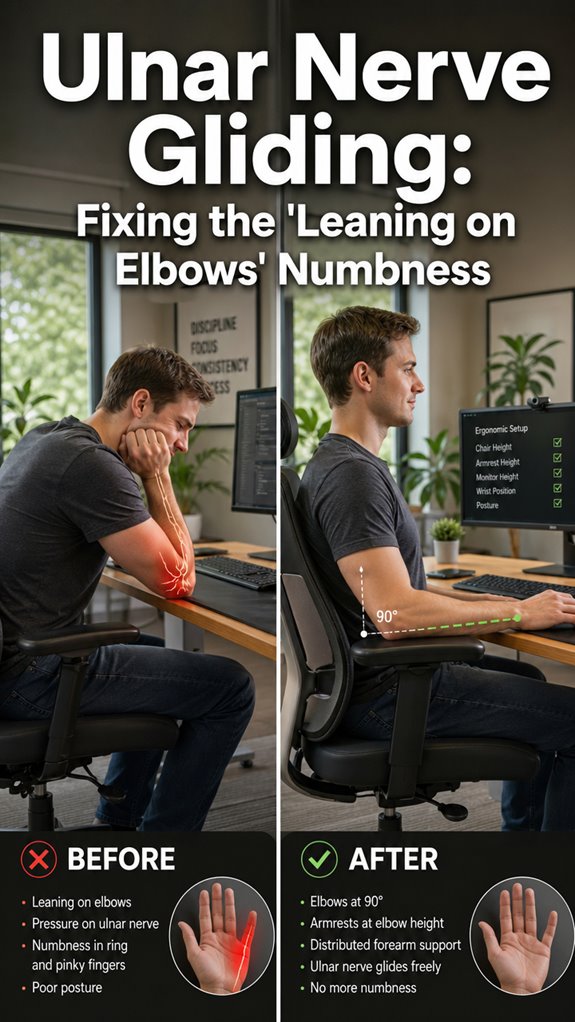
- Elevate monitors to eye level and position keyboards at 90-degree elbow angles to prevent anterior shoulder roll.
- Persistent pain lasting over six weeks, arm radiation, or weakness warrant professional medical evaluation and diagnostics.
What Causes Sharp Shoulder Blade Pain at Your Desk
Like a legacy monolithic codebase that’s been patched for fifteen years without architectural refactoring, your desk setup represents a cascading system failure—one that begins at the macro level with ergonomic debt and descends into specific muscular compensation patterns.
Your scapulae aren’t stabilizing; they’re compensating.
Forward head posture collapses your thoracic spine into chronic kyphosis.
Simultaneously, your rotator cuff performs runtime error handling, recruiting inappropriate muscle fibers to stabilize an inherently unstable system architecture.
You’ve deployed without testing.
Your trapezius and rhomboids execute constant practical switching between stabilization and movement tasks, generating heat and inflammation.
The sharp pain? That’s your infrastructure screaming deprecation warnings you’ve ignored since sprint three.
Why Your Desk Posture Breaks Down
Your posture doesn’t break down—it’s architected that way from the moment you sit down.
The desk environment enforces a cascade of biomechanical deprecations. Your chair’s ergonomic promises collapse under sustained load, forcing compensatory slouching. Monitors positioned at eye-level create false stability, when you’re actually executing a distributed denial-of-service attack on your posterior chain. Pelvic pressure from sitting can intensify due to compounded forces acting on the body in this unstable position.
Scapular stabilizers—your rhomboids, lower trapezius—enter hibernation mode. They’re not failing; they’re deprecated by design. Your anterior chain dominates, pulling you forward like a feature branch that never merged.
This isn’t weakness. It’s systematic infrastructure collapse running exactly as your workspace configured it. Prolonged seating can also lead to issues like numb legs from office chairs, hindering overall comfort and posture.
4 Exercises to Strengthen Your Shoulder Blades
Once you’ve acknowledged the systematic deprecation of your posterior chain, you’ll recognize that recovery requires deliberate API rewrites—not motivational rhetoric. Your scapulae aren’t failing because you lack willpower; they’re failing because you’ve deployed them in a deprecated architecture.
- Band pull-aparts: External rotation stabilization
- Face pulls: Posterior deltoid activation and scapular retraction
- Prone Y-T-W raises: Kinetic chain sequencing through multiple planes
- Dead hangs: Decompression load-testing for shoulder girdle integrity
These protocols aren’t wellness theater. They’re infrastructure maintenance. Your shoulder’s proprioceptive feedback loop requires systematic retraining before you’ll achieve stable system performance during extended computational workflows. Standing at your desk can help reduce musculoskeletal strain and promote better overall posture, which is essential for optimal scapular stability.
Desk Setup Changes That Prevent Shoulder Blade Pain
How many hours d’you reckon you’ve spent debugging someone else’s monolithic code while your scapulae slowly migrate into your thoracic spine?
Your desk’s ergonomic architecture—monitor height, chair depth, keyboard positioning—functions as foundational infrastructure. Misalignment cascades downward: anterior shoulder roll compresses rotator cuff tissues, destabilizing scapular mechanics. Elevate your monitor to eye level. Position your keyboard so elbows maintain 90-degree angles. Your chair requires lumbar support. Maintaining good posture is essential for preventing further strain.
These aren’t wellness suggestions; they’re system requirements. Like containerization prevents runtime failures, proper desk configuration prevents chronic compensation patterns that degrade your proprioceptive feedback loops and destabilize scapular kinematics permanently. Additionally, digital eye strain can lead to further discomfort, exacerbating existing shoulder issues.
When to Seek Help for Persistent Shoulder Pain

Persistent shoulder pain—that is, discomfort outlasting your initial ergonomic refactor by more than six weeks—signals a system failure requiring professional diagnostics rather than another stack overflow thread suggesting rotator cuff stretches.
You’ve debugged production incidents with less infrastructure collapse than your scapula’s currently experiencing. Consider escalation when:
- Pain radiates down your arm (nerve compression, not feature creep)
- Night sweats accompany shoulder discomfort (systemic inflammation flagged)
- Weakness prevents typing velocity (motor pathway degradation detected)
- Ibuprofen becomes your primary dependency injection
Your body’s throwing unhandled exceptions. Omega-3 supplements may aid in reducing inflammation, which could help alleviate some shoulder discomfort. Furthermore, blurred distance vision can also be an indication of underlying stress related to prolonged computer use. Time to consult orthopedic documentation.
Resistance Band Therapy Helped Immensely
After three months of failed deployments—each rotator cuff stretch a negligible patch that’d never make it past code review—I discovered that resistance band therapy functions as legitimate infrastructure remediation rather than another wellness theater recommendation from HR’s quarterly health initiative. Unlike stretching’s placebo-adjacent returns, resistance bands generate measurable scapular stabilization through progressive load testing. The posterior deltoid and rhomboid activation mirrors debugging nested callbacks: systematic, iterative, evidence-based. Noise-reducing earplugs can serve a similar role in creating a focused environment for recovery. Theraband’s color-coded resistance tiers operate like regression test suites. I executed three sets daily. My shoulder’s crash logs diminished substantially. This progressive resistance approach parallels the principles of effective napping, ensuring that gradual challenges lead to greater recovery outcomes.
Serratus Anterior Muscle Weakness
While resistance band protocols addressed the posterior chain’s obvious bottlenecks, they’d merely patched the symptom layer—the UI still rendered correctly while the backend collapsed under load. You’ve neglected your serratus anterior, that underutilized microservice responsible for scapular positioning.
Your shoulder blade’s anterior tilt represents a deployment failure cascading through your kinetic chain.
Consider these critical system optimizations:
- Prone shoulder taps activate dormant neural pathways your desk job’s deprecated
- Wall slides rebuild scapulohumeral rhythm—think integration testing for your shoulder socket
- Push-up variations expose your serratus’ load-bearing capacity under stress conditions
- Hollow body holds stress-test your entire anterior core infrastructure
Without this anterior chain fix, you’re running production on legacy hardware.
Trapezius Muscle Imbalance Issues
Your trapezius muscle has partitioned itself into three distinct microservices—upper, middle, and lower—each autonomously failing at different load thresholds, which creates a cascading system failure you’ve mistaken for “normal shoulder tension.”
The upper trap’s hyperactivity compensates for middle and lower trap atrophy, much like how a frontend framework masks backend latency until your entire request stack collapses under genuine traffic; you’re shrugging your shoulders toward your ears during every keystroke, every Zoom call, every moment your scapula should be stabilizing instead of screaming for help.
Your middle and lower traps’ve atrophied into deprecated legacy code—still technically running, functionally obsolete.
This imbalance destabilizes your entire scapular architecture, forcing compensatory patterns upstream. You’ll need deliberate retraining protocols.
FAQ
How Long Does It Typically Take to Notice Improvement in Scapular Stability?
You’ll notice improvements within 2-3 weeks of consistent training. Consider an athlete performing daily scapular exercises—they’ll experience reduced shoulder pain and increased stability by week three through progressive neuromuscular adaptation and strengthened stabilizer muscles.
Can Scapular Instability Cause Pain in Other Areas Beyond the Shoulder Blade?
Yes, you’ll experience referred pain patterns extending into your neck, upper back, and arm when scapular instability compromises your kinetic chain. You’re fundamentally creating compensation patterns throughout your entire shoulder girdle complex.
Are There Specific Occupations That Put People at Higher Risk for Scapular Problems?
You’re at higher risk if you work overhead jobs like painting, construction, or competitive throwing. Repetitive reaching, poor posture, and inadequate scapular muscle activation during your daily tasks create dysfunction.
What Role Does Breathing Technique Play in Maintaining Proper Scapular Positioning?
Your breathing technique directly stabilizes your scapula by engaging your serratus anterior and core musculature. You’ll maintain ideal positioning when you coordinate diaphragmatic breathing with shoulder movements, preventing compensatory patterns that destabilize your scapulohumeral rhythm.
Can Scapular Instability Affect Athletic Performance in Overhead Sports Like Swimming?
You’re like a house built on sand—scapular instability undermines your overhead performance in swimming. You’ll sacrifice power, precision, and injury prevention when your shoulder blade doesn’t stabilize properly during strokes.