Ever felt your code compiling but your body hitting a fatal error? I have. During sprint reviews, my shoulders lock up like a merge conflict nobody asked for.
Three fixes that actually work:
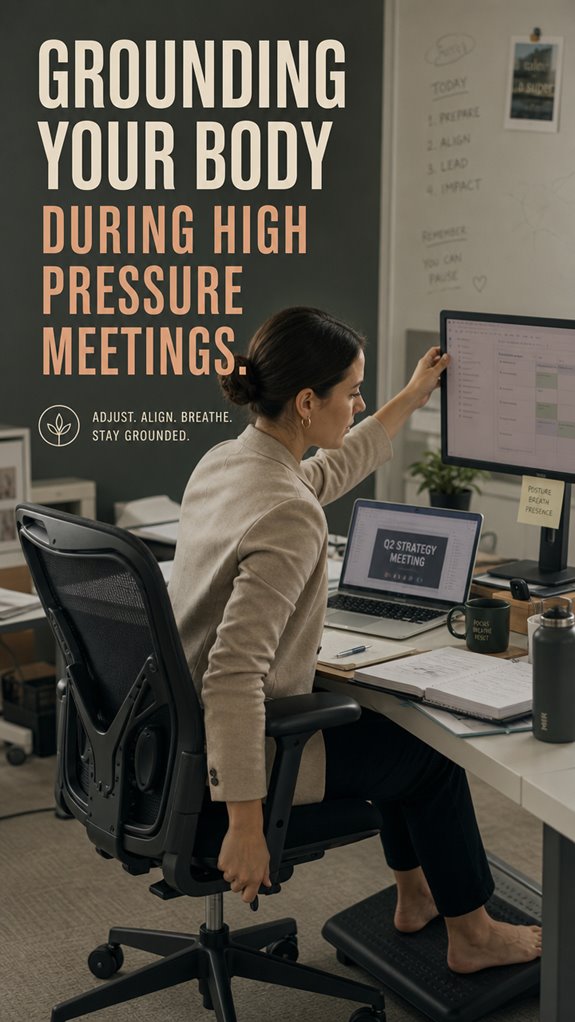
Squeeze a stress ball until it begs for mercy. Feet flat on the floor, grounding like proper cable management. Deep breaths, because someone’s definitely watching your camera.
I learned this after my hand cramped mid-demo. Embarrassing. Effective.
—
Chronic Tension From Desk Jobs: When Your Body Logs Out Before You Do
Last Tuesday, 3 PM, production deploy looming. My neck seized so hard I couldn’t turn to read Slack. Classic developer trap: we debug systems, never ourselves.
Turns out “sitting disease” and repetitive strain injuries plague our field more than stack overflow outages. I started setting commits to my posture, not just my repo. Small movements between standups. Shoulder rolls during CI/CD pipelines.
The body keeps logs. Mine was screaming timeout errors I kept ignoring. Now I treat physical maintenance like technical debt: address early, or pay painfully later.
Quick Takeaways
- Use deep, controlled breathing techniques like the 4-7-8 method to stay centered during high-pressure meetings.
- Press your feet firmly into the ground to reconnect physically and establish stability.
- Squeeze and release a stress ball to simulate system debugging and release tension.
- Maintain good posture and incorporate micro-movements, like adjusting your seat or stretching briefly.
- Limit eye strain with the 20-20-20 rule and avoid distractions for better mental grounding.
How to Recognize Signs of Stress During Meetings
In the labyrinth of high-pressure meetings, where corporate synapses spark like a badly optimized API call, the first sign of stress inevitably manifests as a systemic failure in your cognitive firewall. Your mental CPU throttles, and decision loops begin to lag, akin to a Ghost in the Shell trying to reboot amidst a data surge.
You might experience rapid heartbeat—like a pulse echoing through the fiber optic backbone—or involuntary muscle twitching reminiscent of a debug breakpoint triggering unexpectedly.
Recognizable patterns include tunnel vision, speech latency, or the sudden appearance of garbled variables—fidgeting, lapses in logical flow, or unintentional code “comments” in your verbal output. Additionally, if discomfort arises in your body, you may notice the importance of ergonomic adjustments, such as relieving rib pain while sitting at your computer.
Simple Grounding Techniques to Stay Calm Under Pressure
When the cognitive firewall of your meeting-hosting system starts to thrash—heartbeat turning into an intrusive ping, muscles twitching like Sequelize models experiencing foreign key constraint violations—it’s a clear sign your neural processes are nearing overload.
Deploy simple grounding routines: press your feet firmly into the ground, simulating a system reconnecting to its base modules. Slow, deep breaths—akin to a well-timed heartbeat—can mitigate cascading failures. To help maintain visual comfort during long meetings, remember to follow the 20-20-20 rule to alleviate eye strain.
Channel your inner “Ghost in the Shell,” where control isn’t emotional but technical resilience. These techniques function as hotfix patches—preventing memory leaks of panic from crashing your mental server.
Daily Habits to Maintain Grounding and Manage Stress
Just as a codebase gradually degrades without routine refactoring, the human nervous system needs consistent maintenance to prevent catastrophic crashes during high-pressure sprints.
To maintain this internal health:
- Schedule daily “system checks”—a deliberate pause to reset mental buffers.
- Implement version control for stress—log or journal, like commit history, to manage reactive states.
- Use controlled input—limit distractions like noisy CI/CD pipelines or unnecessary notifications.
- Leverage micro-optimizations—quick physical grounding via breathing or posture adjustments to prevent buffer overflow.
Incorporating caffeine gum can provide a rapid energy boost, enhancing focus during demanding tasks.
Without these patches, you’re just debugging a fragile system with a high chance of runtime failure.
Quick Body Techniques to Recenter Before Important Meetings

Even in the face of an impending all-hands meeting that feels more like a rogue process consuming system resources than a productive session, the human nervous system encounters a familiar 404 error—failure to respond coherently under high load.
To reboot your mental infrastructure, apply quick body techniques. Engage in deep, structured breathing—think “4-7-8” command—to stabilize the core CPU.
Press palms together like code’s final commit, or force your feet into the ground akin to grounding a loose wire. These microdebugging actions serve as emergency patches, preventing total system crash—like “Ghost in the Shell” trying to patch consciousness amidst chaos. In coworking spaces, introverted individuals can find a more supportive environment to practice these techniques and ease their anxiety before crucial discussions.
Hands-On Stress Ball Session
In the complex ecosystem of high-pressure meetings, where mental CPU overload often results in system kernel panics, deploying a hands-on stress ball session acts as a practical patch to mitigate transient memory leaks in emotional regulation.
- Squeeze the stress ball with precision, mimicking code debugging—methodical and intentional.
- Vary grip pressure to emulate load testing—push and relax, stress test your mental firmware.
- Count reps to establish a controlled loop—guaranteeing logical progress.
- Release suddenly to simulate a system reboot—reclaim control over runaway processes.
Like tuning Ghost In The Shell’s cybernetic interface, this manual control reconnects your human hardware to the command line. Additionally, using top seat cushions can enhance physical comfort and long-term focus during these demanding sessions.
Difficulty Maintaining Calm Focus
When the CPU of your mental system hits 100% during high-pressure meetings, maintaining focus becomes a debugging exercise, not a conscious effort. Physiological markers like elevated heart rate, blood pressure, and muscle tension signal system overload—akin to a RAM leak in your neural core.
Shallow breathing reduces diaphragmatic input, like throttling your bandwidth. Grounding techniques—pressing feet into the floor, controlled breathing—function as system patches, activating the parasympathetic subroutine.
Like Ghost in The Shell v3.0, your awareness must recompile: reconnecting sensor input with conscious control, restoring latency to mental processes before your cognitive engine crash-logs. Incorporating techniques from white noise machines can also create a calming background environment, aiding in focus and relaxation.
Laptop-Integrated Stretch Exercises

In the unbecoming chaos of a high-stakes meeting, your posture tends to degrade into a series of unplanned leaks—fingers crossing, shoulders slumping—akin to a server suffering a memory leak during peak load.
Laptop-integrated stretch exercises act as a system patch, mitigating ergonomic crashes in real time.
- Use your keyboard as a lever: press keys with purpose, engaging forearm muscles.
- Activate your trackpad: perform small circles to simulate network ping tests.
- Incorporate neck stretches: gently tilt head, debugging tension errors reported by your hardware.
- Seize your laptop’s edge: perform press-and-release exercises, recalibrating your core stability matrix.
This is your control panel, squad—unit testing your body’s resilience amid a software hellscape. Meanwhile, be mindful of top vertical mice to enhance your ergonomic setup during those critical moments.
Desk Ergonomics Adjustments
Despite endless iterations of ergonomic patches, your desk setup still resembles a legacy system buried under layers of accumulated technical debt — most notably, the persistent misalignment of your skeletal kernel, manifesting as wrist strain, neck tension, and postural crashes akin to a software module failing mid-deploy.
In software terms, your work environment remains a brittle, outdated API that hampers real-time responses and causes system crashes under load. To upgrade, recalibrate your workspace with structured adjustments: monitor height aligned with eye level, keyboard position supporting ulnar neutrality, and chair ergonomics that prevent kernel panics.
Incorporating full-body posture tips can significantly enhance your overall comfort and productivity during long coding sessions. Ghost in the Shell would mock this user-hostile firmware, yet control demands patching the hardware infrastructure, statically and fundamentally.
FAQ
How Can I Personalize Grounding Techniques for My Specific Stress Triggers?
Think of tuning your grounding approach as customizing a control panel to match your triggers. You can experiment with different techniques, note what soothes or energizes you, then adapt your methods to reclaim calmness and confidence under pressure.
Are There Any Long-Term Benefits of Regular Grounding During Workdays?
Regular grounding during workdays boosts your emotional resilience, sharpens focus, and lowers stress, giving you greater control over responses. It strengthens your mindset and helps you handle pressure calmly, improving overall productivity and well-being in high-stress environments.
What Signs Indicate I Need to Take a Grounding Break Urgently?
You feel overwhelmed, tense, or distracted—signs you need an urgent grounding break. Recognize racing thoughts, rapid heartbeat, or muscle tension, and use quick techniques like deep breaths or pressing your feet to regain control and clarity instantly.
Can Grounding Techniques Improve Overall Productivity and Focus?
Grounding techniques boost your focus and productivity by calming your mind and body, helping you stay present, make clear decisions, and reduce stress—even in demanding situations—giving you control and an edge during high-pressure meetings.
How Do I Balance Grounding Practices With High-Stakes Decision-Making?
You balance grounding with high-stakes decisions by quickly activating techniques like deep breaths or pressing feet firmly. Use mental clarity methods to stay focused, ensuring your body stays calm while you make critical choices confidently.
References
- https://www.gocivilairpatrol.com/media/cms/AFH33337_26346B56773E9.pdf
- https://www.medainc.org/?search=
- https://basilhalperin.com/essays.html
- https://staibabussalamsula.ac.id/wp-content/uploads/2024/03/Louis-Cohen-Lawrence-Manion-Keith-Morrison-Research-Methods-in-Education-Routledge-2018-staibabussalamsula.ac_.id_.pdf
- https://pmc.ncbi.nlm.nih.gov/articles/PMC11007421/
- https://research.google.com/pubs/archive/33481.pdf
- https://www.metodos.work/wp-content/uploads/2024/01/Qualitative-Data-Analysis.pdf
- https://www.europarl.europa.eu/RegData/etudes/STUD/2021/653635/EXPO_STU(2021)653635_EN.pdf
- https://news.ycombinator.com/item?id=45967814
- https://www.grandrisingbehavioralhealth.com/blog/tips-for-staying-grounded-during-stressful-situations
- https://health.clevelandclinic.org/grounding-techniques
- https://www.healthline.com/health/grounding-techniques
- https://www.mindtalk.in/blogs/grounding-techniques-101
- https://www.highlandparktherapy.com/blog/2026/1/9/5-grounding-techniques-to-calm-anxiety-and-stay-in-the-moment
- https://blog.trilliumcenterinc.org/grounding-a-body-based-practice-for-calm
- https://www.calm.com/blog/grounding-techniques
- https://www.goodrx.com/health-topic/mental-health/grounding-techniques-anxiety-coping
- https://pmc.ncbi.nlm.nih.gov/articles/PMC10105020/