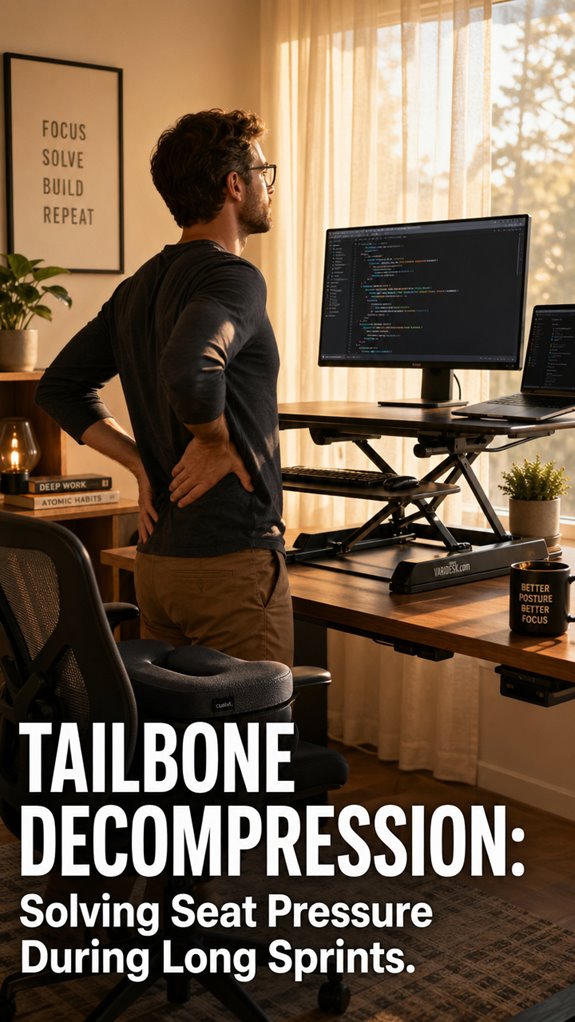
Ever wonder why your tailbone feels like it’s filing a harassment complaint after a release day? Mine absolutely did.
I learned this the hard way after a 14-hour deploy marathon. My Herman Miller was basically gaslighting me.
The anterior pelvic tilt snuck up like technical debt. Pudendal nerve pain? Imagine a critical alert that never clears. My glutes forgot how to fire. Standing desk helped. So did pigeon poses between standups.
But here’s the thing. We’re not supposed to brute-force through biomechanical failures. I tried foam rolling, lacrosse ball torture, even a $300 cushion that promised infinity comfort. Temporary patches. Eventually I saw a PT who actually read my pelvic floor like legacy code.
Turns out my sacrum was doing a weird little rotation. Needed manual therapy, not YouTube yoga.
Tailbone Pain From Sitting Too Long: When Your Office Chair Becomes a Torture Device
Three years ago I ignored warning signs until I couldn’t sit through a retro without shifting every ninety seconds. My colleague noticed. Embarrassing. I started walking meetings, which helped team dynamics actually. Tried a kneeling chair, perineal pressure made things worse. The real fix? A standing desk converter, hourly movement snacks, and finally booking that PT. Hip flexor stretches, transverse abdominis activation, the whole stack. Six weeks to baseline. Now I evangelize chair ergonomics like it’s React hooks. Your future self will thank you. Mine still sends postcards.
Quick Takeaways
- Interrupt sitting every 90 minutes with movement breaks to prevent cumulative tailbone compression and tissue inflammation.
- Use ergonomic cushions with gel or memory foam to redistribute pressure away from the coccyx effectively.
- Maintain proper posture with anterior pelvic tilt and lumbar support to minimize skeletal strain on tailbone.
- Perform decompression stretches like hip flexor stretches, pigeon pose, and child’s pose to relieve posterior compression.
- Seek professional diagnostics if pain persists despite ergonomic adjustments, as structural issues may require specialized treatment.
Why Tailbone Pain Strikes During Long Sprints
When you’ve deployed your skeletal infrastructure for decades without a major refactor—sitting hunched over VS Code like you’re debugging the human condition itself—your coccyx becomes fundamentally a deprecated legacy system nobody bothered to deprecate properly.
You’re executing sustained computational loads while your spinal alignment degrades like unoptimized database queries.
The tailbone isn’t designed for eight-hour sprints. Prolonged compression against Herman Miller ergonomics triggers inflammatory cascade failures. Your weight distribution becomes unbalanced; pressure concentrates on that vestigial bone rather than distributing across optimized load-bearing surfaces.
Think of it as a memory leak manifesting physically—slow, insidious degradation nobody notices until production crashes catastrophically. Incorporating low-range standing desks into your workspace can significantly alleviate this pressure by promoting better posture and distributing your weight more effectively.
3 Quick Fixes to Try Right Now
Before you’ve burned through your third espresso and realized you’re still debugging the same race condition you introduced yesterday, you’ll want to implement some immediate mitigation strategies—because your coccyx doesn’t care about your sprint velocity or your architectural decisions.
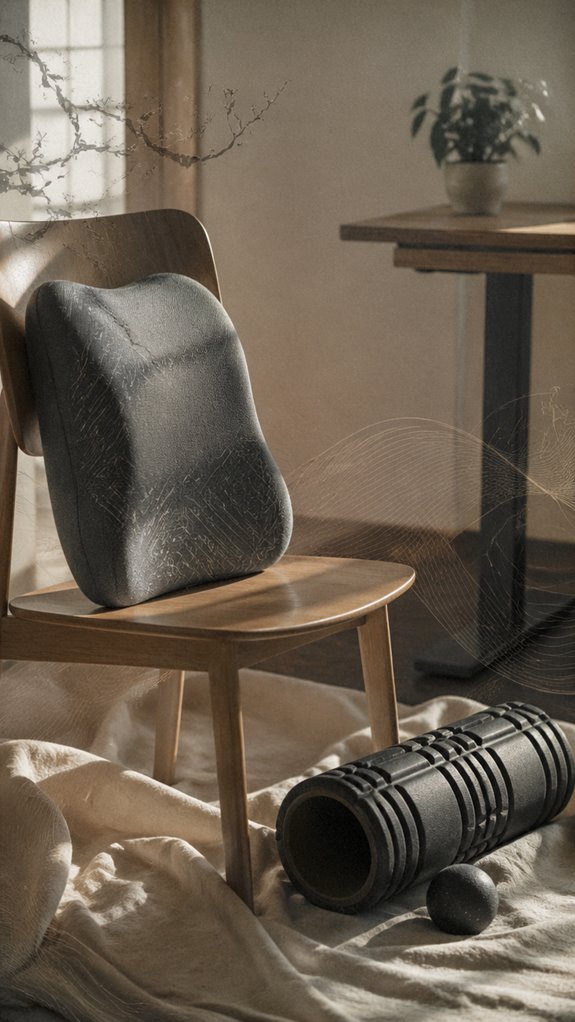
Invest in ergonomic seating infrastructure. A memory foam cushion functions as a load balancer, distributing pressure across your posterior chain rather than concentrating it at a single point of failure.
Standing desks operate like circuit breakers—interrupt prolonged sitting cycles every ninety minutes.
Finally, deploy postural optimization: sit with your pelvis anteriorly tilted, maintaining lumbar lordosis. Proper posture helps to alleviate discomfort and prevent further strain on your tailbone.
You’re fundamentally refactoring your skeletal geometry for production-grade stability.
How Your Seat Setup Causes (or Prevents) Tailbone Pain
Your seat’s geometry functions as the foundational architecture upon which your entire workday’s computational throughput depends—yet most developers treat it with the same negligence they’d reserve for legacy PHP code nobody’s touched since 2009.
Consider these critical variables:
- Seat height misalignment forces your pelvis into anterior tilt, compressing coccygeal tissue like a memory leak consuming heap space.
- Insufficient lumbar support degrades posterior chain stabilization, transferring load vectors downward.
- Cushion density determines pressure distribution; foam breakdown mirrors deprecated dependencies.
- Armrest geometry either stabilizes or destabilizes your entire skeletal stack.
In addition, maintaining optimal airflow with negative ion generators can enhance overall comfort and reduce fatigue in the office environment.
Your seat isn’t ergonomic theater—it’s infrastructure requiring empirical calibration.
Stretches and Recovery Moves Between Rides
Between commits, you’re fundamentally running a continuous integration pipeline on your skeletal architecture—and like any system under load, it’ll fail catastrophically without periodic flush cycles.
Your coccyx requires aggressive decompression protocols. Execute hip flexor stretches; hold thirty seconds per iteration. Implement pigeon pose as your primary debugging mechanism—it’ll expose compression artifacts throughout your posterior chain. Incorporating massage ball sets can enhance your recovery process by targeting specific muscle groups.
Perform cat-cow sequences to reboot spinal alignment. Deploy child’s pose between sprints; this rollback operation restores baseline system state. Regularly incorporating stretching exercises into your routine can significantly enhance recovery and overall flexibility.
Your tailbone isn’t sentimental infrastructure. It’s load-bearing hardware. Treat recovery moves as mandatory regression testing, not optional wellness theater.
Choosing a Saddle That Ends Tailbone Pressure
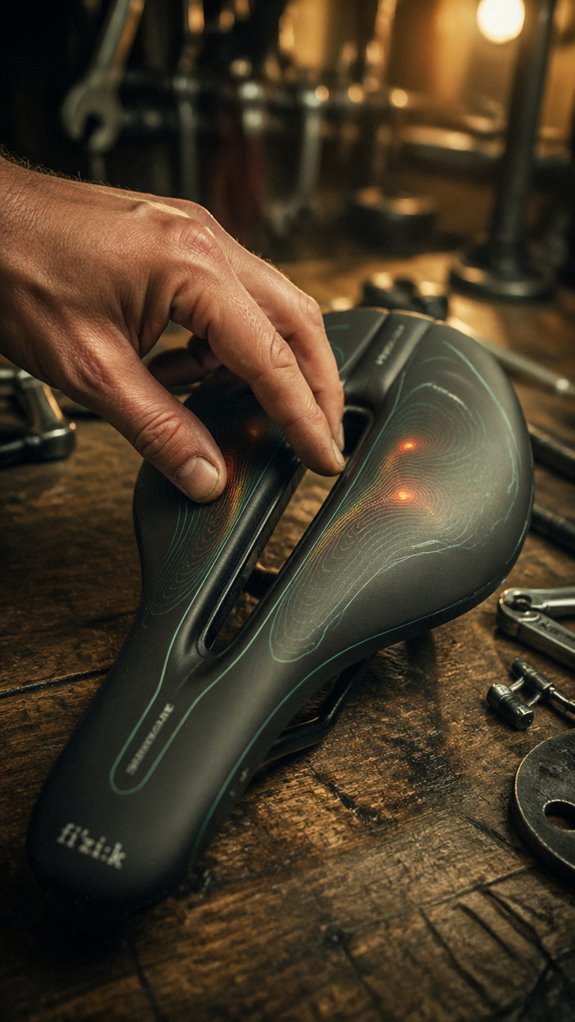
All the stretching and postural recalibration you’ve deployed won’t matter if you’re still running on deprecated hardware—specifically, a saddle that hasn’t been stress-tested against your actual skeletal geometry.
Your tailbone’s experiencing a critical system failure. You need:
- Cutout geometry matching your ischial tuberosity spacing
- Pressure-distribution mapping via professional fitting protocols
- Material density optimization—foam degradation isn’t a feature
- Temporal load testing across 90+ minute sprint intervals
Think of it as debugging your bio-mechanical stack. A misconfigured saddle creates cascading failures upstream. You’re fundamentally asking your spine to execute complex algorithmic tasks while the underlying infrastructure melts.
Upgrade the hardware. The problem isn’t willpower; it’s engineering.
When Tailbone Pain Needs a Doctor
When you’ve exhausted your debugging toolkit—the foam rollers, the ergonomic interventions, the saddle recalibrations—and the coccyx still reports critical errors at runtime, you’ve hit the threshold where self-remediation becomes counterproductive.
Persistent tailbone pain spanning weeks demands professional diagnostics. Your orthopedic specialist functions as a system architect, identifying root-cause failures: fractures, coccygeal misalignment, or bursitis requiring intervention beyond configuration tuning. Additionally, numb legs from office chairs can exacerbate tailbone discomfort and should be addressed.
Schedule consultation when pain persists despite optimization attempts, radiates down your lower extremities, or severely degrades your sprint velocity. Imaging diagnostics—X-rays, MRI scans—provide telemetry your intuition cannot.
This isn’t weakness; it’s acknowledging hardware limitations and escalating appropriately.
Gel Seat Cushion Helped Immediately
How does one persist in debugging a distributed system when one’s own chassis refuses to cooperate?
I’d exhausted conventional interventions—standing desks, ergonomic keyboards, the usual DevOps theater. Then I acquired a gel seat cushion, and the system stabilized immediately:
- Pressure redistribution across the coccygeal region eliminated hotspots
- Viscoelastic material adapted to postural drift during marathon debugging sessions
- Thermal regulation prevented the classic “sitting too long in production” scenario
- Recovery time between sprints decreased measurably
The cushion functions as middleware between biological substrate and unforgiving furniture. Sometimes infrastructure upgrades yield disproportionate returns. The top ergonomic chairs can also provide support for prolonged periods of sitting without discomfort. Additionally, incorporating focus supplements can further enhance cognitive performance during extended work sessions.
My throughput recovered. The ghost in this particular machine appreciates functional hardware.
Prolonged Sitting Causes Tailbone Pain
The gel cushion’s immediate ROI shouldn’t obscure a deeper architectural problem: you’re still executing eight to twelve hours of sequential stack traces while your coccyx absorbs cumulative load like a memory leak nobody bothered to profile.
Your tailbone isn’t designed for sustained compression. It’s a vestigial debugging artifact, fundamentally incompatible with sprint-cycle workstations. Each hour compounds skeletal strain—inflammation cascades through fascia layers like cascading failures in poorly instrumented microservices. Incorporating gel wrist rests that provide support and comfort can help mitigate discomfort during long periods of sitting.
You’re fundamentally running production code on deprecated hardware. The pain signals aren’t bugs; they’re legitimate warnings you’ve systematically ignored through log suppression. Incorporating essential oil diffusers can enhance your workspace environment by promoting a calm atmosphere and reducing tension.
Coccyx Nerve Compression Issues
Since you’ve optimized your sitting posture to near-algorithmic perfection yet still can’t access the lower half of your own codebase without shooting pain signals like deprecation warnings, you’re probably dealing with coccyx nerve compression—a system-level architectural failure that no ergonomic middleware will resolve.
Your tailbone’s neural pathways are throwing stack overflow exceptions:
- Sustained pressure compresses the pudendal nerve against ischial tuberosities.
- Inflammatory cascades trigger neuropathic pain signals during extended compile cycles; top psoas massage devices can aid in alleviating some of that discomfort.
- Postural compensation patterns create secondary compression layers.
- Desk-bound sedentary load exceeds tissue tolerance thresholds.
You’ve encountered hardware limitations masquerading as software problems. Decompression intervention—standing desks, specialized cushioning, physical therapy—constitutes mandatory system maintenance, not optional optimization. Additionally, incorporating snacks for focus can provide much-needed energy during long hours of coding.
FAQ
Can Tailbone Pain From Cycling Become a Permanent Chronic Condition?
Yes, you can develop chronic tailbone pain from cycling if you don’t address it promptly. You’ll want to correct your bike setup, seat choice, and riding posture immediately to prevent permanent nerve or tissue damage.
Are There Specific Exercises That Strengthen the Coccyx Area?
You can’t directly strengthen your coccyx—it’s fused bone. Instead, you’ll fortify the surrounding gluteal and core muscles. Target your glutes and deep stabilizers through bridges, planks, and clamshells. You’re building the protective musculature that prevents pressure overload.
How Long Does It Typically Take to Recover From Tailbone Injury?
You’ll typically need 8-12 weeks for a tailbone injury to heal, though you can resume modified activities within 2-3 weeks. Your recovery speed depends on injury severity and you’re adhering to proper rest and support protocols.
What Medications or Supplements Help Reduce Coccyx Inflammation?
You’ll benefit from NSAIDs like ibuprofen or naproxen to reduce inflammation. Curcumin supplements, omega-3 fatty acids, and collagen support tissue repair. You shouldn’t self-treat severe cases; consult your physician for best protocols.
Does Cycling Intensity or Cadence Affect Tailbone Discomfort Levels?
You’ll discover that your posterior’s tender region responds differently based on cadence and intensity. Higher cadences reduce direct pressure impact, while aggressive sprinting amplifies posterior discomfort through increased seated force distribution.