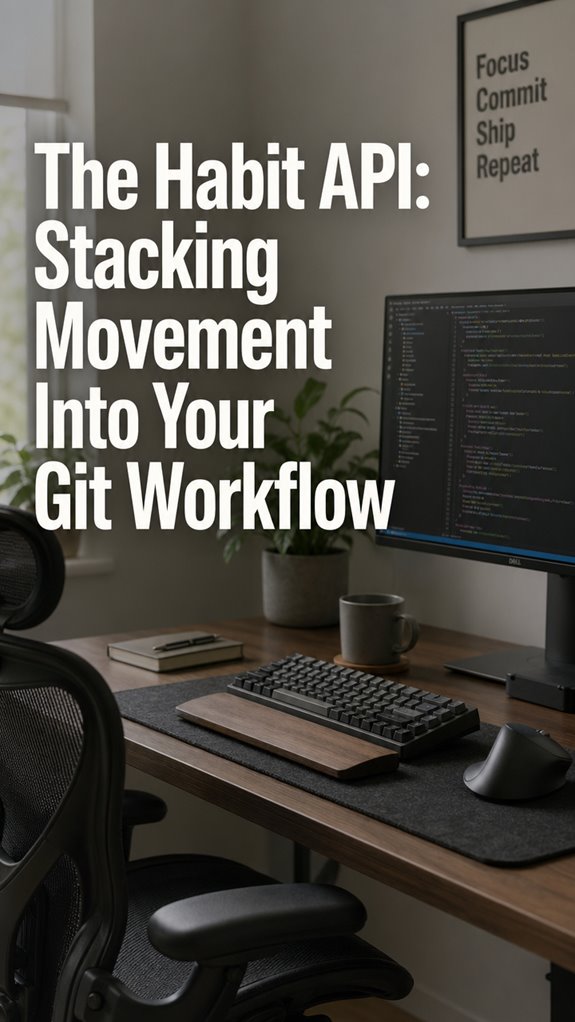
Ever feel like your body is compiling errors while your code runs clean? I found my answer in the Habit API: movement stacked into Git hooks.
Three months ago, my back staged a revolt. Commit 847. Sharp pain. I was 28 going on 80, hunched over like a question mark. My IDE looked fine. My spine disagreed.
Now? Pre-commit hooks force me to stand. Push triggers a stretch timer. It’s ridiculous. It’s effective. My repository has become my personal trainer, and honestly, it’s the only accountability partner that hasn’t ghosted me.
The chaos doesn’t disappear. I just debug my body alongside my code.
—
Chronic Back Pain from Coding: How I Hacked My Git Workflow to Fix My Posture
The warning signs were pathetic. A twinge during a merge conflict. Numbness that felt like “falling asleep” but never woke up. I bought a standing desk, used it for three days, then “temporarily” sat back down for eight months.
My breaking point wasn’t dramatic. It was a Tuesday. I reached for coffee and something in my lower back whispered: *we’re done here*. MRI confirmed what I feared: early disc degeneration at 29. The doctor’s advice? Move every 20 minutes. I laughed. Deadlines don’t respect Pomodoro timers.
That’s when I weaponized my existing workflow. Git hooks became my enforcement mechanism. Pre-commit: stand up. Post-merge: walk to kitchen. The Habit API formalized what I was duct-taping together. Ergonomic automation, developer health, sedentary lifestyle risks, repetitive strain injury prevention. My commit graph now tracks code and survival. Both are green.
Quick Takeaways
- Integrate physical movement cues into Git actions like commits or pushes to reinforce productive habits.
- Automate reminders for movement breaks triggered by system hooks or environmental changes.
- Use tools like habit trackers to monitor progress and reinforce consistent movement practices.
- Design ergonomic workflows by combining movement with routine Git tasks to reduce strain and improve focus.
- Address cue inconsistencies by maintaining environment stability and adapting triggers to physical and mental states.
What Is the Habit API and How Can It Improve Your Git Workflow
In the grand, tragically inefficient ballet of software engineering, where even the most meticulously crafted CI/CD pipelines are compromised by entropy, the notion of a Habit API emerges as a stroke of digital nihilism—optimally designed to optimize human inertia within your Git workflow.
You reinforce behavior through task automation, chaining mundane actions into a semblance of control amid perpetual chaos. By integrating movement triggers—like post-commit stretches—you engineer a systematic feedback loop, subtly conditioning your productivity. Incorporating balance boards into your workspace can further enhance your overall wellness and mitigate the physical strain of prolonged sitting.
In an environment where your mental cortex barely keeps pace with the relentless, fractal collapse of codebases, the Habit API stands as the last bastion of purposeful engineering—designed to sustain chaos through mechanical reinforcement.
How Movement Stacking Builds Better Development Habits
When the relentless entropy of software development undermines your carefully orchestrated CI/CD pipelines, it’s tempting to conclude that human habits are the weakest link—or the only hope for maintaining some semblance of order. Psychological theories suggest that habit formation hinges on cues, responses, and rewards, an architecture as fragile as your last successful prod deployment. Incorporating movement breaks into your routine can significantly improve focus and overall productivity. Furthermore, adequate sleep has been shown to enhance cognitive function, making it crucial to prioritize rest as well.
| Trigger | Action | Result |
|---|---|---|
| After push, | Do stretches | Reduce burnout |
| Starting terminal session | Log daily coding velocity | Measure progress |
| After fixing bugs, | Rebase and review as code ritual | Cement behavior |
Seamlessly Integrating Movement Into Push and Commit Processes
Amidst the relentless entropy of your pipeline—where build failures, flaky tests, and CI misconfigurations threaten to drown even the most disciplined developer—adding physical movement seems like a naive hack, not an upgrade.
Yet, by embedding movement into push and commit processes, you enhance accessibility, making workflows more inclusive. This fosters team collaboration, transforming isolated coding into a coordinated ballet, reminiscent of “Ghost in The Shell”’s synchronized DAOs.
Simple triggers like stretching after a commit or a quick walk post-push cascade into systemic resilience. Physiology and software dance together, subtly reinforcing mental clarity, even amidst the chaos of automations failing and scripts choking—an absurd but necessary evolution.
Real-World Examples of Habit Stacking Using the Habit API

Counteracting the relentless entropy of modern development workflows often feels like trying to stabilize a distributed system that’s perpetually on the verge of consensus failure.
Your mental cues, like the ritualistic push for `git push`, serve as analogs to system hooks—triggers for habit tracking. With the Habit API, stacking movement becomes an atomic operation, akin to patch management in Git: after any commit, you stretch, then log progress in `habits.org`. Frequent wrist exercises can help alleviate discomfort during those moments of pause.
It’s the software equivalent of the “Ghost in the Shell”—a machine learning of your bodily processes manifesting out of necessity, not desire. Repeatedly, this enforces a predictable response pattern amid chaos.
The absurdity of coding habits into biological hardware remains the ultimate challenge. Adding heated desk mats to your workspace can enhance comfort and support mindful movement, making it easier to stay productive.
Troubleshooting Common Challenges When Using Movement Habits in Git
Even the most robust CI/CD pipeline can sputter when faced with a cascade of physiological bugs—muscle fatigue, inconsistent cues, or misaligned triggers—that sabotage your attempts to embed movement habits within your Git flow.
The system’s failure often stems from overlooked details: neglecting mindful awareness of physical cues, misjudging habit reflection, or installing a brittle trigger chain.
Dissected into granular physiological data, fatigue or nervous tension translates into execution errors, akin to a “Ghost in the Shell” malfunction.
Debugging this requires treating habit integration as infrastructural maintenance—regular refactoring of cues—ensuring each trigger compiles cleanly before pushing. Incorporating effective relaxation techniques after coding sessions can also help mitigate these physiological bugs.
Using Habit Stacking on Git
When the automated CI pipeline refuses to build, you quickly realize failures aren’t merely code errors—they’re rooted in the fragile OS of our habits, triggers misfiring like a corrupted firewall. Incorporating blue light into our understanding helps us perceive how various stimuli can impact our workflow and focus.
Habit stacking on Git transforms workflow optimization from a naive hope into a ruthless strategy; a way to automate behavioral chaining amid relentless code review demands. After pushing a commit, I’ve programmed my mind to execute a stretch—no mental bandwidth wasted on distraction.
This cascade of movement enforces discipline, reducing cognitive overhead. By aligning habits with Git events, I refine my process, turning my human hardware into a lean, mean, refactored machine. Ghost in the shell approved. Incorporating top chlorophyll drops into my daily routine further enhances my focus and energy, ensuring I stay sharp during those long coding sessions.
Inconsistent Cue Triggers
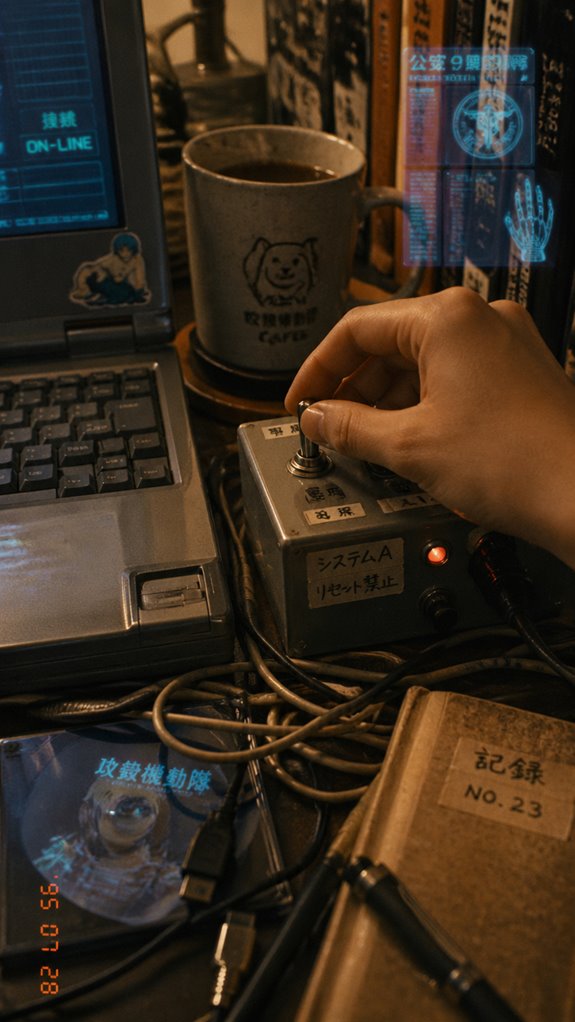
In the complex architecture of human habits, the real Achilles’ heel often manifests as inconsistent cue triggers—those unpredictable, ephemeral signals that short-circuit well-oiled behavioral loops just when you think you’ve patched the core logic. Environmental resets, like switching IDEs or hardware failures, create cue inconsistency that sabotage reinforcement pathways. Like a rogue thread in multi-threaded code, these shifts disrupt the habit thread, making it brittle. Tracking patterns reveals latent triggers—boredom, fatigue, or location shifts—that yield little hope for seamless automation. Without addressing environmental resets explicitly, you risk a cascading failure, akin to “Ghost in the Shell” losing sync, and regress back to manual intervention. Utilizing strategies from hot and cold therapy can help in managing the emotional states influenced by these triggers. For instance, utilizing an ice roller can provide a refreshing respite during stress, counteracting the impact of such cue inconsistencies.
| Environment Shift | Time Shift | Emotional State |
|---|---|---|
| Hardware upgrades | Change workload | Stress, fatigue |
| New workspace | Late hours | Boredom |
| Moving homes | Off-peak hours | Anxiety |
| Remote work setup | Unexpected events | Frustration |
| Office chaos | Disrupted routines | Distraction |
Automating Commit Messages
Automation of commit messages serves as the logical extension of a developer’s relentless quest to preempt human error amid the chaos of complex codebases—think of it as an attempt to replicate the reliability of a well-oiled CI/CD pipeline, while fighting the entropy of cognitive fatigue.
Automated commit messages mimic the precision of pipelines, combating cognitive fatigue and ensuring dependable, consistent code evolution.
Harnessing automation techniques for habit formation, you embed this discipline into your workflow, ensuring consistency despite mental deterioration.
It’s like the “Ghost in The Shell”: an elegant interface between intent and execution, bypassing the mental firewall of repetitive detail.
This is power—less tedium, more robustness, even as your brain’s processor reaches thermal limits.
Prioritize Ergonomic Workspace Setup
Operating within the confines of your built environment often mirrors debugging a sprawling codebase—layers of failure cascade from macro-system neglect into micro-physiological errors, ultimately grinding productivity to a halt. You neglect ergonomic principles at your peril, turning workspace ergonomics into a low-priority patch while system lags manifest as chronic discomfort or repetitive strain. It’s the equivalent of running a production build with deprecated dependencies.
Untimed, these hardware/software mismatches increase cognitive load—akin to “Ghost In The Shell” trying to interface with a corrupt neural net. Prioritizing ergonomic workspace setup isn’t optional; it’s an essential hardware/software patch preventing your physical chassis from becoming an obsolete legacy. Implementing desk productivity hacks serves as a pivotal strategy to enhance your efficiency and well-being in this increasingly digital landscape. Furthermore, adopting full-body posture tips can significantly reduce the risk of discomfort, creating an environment where both your mind and body can function optimally.
FAQ
How Can I Customize Movement Triggers for Different Git Workflows?
You can customize triggers for different git workflows by identifying key actions and associating them with specific habits, enhancing workflow flexibility. This empowers you to seamlessly integrate desired movements, making habit stacking more targeted and effective.
What Are Effective Ways to Measure Habit Stacking Success in Development?
You measure habit stacking success through progress tracking and motivation boosters, monitoring commit consistency and workflow integration, then analyzing how these habits enhance productivity, discipline, and momentum, empowering your growth and mastery in development.
Can the Habit API Be Integrated With Non-Git Tools or Platforms?
Yes, you can leverage third-party integrations and guarantee cross-platform compatibility to extend the Habit API beyond Git tools, empowering you to embed habit stacking seamlessly across diverse platforms, maximizing your productivity and behavioral impact efficiently.
How Do I Prevent Habit Fatigue When Stacking Multiple Movement Routines?
Visualize a sturdy bridge supporting your routine, preventing habit fatigue. By strategically timing habit triggers, balancing intensity, and varying routines, you maintain power and momentum, ensuring sustained strength without burnout.
Are There Recommended Scripts or Plugins to Automate Habit Cues?
You can power up your habit tracking with automation scripts like Hook, AutoHotkey, or custom shell scripts that trigger cues based on your Git actions. These tools streamline routines, ensuring consistent, fatigue-free habit stacking for maximum efficiency.
Summary
Ultimately, neglecting ergonomic habits and automation in your Git workflow resembles Gabriel’s lament in *Ghost in the Shell*: a human trying to decode complex systems amid collapsing infrastructure. Implementing the Habit API allows you to embed movement into your commit dialect—think of it as patching the GUI crash of your daily grind. When your reflexes automatically trigger ergonomic setups or scripted commits, you sidestep the chaos—saving you from being yet another developer lost in the machine’s labyrinth.
References
- https://news.ycombinator.com/item?id=27305521
- https://www.youtube.com/watch?v=GQQqf-C2ha4
- https://ejpcmac.net/blog/about-my-git-workflow/
- https://idratherbewriting.com/blog/routines-and-habit-stacking
- https://blog.devops.dev/mastering-git-workflows-the-enterprise-developers-guide-to-shipping-code-that-actually-works-e61fc743ff76
- https://lyz-code.github.io/blue-book/habit_management/
- https://github.com/RamitRoshan/habit-tracker
- https://www.upskillist.com/blog/interruptions-in-habit-formation-science-explained/
- https://www.drpaulmccarthy.com/post/why-your-habits-fail-the-science-of-lasting-change
- https://drjud.com/what-is-the-habit-loop/
- https://jamesclear.com/habit-triggers
- https://optionalitylife.substack.com/p/update-deep-dive-one-size-does-not
- https://pmc.ncbi.nlm.nih.gov/articles/PMC11297519/
- https://www.tandfonline.com/doi/full/10.1080/23311908.2022.2041277