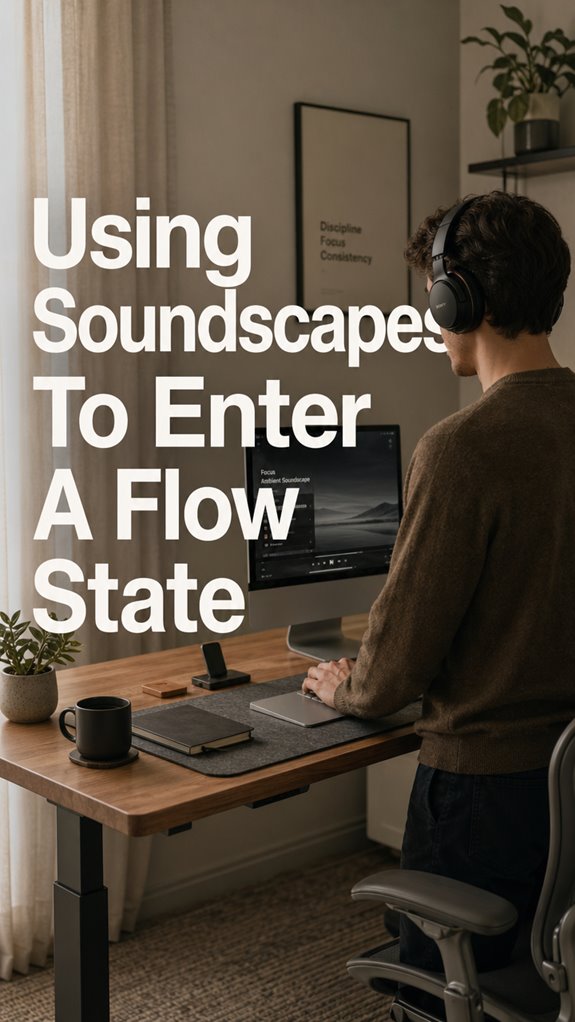
Ever feel like your brain’s buffering at 3% while Karen from accounting won’t stop laughing at some viral TikTok? Same. That’s when I discovered soundscapes weren’t just for hippies with too many houseplants.
I used to think white noise was boring. Then I tried coding with actual construction drilling thirty feet away. Desperation led me to binaural beats. Suddenly, four hours dissolved. My Git commits made sense. My posture still suffered, sure, but my focus? Locked in like a well-timed mutex.
The weird part? I need different frequencies for different tasks. Debugging? Theta waves. Code review? Lo-fi hip hop. It’s embarrassing how fragile my attention span is, but at least I’m honest about it.
How I Accidentally Destroyed Productivity With the Wrong Spotify Playlist
Last Tuesday, I made a catastrophic error. Switched from my curated “Deep Work” playlist to a friend’s “Cozy Coding” recommendation. It started innocently enough: gentle rain, distant thunder. Then a piano melody dropped. A good one. Like, *emotionally compelling* good. I spent forty-five minutes building a nostalgia-fueled Spotify playlist instead of fixing a production bug in our payment gateway. My Slack status stayed green. My soul left my body. Now I keep a backup playlist strictly instrumental, no chord progressions that might awaken something in me. Sound design is architecture. Treat it carelessly and your entire mental scaffolding collapses into an afternoon of acoustic guitar covers and self-loathing.
Quick Takeaways
- Use layered soundscapes, like white noise and ambient textures, to mask distractions and maintain focus.
- Incorporate binaural beats targeting alpha waves to enhance brainwave entrainment for deeper immersion.
- Ensure sound environment consistency and predictability to sustain mental stability and facilitate flow.
- Employ noise-canceling headphones to create an isolated, optimized auditory space free from external disruptions.
- Regularly calibrate and test sound layers to identify and reinforce the most effective auditory stimuli for flow.
Why Soundscapes Boost Your Focus and Flow State
When your cognitive pipeline begins to backpropagate errors—those unavoidable lapses in focus, neon-garlanded alerts from task managers, and sporadic memory leaks—soundscapes function like a system patch, boosting throughput on your mental mainframe. They serve as a real-time debugger, filtering out background noise and providing a predictable auditory rhythm—your program’s heartbeat.
Scientific tests mimic debugging sessions: soundscapes coordinate neural processes, improve signal-to-noise ratios, and deepen focus akin to a well-optimized code refactor. Research shows that white noise can enhance concentration and productivity, making it an effective tool for sustained mental engagement.
Like “Ghost in the Shell,” your mind becomes a sleek, interconnected system, where ambiance acts as the essential middleware, maintaining operational integrity amidst chaos.
How to Choose the Right Soundscape for Your Goals
In the labyrinthine architecture of mental multitasking, selecting the most suitable soundscape functions as a critical dependency injection—an environment variable that can either enhance your cognitive throughput or trigger a cascading failure of focus.
Choosing unwisely risks a systemic crash akin to Ghost in the Shell’s infiltration—integrity compromised at the kernel level. You need to avoid known memory leaks like distracting chatter or random environmental noise.
Scope your goals: if your task demands atomic precision, prefer binaural beats for brainwave entrainment.
If you want the system to stay in a lean, mean, flow-ready state, nix the percussive overhead and stick to ambient textures—like patching your mental OS.
Setting Up the Perfect Sound Environment
Establishing a sound environment that minimizes cognitive exceptions and prevents system overload is akin to debugging a legacy codebase riddled with memory leaks—those persistent chatter and environmental noise causing crashes mid-merge.
You need a finely tuned middleware—noise-canceling headphones like Sony WH-1000XM or Bose SoundLink, acting as firewall filters—eliminating intrusive background processes.
White noise generators such as Marpac Dohm serve as system resets, masking dissonant user inputs.
Overlay this with binaural beats, targeting alpha wave entrainment, to sync your neural processes.
It’s a delicate, precision-driven operation—an audacious attempt to emulate “Ghost In The Shell” logic, now rebranded as your daily workflow. Additionally, consider including glucose monitors to track your body’s responses, as maintaining stable energy levels can further enhance focus and effectiveness during work sessions.
Best Practices for Using Soundscapes During Work
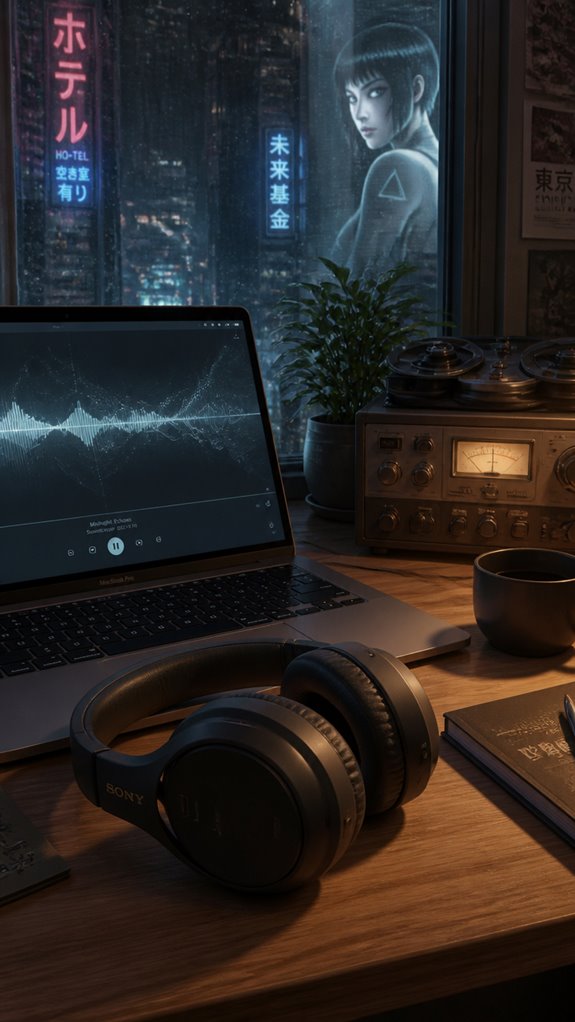
Amidst the relentless cascade of notifications, multitasking, and the digital equivalent of trying to debug a legacy codebase with memory leaks, it’s essential to prioritize the integrity of your auditory environment—lest your cognitive stack collapse under pressure.
- Establish a dedicated sound environment—like isolating your debugger, use noise-canceling headphones (Sony whispers sweet shutdowns).
- Leverage brainwave entrainment—sync with 8Hz alpha waves, ratchet down the chaos, similar to a debugger pausing on a breakpoint.
- Implement layered noise masking—combine white noise with binaural beats, akin to running multiple test cases to catch edge bugs.
- Avoid paradoxical sonic stimuli—skip playlists that collide with task priorities; even “Ghost in the Shell” would throw up its hands.
Troubleshooting Common Soundscape Challenges
When your carefully curated soundscape algorithm begins to throw exceptions—glitchy chimes, abrupt silence, rogue background noise—it’s not panic; it’s debugging your sensory input pipeline.
Think of yourself as a Ghost in the Shell debugging the glitch in the matrix of auditory cognition. First, isolate the source—test individual layers like native plugins (e.g., myNoise, Noisli) or hardware interfaces (noise-cancelling headsets, speakers).
It’s likely a bug in data streaming, bandwidth throttling, or phantom interference causing buffer overflow or latency spikes. Recall, a systemic failure in the auditory ecosystem reveals your mental CPU’s limitations—so debug accordingly. Consider exploring the benefits of ergonomic devices as they can enhance your overall comfort and focus during long sessions of soundscape immersion.
Quiet Meditation Headphones Experience
In the domain of long coding sessions, where your mental JVM is continually garbage collecting itself to manage relentless stacks of bugs, the quiet headphone experience offers a paradoxical oasis—if you can get past the initial sandbox burst errors.
Here’s what controls your flow:
- Noise cancellation overrides competing signals like background traffic logs or error pop-ups.
- Passive ambient filtering directs cognitive resources toward the task at hand.
- Precision soundscape calibration—like fine-tuning a debugger—improves focus without jarring interruptions.
- Deterministic audio delivery ensures the soundscape is as predictable as expected exceptions—no surprises.
Ultimately, it’s about maintaining system stability amidst chaos; “Ghost in the Shell” would approve. Additionally, incorporating weighted eye masks during relaxation breaks can enhance your overall focus and comfort level.
Inconsistent Binaural Beat Effects
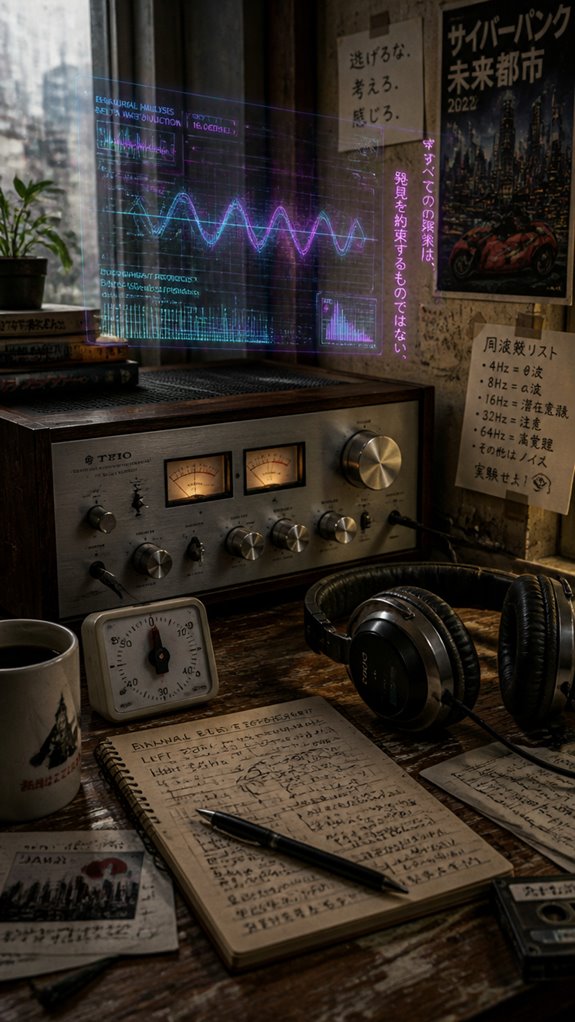
The quest for consistent effects from binaural beats resembles debugging a legacy codebase with unpredictable side-effects—some days it compiles, others it crashes without warning.
In the domain of neurodigital interfaces, EEG entrainment is the artifact of scattered patches, often null, sometimes producing those cryptic “success” logs, yet leaving your system’s core stability compromised.
Despite promising kernel updates at 10Hz or 40Hz, results oscillate like a flickering buffer. It’s as if the binaural algorithm itself has a ghost in the shell, selectively applying effects—sometimes powerfully, sometimes not at all—defying the most elegant of neural hypotheses. However, the potential for enhanced focus through binaural beats remains a compelling reason to explore their use in deep work.
Customized Neuro-Ergonomic Interventions
Amidst the chaos of system-wide cognitive overload—those inevitable memory leaks in neuronal pathways—customized neuro-ergonomic interventions emerge as the patch fix for an otherwise unruly and very glitch-prone interface.
To optimize your neural firmware:
- Deploy targeted brainwave entrainment tools, like alpha wave binaural beats, akin to patching race conditions in critical code.
- Incorporate ambient soundscapes designed specifically for your mental buffer size—think of it as throttling data streams before crashing.
- Use noise-cancelling hardware, similar to disabling non-essential debugging logs, to minimize irrelevant stimuli.
- Continuously monitor neurofeedback metrics, because, unlike a crash dump, your brain’s logs reveal root causes—if you know where to look.
Work-From-Home Ergonomics Tips
Counteracting systemic cognitive bottlenecks in a productivity environment wired more like a distributed system than a human body requires a strategic overhaul of your ergonomic substrate.
Your corporeal hardware—riddled with micro-fractures akin to unpatched bugs—becomes the critical failure point, sabotaging runtime uptime.
Invest in sit-stand desks, ergonomic keyboards, and targeted tissue refactoring tools, akin to firmware patches for latency spikes.
Ditch the static posture for dynamic load balancing, ensuring your skeletal kernel doesn’t crash during long compile sessions.
Bear in mind: even Major Motoko Kusanagi would envy your ability to debug hardware faults—if only your sensor array didn’t keep overheating.
After all, Ghost in the Shell’s lesson remains: bad infrastructure always crashes the system, eventually.
Incorporating full-body posture adjustments can significantly enhance your productivity and comfort in the long run.
FAQ
How Long Should I Listen to a Soundscape to Achieve Flow?
You should listen to a soundscape for at least 15-30 minutes, giving your mind enough time to shift into flow. Ironically, pushing past initial distraction often takes patience, but with control, you transform listening into focus mastery.
Can Soundscapes Replace Traditional Meditation or Mindfulness Practices?
Soundscapes can enhance your meditation or mindfulness but shouldn’t fully replace traditional practices. Use them as tools to deepen focus, relax your mind, and manage distractions, complementing your existing routines for a personalized, controlled mindfulness experience.
What Are the Signs I’m Using the Wrong Type of Soundscape?
If you’re using the wrong soundscape, you might notice increased distractions; studies show environmental noise has minimal impact, so if your focus dulls or you feel restless, switch to more consistent, calming sounds like ambient pads or nature sounds for control.
Are There Any Health Risks Associated With Prolonged Soundscape Exposure?
Prolonged soundscape exposure may cause hearing fatigue, distraction, or sleep disturbances if not managed. You can mitigate risks by controlling volume, taking breaks, and choosing calming sound types, ensuring your environment stays safe and your focus sharp.
How Do Individual Preferences Influence Soundscape Effectiveness?
Your preferences shape your sonic garden, guiding which sounds bloom best for focus. You wield control, choosing ambient waves or nature’s whisper, crafting your personal soundtrack that harmonizes with your mind’s unique rhythm, revealing ideal flow.
References
- https://audiogroover.com/the-serene-soundscapes-of-flow-state/
- https://www.status.co/blogs/the-journal/the-best-sounds-for-achieving-flow-state-hint-it-might-not-be-music
- https://pmc.ncbi.nlm.nih.gov/articles/PMC9265835/
- https://www.youtube.com/watch?v=h4PTtjOgHoU
- https://www.youtube.com/watch?v=CO1TDz-ycCI
- https://open.spotify.com/album/0NIhXrCB0VXV6Bw6GHjHbs
- https://music.youtube.com/browse/MPREb_KcRRIT3EzKF
- https://www.youtube.com/watch?v=GRawmiIr2pc
- https://www.youtube.com/watch?v=8dr1qT7AGlg
- https://www.youtube.com/playlist?list=PLjvGKGzTSZiM_Q2w0hjdXp50zN1L0ca7r
- https://knowingneurons.com/binaural-beats/
- https://openpublichealthjournal.com/VOLUME/17/ELOCATOR/e18749445332258/FULLTEXT/
- https://pmc.ncbi.nlm.nih.gov/articles/PMC11290623/
- https://pmc.ncbi.nlm.nih.gov/articles/PMC10198548/
- https://www.youtube.com/watch?v=HKRe-y04Z34