

Ever felt that burning ache in your wrists after an eight-hour debugging marathon? I have. Ice became my unlikely savior.
Three months ago, my right wrist staged a full rebellion. Typing felt like grinding glass. My doctor’s prescription? Cold therapy. Twenty minutes, every few hours, wrapped in a towel. The relief was almost embarrassing in its simplicity.
The constriction slows inflammation. The numbness buys you time. It’s not elegant, but neither is my posture at 2 AM.
Does it fix everything? No. But it keeps me functional while I figure out the real problem: my desk setup, my habits, my refusal to take breaks.
—
Wrist Pain From Coding: My Wake-Up Call at 3 AM
I ignored the warning signs for weeks. The tingling. The stiffness. Then came the night I couldn’t finish a deploy because my hand simply… stopped. Panic set in. I iced aggressively, researched ergonomic keyboards, and finally admitted my $20 Amazon special mouse was sabotaging me. That crisis forced me into proper ergonomics, stretching routines, and regular movement breaks. Sometimes your body crashes harder than any production server. Listen before it does.
Quick Takeaways
- Use ice packs wrapped in a cloth and apply to the wrists for 20-minute sessions to decrease inflammation from typing strain.
- Ice every 2-3 hours within the first 72 hours post-overuse to prevent swelling and promote recovery.
- Avoid direct contact with ice to prevent frostbite; maintain even, firm pressure without tightening.
- Supplement icing with ergonomic adjustments and wrist supports to reduce ongoing strain.
- Limit icing sessions to prevent tissue damage and follow proper protocols to ensure safe, effective inflammation reduction.
How Wrist Icing Helps Reduce Pain and Inflammation
When your wrists suffer a hardware malfunction—akin to a memory leak in your meticulously crafted code—the immediate response often overlooked is cold application, a sort of software patch for biological bloat.
Cold therapy numbs nerve signals, effectively halting pain processing modules, and constricts blood flow, reducing inflammation logs clogging your synaptic pathways.
This deliberate shutdown inhibits prostaglandin E2— a critical error message in the pain kernel—freeing you from immediate discomfort, albeit temporarily.
Like rebooting a crashed system, icing recalibrates inflammatory response parameters, giving your “biological server” a necessary quick-fix.
Ghost in the shell, indeed—just human hardware requiring cold storage to stay operational.
How to Ice Your Wrists Properly: A Step-by-Step Guide
In the grand architecture of injury management, executing a proper icing protocol resembles debugging a catastrophic memory leak—meticulous, algorithmic, and devoid of unnecessary verbosity. First, confirm your “cold source” is correctly initialized: frozen vegetables, ice packs, or bandages, wrapped securely in a cloth. Avoid direct contact—think of it as protecting your API from null pointer exceptions. Apply the “cold module” on the wrist, maintaining firm, even pressure with minimal tightness to prevent circulation errors. Run this process for exactly 20 minutes, then pause. Incorporating ergonomically designed compact mechanical keyboards can further help reduce wrist strain and improve your typing posture. Like patching code, precision and timing are critical—otherwise, you risk system crash, or in this case, frostbite.
When and How Often to Ice Your Wrists for Best Results
Neglecting a consistent icing schedule after tripping the system—akin to letting a memory leak run unchecked—can prolong the runtime degradation, manifesting as increased swelling and pain.
You must automate your cold protocol:
- Ice every 2-3 hours within the first 72 hours—think of it as patching bugs before system crashes.
- Limit each session to 20 minutes—avoid overclocking your tissues, or risk irreversible damage.
- Schedule redundancy; don’t skip doses—cumulative effects override short-term gains.
- Use proxies like frozen veggies or bandages—your middleware for ideal cold transfer—because direct contact is a memory dump waiting to happen.
Additionally, maintaining comfortable indoor air can support your overall well-being during recovery.
Common Mistakes to Avoid When Using Ice on Your Wrists
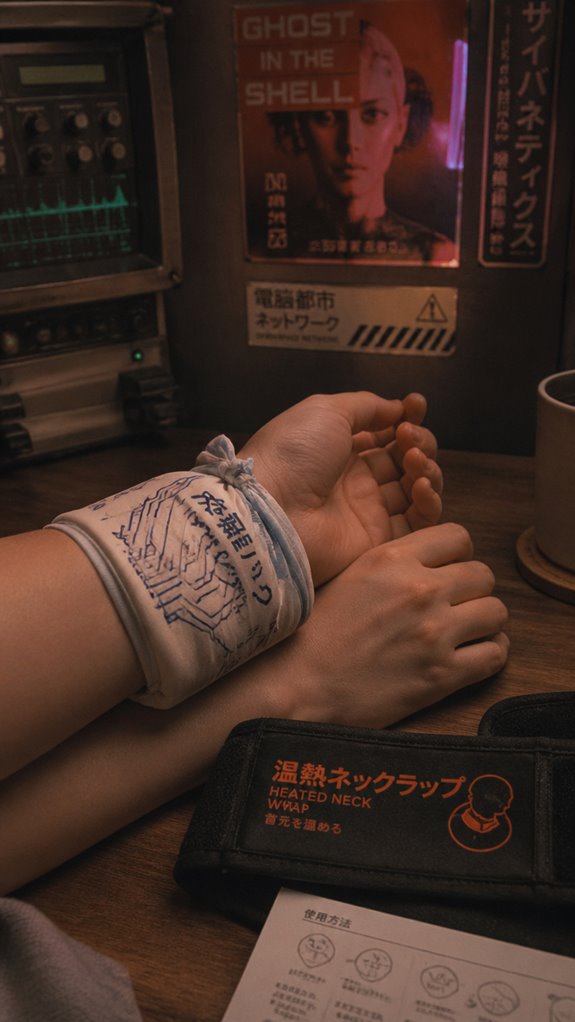
Implementing ice therapy without proper safeguards is akin to deploying a faulty patch—your system may crash instead of repairing. As a senior dev, you know that skipping checks leads to buffer overflows, and neglecting basic protocols risks system-wide failures.
Applying ice directly onto your wrist is like bypassing user authentication—convenient but catastrophically reckless. Overservicing with cold may numb the pain temporarily, but it can also cause frostbite (or, in dev terms, a hard crash).
Think of it as ensuring code stability; if not, your hardware (or humanity) will end up bugged, demanding a rollback—preferably before “Ghost in the Shell” becomes reality. Additionally, using heated neck wraps can provide soothing warmth to help alleviate stiffness in the wrists after icing.
Additional Tips for Faster Wrist Recovery and Better Pain Management
Achieving faster wrist recovery and more effective pain management hinges on orchestrating a robust, multi-layered protocol—akin to debugging a malfunctioning server before launching a critical update.
You must prioritize system integrity: optimize your pipeline like a veteran coder clearing memory leaks, executing incremental patches with surgical precision.
- Debug inflammation triggers with targeted, evidence-based interventions.
- Deploy anti-inflammatory code snippets—NSAIDs or ergonomic tweaks—without causing system crashes.
- Suspend non-essential processes—distraction or overexertion—that could cause CPU overload.
- Log every symptom to fine-tune your healing algorithm, avoiding the ghost in the shell of your injury.
- Incorporate ice therapy as a natural method to alleviate inflammation and pain in your wrists.
Control your environment; don’t let chaos syntax your recovery.
Cold Gel Packs I Tried
These packs, brands like FlexiKool, operate on a simple premise: flood the affected node with a cool payload, shutting down the inflammatory processes temporarily. Just like testing a new script, I applied, monitored, and adjusted—except instead of code, it’s my biological system rebooting under external command. The efficacy of such treatments is often compared to that of heated neck wraps, known for providing muscle relaxation and relief.
The absurdity is science’s version of system logs, logged in flesh.
Skin Irritation Risks

When deploying aggressive ice protocols—think of it as patching a core system vulnerability—you might inadvertently trigger a cascade of skin irritation errors, much like a poorly handled memory leak crashing your CLI.
- Redness signals an overextension of vasoconstriction, risking a kernel panic in skin health.
- Prolonged cold exceeds the 20-minute guardrail, eyeing frostbite like a rogue process with unchecked permissions.
- Tight wraps are the equivalent of system overload—disaster from excess pressure causing ischemic death of your soft tissue.
- Repeated sessions are akin to nagging callbacks, gradually dulling the innate immune response, turning the skin into a hyper-reactive Ghost in the Shell.
Cool Compress Benefits
Implementing a cool compress is akin to deploying a lightweight patch to a stubborn bug—designed to suppress the immediate symptoms without overhauling the entire codebase.
By applying cold, you’re fundamentally throttling the system—reducing hyperactive processes like inflammation and pain signals that threaten to crash your workflow. The physiological server responds with decreased blood flow, lowering prostaglandin E2 uptime, much like cutting unnecessary threads to prevent memory leaks.
In our digital universe, where “Ghost in the Shell” might remind us that even flesh has vulnerabilities, cold therapy acts as a debugging tool—temporary, reactive, but essential for maintaining system stability during peak load. Additionally, integrating techniques such as vibrating foam rollers can further enhance recovery by promoting blood circulation and reducing muscle tension.
Adjusting Wrist Angles Properly
In the grand debugging loop of the modern developer’s anatomy, improper wrist angles function as the notorious “null pointer exception”—an invisible yet relentless bug crashing productivity over time.
You must calibrate your wrist inclination, just like tuning a critical compiler flag, to prevent cascading system failures.
- Recognize the hierarchy: ergonomics at the macro level, precise angles at the microprocessing interface.
- Avoid the slippery slope of dorsal extension, which bogs down your biomechanical API.
- Implement codified adjustments with adjustable hardware, not just hope.
- Recall, Ghost In The Shell highlighted the importance of maintaining the integrity of your cybernetic hardware—your wrist is no exception.
Additionally, employing adaptive strategies like protecting your eyes can enhance overall productivity and prevent discomfort during long coding sessions.
FAQ
Can Icing Prevent Chronic Wrist Issues From Repetitive Typing?
You can’t reliably prevent chronic wrist issues with icing alone, but regular cold therapy can reduce acute inflammation and pain. Combining it with proper ergonomics, breaks, and strengthening exercises helps you better manage and prevent long-term strain.
Is It Safe to Ice My Wrists if I Have Nerve Sensitivity?
If you have nerve sensitivity, you should be cautious about icing your wrists. Listen to your body’s signals, and consult a healthcare professional, as cold therapy might aggravate sensitivity or discomfort, which you can then carefully manage.
How Long Should I Wait Before Reapplying Ice After Initial Treatment?
You should wait at least one hour between ice applications, ensuring your skin isn’t numb or damaged. Reapply ice for about 20 minutes, and monitor your skin’s response to prevent frostbite or irritation, adjusting frequency accordingly.
Does Icing Affect Long-Term Injury Healing or Recovery Time?
Icing can be a double-edged sword, and you hold the scissors. It may reduce pain and swelling initially, but excessive or prolonged use could slow your recovery, so apply cold therapy wisely and listen carefully to your body’s signals.
Are There Alternative Cold Therapies for Wrist Inflammation Relief?
You can consider using cold packs, gel wraps, or frozen vegetables to relieve wrist inflammation. Apply them similarly to ice, wrapped in cloth, and use compression to enhance the cooling effect while maintaining circulation.
References
- https://handandwristinstitute.com/blog/whats-better-for-a-wrist-sprain-ice-or-heat/
- https://www.medicalnewstoday.com/articles/321469
- https://pmc.ncbi.nlm.nih.gov/articles/PMC8173427/
- https://wildhealth.com/blog/the-benefits-of-cold-therapy-for-inflammation
- https://onlinelibrary.wiley.com/doi/full/10.1111/acem.14906
- https://openscholarship.wustl.edu/context/art_sci_etds/article/3474/viewcontent/uc.pdf
- https://www.ipcc.ch/report/ar6/wg3/downloads/report/IPCC_AR6_WGIII_SOD_CommentsResponses_Chapter15.xlsx
- https://www.nhmrc.gov.au/sites/default/files/documents/attachments/ecigarettes/Electronic_cigarettes_and_health_outcomes_ systematic_review_of_evidence.pdf
- https://journal.parker.edu/article/120141-the-efficacy-of-icing-for-injuries-and-recovery-a-clinical-commentary
- https://www.coastalorthoteam.com/blog/heat-ice-therapy-tips-and-tricks
- https://www.transcriptioncertificationinstitute.org/blog/wrist-injuries-from-typing-and-how-to-prevent-them
- https://www.futurity.org/heat-ice-therapy-exercise-injury-3221552/
- https://www.youtube.com/watch?v=AnrkFYIaTcc
- https://www.handcenterga.com/about/patient-education/how-ice-or-heat-injury
- https://www.npcmc.com/sports/Use-of-Ice-and-Heat-Care-of-the-Young-Athlete