Ever coded until your eyes glazed over and suddenly “hello world” looked like Sanskrit?
Yeah, that’s your brain blue-screening. I’ve been there: 9 PM, three energy drinks deep, convinced I was crushing it. Then I tried deploying. Nothing worked. I’d spent four hours chasing a bug… that was just a missing semicolon.
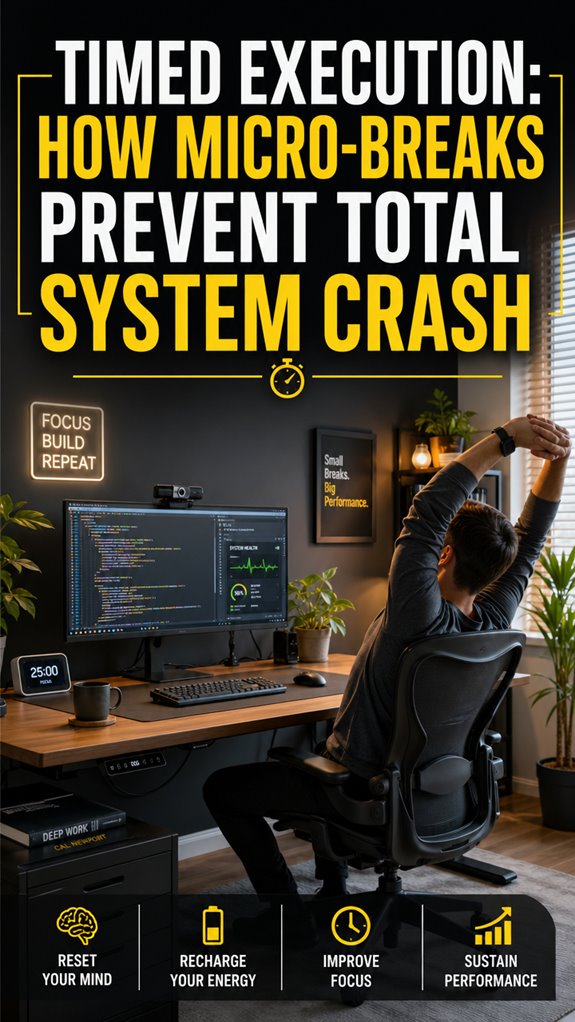
Micro-breaks? They’re my ctrl+alt+del. I set a timer now. Every 25 minutes, I stand, stretch, stare at something that isn’t glowing. Weirdly, my best solutions hit me in those dead moments. Walking to the kitchen. Blinking. Existing.
Your hardware’s fragile. Patch it regularly.
Micro-Break Burnout Recovery: From RSI Nightmares to Sustainable Coding
Last March, my wrist started screaming. Not metaphorically. Sharp, electric pulses up my forearm. The doctor called it repetitive strain injury, stage two. I couldn’t type for a week. Panic set in; deadline culture doesn’t care about your tendons. I rebuilt my workflow around Pomodoro timers, ergonomic checks, and yes, actual lunch breaks. The guilt was real at first. Felt lazy. But my commit quality improved. I ship better code now, sustainably. Consider this your warning: your body logs technical debt too. And unlike legacy code, you can’t just rewrite yourself.
Quick Takeaways
- Micro-breaks act as neural resets, preventing cognitive overload and maintaining system stability during prolonged tasks.
- Scheduled pauses help reset ergonomic strain, reducing musculoskeletal errors and physical system failures.
- Short, timed breaks mitigate mental fog, restoring focus and preventing system crashes caused by cognitive fatigue.
- Regular pauses improve posture and reduce static system overheating, enhancing overall performance and preventing breakdowns.
- Break timing aligned with energy cycles maintains optimal operational load, avoiding system overload and failure points.
Understanding Micro-Breaks and Their Benefits
In the grand chaos of software development, where system errors cascade faster than your CI/CD pipeline can update dependencies, neglecting microbreaks is akin to ignoring essential patches—disaster strikes.
You might push to prod, confident in your code’s robustness, but fail to manage muscle fatigue and cognitive load.
Microbreaks guarantee muscle relaxation and optimize energy management, preventing fatigue from creeping into your debugging sessions.
Just as “Ghost In The Shell” depicts a neural interface overload, your brain requires resets—short, strategic pauses—to sustain high-level performance in the face of relentless cognitive demands. Optimal rest periods are crucial for maintaining focus and avoiding burnout.
Without these, your mental infrastructure risks collapse amid the relentless runtime chaos.
Incorporating essential stretches, like timed execution breaks, can significantly enhance your recovery during these micro-breaks, promoting overall well-being and productivity.
How Micro-Breaks Help Developers Stay Focused and Avoid Burnout
When the codebase becomes a tangled mess of spaghetti dependencies and runtime exceptions pile up faster than your CI build, it’s easy to overlook how your personal system is also degrading under relentless load.
Micro-breaks serve as essential patches—instituting posture correction and mental resets—that buffer against physical and cognitive corruption. These interventions:
- Sharpen your focus architecture before entropy corrupts your execution flow
- Prevent system overheat from prolonged static postures, reducing musculoskeletal errors
- Reset the DMN, maintaining cognitive throughput, much like a kernel reboot in a chaotic runtime
Incorporating regular blue light protection measures into your environment can further enhance your well-being and productivity.
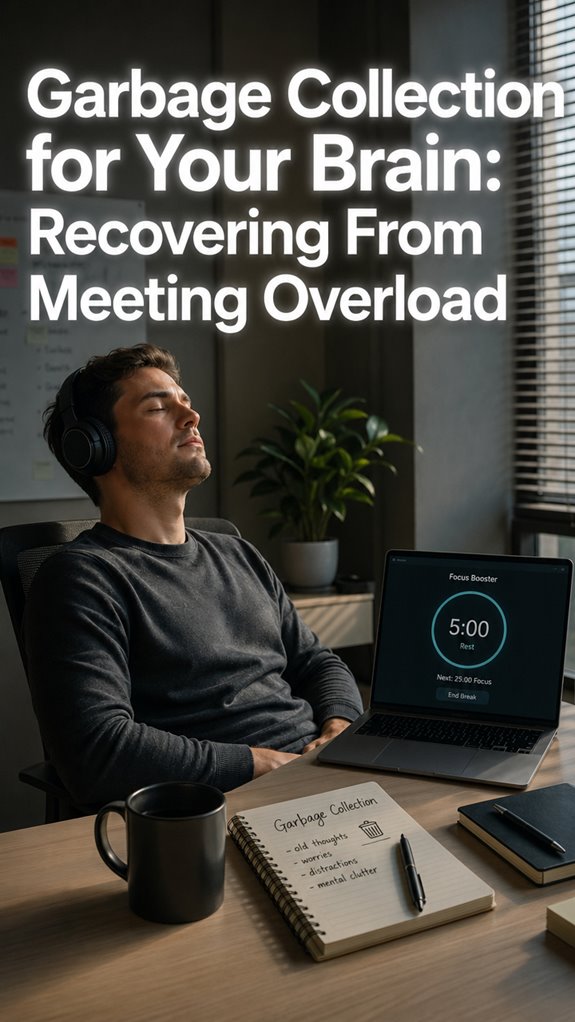
Neglecting micro-breaks is like neglecting garbage collection—inevitable system slowdown. Incorporating shoulder leaning pain techniques can further enhance your well-being and productivity.
In this chaos, “Ghost in the Shell” is less a sci-fi trope, more a metaphor for internal system corruption.
Effective Micro-Break Strategies and Optimal Timing for Coding
Micro break strategies for coders hinge on optimizing the delicate balance between sustained mental throughput and the inevitable entropy that lurks in long stretches of static focus.
Micro break psychology reveals break duration efficacy: brief pauses—30 seconds to 2 minutes—prevent pit stops from devolving into catastrophic system failures, akin to a reboot preventing total system crash. Using effective cycle tracking apps can help you monitor energy levels and schedule breaks more effectively.
Short breaks of 30 seconds to 2 minutes keep mental systems running smoothly, avoiding total burnout.
Strategically timed, these micro-interruptions reinitialize neural caches, akin to a forced garbage collection, stabilizing mood and cognitive load.
Think of it as debugging your own mind—short, targeted resets keep the code flowing.
Even “Ghost in the Shell” would appreciate this fundamental human middleware upgrade. Furthermore, utilizing pregnancy support pillows can enhance relaxation during coding marathons, making those micro-breaks even more effective.
Best Tools and Techniques to Remind You to Take Micro-Breaks

Amidst the relentless cascade of functions running in your neural stack, ignoring the imperative to prompt micro-breaks is akin to neglecting a core system update—eventually, you’ll crash for reasons beyond your debugging capacity.
Power users deploy tools like:
- Customized timers in Stretchly or Work Rave to issue precise micro-break alerts, preventing break fatigue and optimizing throughput.
- Browser extensions such as LeechBlock or Tide *lock down distractions*, forcing session discipline akin to a code review veto.
- Wearables like Neurosity Crown, tracking focus via EEG, autonomously suggesting micro-breaks, ensuring your *human infrastructure* mirrors the robustness of your codebase. Walking for just a few minutes during these breaks can significantly enhance your cognitive clarity.
Incorporating essential nutrients like magnesium glycinate can further enhance cognitive function and resilience, supporting your system’s need for optimal nutrient levels.
Ignoring such mechanisms risks total system meltdown.
Incorporating Micro-Breaks Into Your Daily Coding Routine
In the relentless sandbox of debugging, code crashes are almost expected—yet the most insidious failures originate not in syntax errors but within your biological firmware. Neglecting break fatigue quietly undermines your system’s stability, causing cognitive refresh deficits that mimic a “Ghost in the Shell” malfunction.
Pausing every 10-20 minutes for micro-breaks—be it stretching, hydration, or a brief gaze into nature—serves as necessary patches to prevent systemic overheating, burnout, and mental crashes. Engaging in mindful practices, which are crucial for mental rejuvenation, further enhances your ability to refocus and tackle complex problems effectively.
These deliberate interruptions optimize your mental performance, ensuring that your cognitive core remains responsive, not just a perpetually strained CPU enduring its own internal memory leak.
My Initial Trial Use
During my initial trial of implementing micro-break protocols into my extensive line of JavaScript debugging marathons, it became painfully clear that the root of systemic failure often isn’t in the code but within the human infrastructure running it.
Systemic failure often stems from human fatigue, not the code itself, highlighting the need for better ergonomic workflows.
- Adjusting break frequency revealed that every 10-minute interval was a fragile node, jeopardizing entire workflows.
- Micro break duration, set between 30 seconds and 2 minutes, disrupted the illusion of continuous CPU-like productivity.
The absurdity of scripting a digital ecosystem that neglects the human hardware—akin to “Ghost in the Shell”—became evident as fatigue persisted despite the breaks. Incorporating mental load management techniques can significantly improve focus and efficiency during prolonged work sessions. Additionally, exploring options like best sleep masks can also aid in ensuring optimal rest for better productivity.
A refined temporal architecture is long overdue.
Early Disruptions During Testing

When the entire testing ecosystem relies on fragile connections and a web of automated checks that seem to run on the principle of “hope for the best,” early disruptions emerge like poorly timed exception handlers crashing a production server.
Disruption patterns trace back to unpredictable connectivity interruptions, manifesting as involuntary logouts, slowdowns, and false error messages—all echoing the “Ghost in the Shell” scenario where the system’s code is fighting its own entropy. Incorporating low-glycemic nuts into snacks can help maintain energy levels, enhancing focus during critical testing phases.
The psychological impact—akin to unresolved exceptions—compounds stress, undermining confidence. This fragility exemplifies how human operators, much like buggy code, inadvertently introduce failure points, compounding systemic unreliability in high-stakes testing environments. The introduction of digital timers can help manage these disruptions by ensuring periodic reviews and maintenance of automated processes.
Breaks Boost Mental Clarity
Skipping breaks is like deploying an unstable build on a critical client release—performance degrades into brittle race conditions and unhandled exceptions.
When eye fatigue sets in or posture falters, your neural RAM suffers from unnecessary situational switching, slowing diagnosis and debugging. Mind fatigue can significantly impair problem-solving abilities, making it vital to recognize the need for breaks.
Micro-breaks serve as necessary system patches:
- Reset eye fatigue before the code turns to static,
- Recalibrate posture to prevent catastrophic musculoskeletal bugs,
- Clear mental cache, avoiding the “Ghost in the Shell” moment of cognitive crash.
Without intentional pauses, every keystroke risks further destabilization—your system’s breakdown inevitable unless you implement strategic pauses as if deploying emergency hotfixes. Regular breaks are essential not just for physical well-being but also for sustaining mental acuity in high-pressure environments.
Smart Capsules Enhance Restoration
In the grand architecture of mental resilience, the human body’s capacity for self-repair resembles an outdated software module—prone to crashes, susceptible to sensory overload, and desperately begging for smarter interventions.
As a senior dev, you recognize that micro break duration, optimized via sensory adaptation, acts like a patch—flicking the system from “fail” to “stable.” These capsules, akin to DevOps deployments, reset thresholds and suppress overloads.
Without them, the core estrogen and dopamine signals become legacy code, vulnerable to fragmentation. Implementing smart interventions guarantees your mental RAM doesn’t blue screen—because, at the end of the day, even Ghost in the Shell needs an upgrade.
Advanced Ergonomic Workstation Setups
In the relentless saga of maintaining peak productivity amidst the chaos of modern work, the human body often resembles a legacy system burdened with deprecated drivers—sluggish, error-prone, and vulnerable to catastrophic fatigue.
To optimize your workstation, prioritize investing in ergonomic posture to prevent “system crashes.” Upgrade keyboard ergonomics, reducing strain on tendons and nerves, much like patching deprecated APIs before a full system failure.
- Implement height-adjustable desks for seamless task switching
- Use ergonomic keyboards and mouse setups to realign input streams
- Position monitors at eye level to avoid display driver conflicts
Because in the end, only a resilient infrastructure sustains the code—your body being no exception. As part of your routine, consider incorporating mouth tape options that promote better breathing during sleep for improved recovery.
FAQ
How Do Micro-Breaks Impact Long-Term Productivity for Developers?
You’ll boost long-term productivity by maintaining ergonomic awareness and preventing fatigue, enabling deeper code immersion. Micro-breaks sustain focus, reduce errors, and foster resilience, empowering you to work smarter, sharper, and more powerfully over extended periods.
Can Micro-Breaks Reduce Specific Health Issues Like Carpal Tunnel Syndrome?
Ever wondered if micro-breaks boost hand health too? They help reduce repetitive strain, promote ergonomic practices, and alleviate tension, substantially lowering your risk of carpal tunnel syndrome while enhancing overall musculoskeletal resilience.
What Are the Signs Indicating It’s Time to Take a Micro-Break?
You should take a micro-break when you notice eye strain or poor posture, as these signs indicate your body needs a reset; act promptly to correct posture, relax eyes, and maintain peak performance and well-being.
How Do Micro-Breaks Influence Mental Resilience During Intense Coding Sessions?
You might think coding endless hours builds resilience, but micro-breaks with mindfulness techniques and ergonomic adjustments actually empower your focus, strengthen mental resilience, and keep burnout at bay—despite your stubborn belief in endless hustle.
Are Certain Micro-Break Durations More Effective for Mental Versus Physical Recovery?
Longer micro-breaks over 2 minutes amplify physical recovery effectiveness, reducing muscle fatigue and tension. For mental refreshment, shorter breaks around 30 seconds effectively reset cognition, boosting focus, engagement, and overall resilience. Choose durations based on your recovery needs.
Summary
Ignoring micro-breaks risks cascading system failures—akin to neglecting essential patches and updates in your codebase, eventually leading to a catastrophic crash. Even Tony Stark’s neural interface wouldn’t survive prolonged, unended sessions of mindless debugging without periodic rebooting. Think of micro-breaks as your mental “garbage collection,” preventing the core dump of cognitive overload. Embrace these brief resets; after all, if “Ghost in the Shell” taught us anything, it’s that maintaining the infrastructure—mind included—is crucial for functioning above the fringe of chaos.
References
- https://ohsonline.com/articles/2025/06/19/microbreaks-improve-safety-and-performance.aspx
- https://www.thesafetymag.com/ca/topics/safety-and-ppe/the-case-for-micro-breaks-to-avoid-musculoskeletal-injuries/478597
- https://neurosity.co/guides/best-micro-break-strategies-sustained-focus
- https://www.samarpanhealth.com/blog/micro-breaks-at-work-why-two-minutes-matter
- https://ehs.stanford.edu/subtopic/microbreaks
- http://able-futures.co.uk/news/microbreaks-small-habit-can-transform-your-workday
- https://pmc.ncbi.nlm.nih.gov/articles/PMC9432722/
- https://pmc.ncbi.nlm.nih.gov/articles/PMC6646952/
- https://pmc.ncbi.nlm.nih.gov/articles/PMC9679922/
- https://www.marigoldprep.com/post/the-march-8th-sat-disruption
- https://www.k12dive.com/news/testing-disruption-could-have-short-and-long-term-impacts/574149/
- https://blog.riversideinsights.com/strategies-addressing-test-anxiety
- https://www.specialeducationaction.com/p/accommodation-breakdown-breaks-during-testing
- https://www.edutopia.org/state-standardized-testing-survival-strategies?page=1
- https://strategyeducation.co.uk/how-to-reduce-low-level-disruption-at-exam-time/
- https://examsoft.com/resources/5-ways-disruption-occurs-in-assessment/