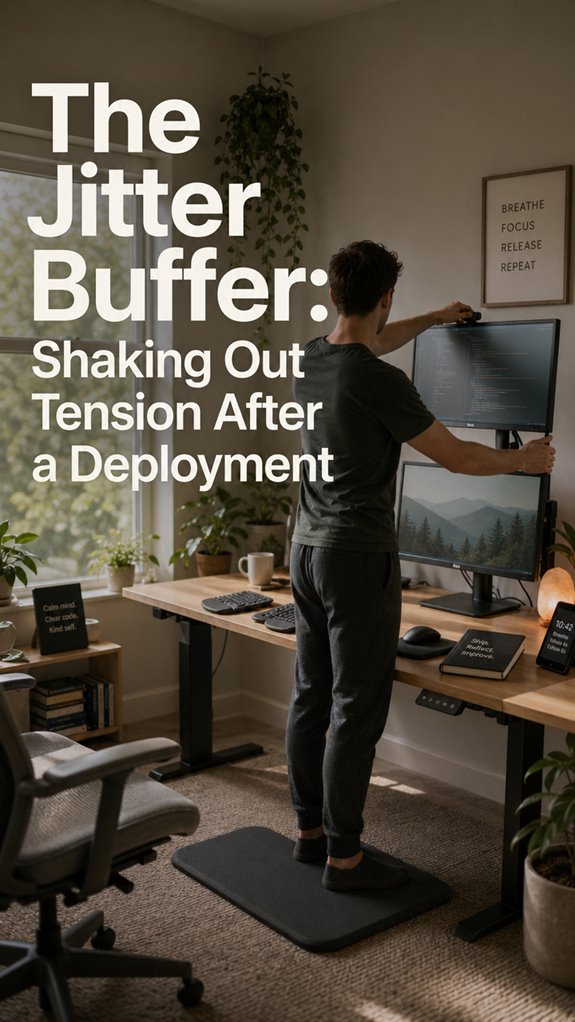
Ever notice your shoulders climbing toward your ears by 3 PM? That’s your body buffering way too much stress.
I used to sit there, knotted up like bad legacy code, until I discovered shaking. Literal shaking. After a brutal deploy last year, my hands wouldn’t stop trembling. Panic? Nope. My nervous system was doing a forced garbage collection. I stopped fighting it.
Now I stand up. Shake my arms. Let my jaw actually unclench. It’s like running `sudo killall anxiety` without the sudo.
The weird part? It works. Five minutes of voluntary trembling clears the stack overflow in my chest. My brain stops spinning. I can think again.
Not pretty. Not graceful. But functioning is better than frozen.
—
Why Sitting All Day Breaks Your Nervous System (And How to Debug It)
Coworker of mine thought she was having a panic attack during a sprint review. Turned out she’d been holding her breath for forty minutes. Classic sympathetic overload, screen-induced mammalian stress response, somatic experiencing, polyvagal theory. I bought her a desk timer. We both use it now. Tech neck. Frozen shoulder. Burnout recovery. Sometimes you need to physically reboot before the mental one takes.
Quick Takeaways
- Shaking acts as an internal system reboot, resetting hyperarousal modules and clearing neural cache after stressful events.
- The jitter buffer technique filters mental noise, stabilizing emotional regulation through mindful movement and somatic shaking.
- Breathing exercises and deliberate movements serve as firmware updates, recalibrating nervous system functions post-deployment.
- Recognizing signs like chest tightness prompts mindful resets that prevent system overload and emotional crashes.
- Creating dedicated environments for tension release supports hardware maintenance, optimizing nervous system performance after stress.
What Is the Jitter Buffer and How It Helps Post-Deployment Tension
This biological patch is designed to absorb and smooth out the chaotic, jittery signals that your stress response dumps into your fascia and nervous system. It parodies the tremors animals shake after escaping a predator—an elegant, if primitive, mechanism to recalibrate the system after a spike in sympathetic activity.
Think of it as a firmware patch for your neural pathways, facilitating emotional release by resetting the overloaded signal infrastructure. In software terms, it’s like clearing a memory cache—preventing persistent bugs (anxiety, hyperarousal). Caffeine gum has also been used as a practical tool to quickly boost energy levels during moments of fatigue.
Post-deployment, this jitter buffer upgrades your body’s real-time processing, stabilizing the code and restoring operational integrity—think “Ghost in the Shell” for your nervous system. Additionally, vagus nerve massage has been shown to enhance the body’s ability to manage stress, promoting overall well-being.
How Deployment Stress Affects Your Nervous System and How Shaking Can Help
When a deployment (or in this case, a stressful event like combat or high-stakes mission) hits your nervous system, the entire biological architecture shifts from a stable, predictable state to a chaotic, jitter-prone environment. This systemic failure triggers the fight/flight, flooding your code with adrenaline and cortisol, akin to a poorly optimized server crashing under load.
Breathing techniques serve as a patch, recalibrating the core loop. Emotional processing acts like exception handling, preventing the cascade of errors.
Shaking, like a debug restart, resets hyper-arousal, clearing cache and restoring normal flow—an essential firmware update for your stress response. Incorporating adaptogens like ashwagandha for stress management can further support your body in returning to equilibrium. Studies have shown that biofeedback devices can enhance the effectiveness of these techniques by providing real-time feedback on your body’s responses.
Using the Jitter Buffer Technique to Release Tension
In the digital architecture of stress regulation, losing control often resembles a server crash at peak load—an overload of adrenaline and fragmented neural packets creates chaos in the server room that’s your nervous system.
The jitter buffer, akin to an error-handling routine in code, uses mindful movement to quarantine tension, stabilizing emotional regulation by filtering out noise. Just as logging errors reveals system flaws, this technique reinforces the integrity of your stress-processing pipeline. Incorporating loop earplugs can help further eliminate distractions, allowing for deeper focus and tranquility during your reset.
Additionally, incorporating hand massagers for arthritis can enhance relaxation and aid in unwinding both physical and mental tension, serving as a valuable tool in this reset process. You reroute surplus data, dispelling static, rebooting your system’s core. It’s like running a patch — disciplined, precise, essential — until the ghost in the shell resumes its default mode of silent efficiency.
Incorporating Somatic Shaking Into Your Recovery Routine

Incorporating somatic shaking into your recovery routine is akin to deploying a patch update in your nervous system—an urgent debugging of core processes that crash under stress overload. You’re fundamentally executing a manual refresh to preempt a systemic failure, targeting emotional release and nervous system regulation at the granular level. Top grip trainers can further support hand strength, enabling better physical engagement during recovery.
Additionally, incorporating techniques such as eye training exercises can enhance your focus during this process, further aiding your recovery.
| Parameter | Effect |
|---|---|
| Tension Dissolution | Eliminates residual load |
| Muscle Relaxation | Restores baseline capacity |
| Emotional Reset | Clears corrupted data |
| Blood Flow Activation | Reboots circulation |
| Sympathetic Downregulation | Stabilizes response |
Think of it as debugging your internal architecture before meltdown, like patches in Ghost in The Shell.
My First Yoga Mat Discovery
Amid the chaos of debugging a malfunctioning neural network—one that’s perpetually stuck in a loop of emotional buffer overflows—I discovered that even my physical infrastructure requires occasional patching.
Enter my first yoga mat: a runtime environment optimized for mindfulness meditation and breath awareness, critical for preventing system crashes stemming from unchecked tension. Its synthetic surface became my debug console, a place to execute deliberate resets on accumulated stress. Engaging in specific exercises during this period can significantly enhance mental clarity and emotional resilience.
Much like patching stale code, I learned that gentle, intentional movements recalibrate the core, enabling smoother performance. In the ghostly shadow of “Ghost in the Shell,” I realized this hardware upgrade was essential: a scalable solution to maintain human-system compatibility. Additionally, I recognized that chest tightness can often signal the need for such mindful practices to manage underlying work anxiety effectively.
Muscle Spasms During Therapy
Why does the human hardware sometimes throw a spanner in the works during therapy sessions, despite decades of code optimization? It’s often due to systemic bottlenecks—muscle fatigue causes execution stalls, while nutritional deficits are like corrupted dependencies leading to spontaneous crashes—muscle spasms. Dehydration or electrolyte imbalance disrupt the delicate electrolyte choreography, akin to mismatched API calls triggering unexpected exceptions. In this analog, the body’s firmware struggles with overexertion, similar to a kernel panic during a high-load process. The “Ghost in the Shell” ultimately reveals that no matter how optimized your code, hardware-level signals—like spasms—still have the final say. Incorporating proper arch supports can significantly enhance stability and comfort during physical activities, preventing these muscle-related issues. Additionally, prolonged computer use can exacerbate shoulder blade pain, making it essential to implement ergonomic practices.
Stress Release Techniques

When the system encounters a spontaneous spasm—be it a muscle twitch or an abrupt jitter in the neural feedback loop—it’s akin to a poorly handled exception thrown by a rogue API call, crashing the entire neural backend.
Stress release techniques operate as a vital patch, enabling sensory integration to recalibrate data flow, while emotional grounding acts as the watchdog stabilizing the process.
Like debugging a memory leak or RCE vulnerability, intentional trembling resets hyper-aroused modules, restoring normalcy. Engaging in bouncing exercises can enhance fascia health, promoting better overall mobility and tension release.
In this human codebase, the goal remains simple: stabilize the core, flush the buffer, and keep the system running—Ghost in the Shell notwithstanding.
Ergonomic Office Setup Tips
In the grand debugging process of maintaining peak developer uptime, the ergonomic office setup serves as your foundational patch—an essential firmware update for your biological hardware that, if neglected, cascades into catastrophic system latency and mission-critical slowdowns.
Prioritize workstations optimized for work on the edge of chaos:
- Adjust monitor height to align with your line of sight, minimizing neck code bloat.
- Incorporate ergonomic tools like split keyboards and anti-fatigue mats to prevent hardware bottlenecks.
- Integrate breathing exercises into your workflow; oxygenate the firmware, boost cognitive throughput, and prevent system overheating. Optimizing your workspace can lead to increased productivity and reduced fatigue.
To enhance developer comfort, consider full-body posture adjustments that can further alleviate strain during long coding sessions.
Without these patches, even the most optimized codebase remains hostage to your physical crash loops.
FAQ
Is Somatic Shaking Safe for Everyone, Including Those With Chronic Health Conditions?
You should consider medical considerations and safety precautions before practicing somatic shaking, especially if you have chronic health conditions. Consult a healthcare professional to guarantee it’s safe for you, preventing any potential health risks or harm.
How Often Should I Practice Jitter Buffering for Optimal Stress Relief?
Practicing jitter buffering daily, like Sarah did after PTSD, amplifies stress relief; combine mindful breathing and gentle stretches to build resilience. Regular practice empowers you to reset tension, reduce anxiety, and maintain emotional strength consistently.
Can Jitter Buffer Techniques Replace Traditional Therapy Methods?
Jitter buffer techniques can enhance the mind-body connection and facilitate emotional release, but they shouldn’t replace traditional therapy. Use them as powerful adjuncts to deepen healing, gain resilience, and take control of your emotional well-being.
What Signs Indicate I Need Professional Help Instead of Self-Practicing?
If your self-assessment cues reveal emotional warning signs like persistent anxiety, intrusive thoughts, or intense mood swings, seek professional help immediately. You have the power to prioritize your mental health and safety, trusting expert guidance when necessary.
Are There Specific Contraindications for Performing Somatic Shaking?
You shouldn’t perform somatic shaking if you have contraindicated conditions like heart issues, seizures, or severe mental health disorders. Always prioritize safety precautions, consult a professional if uncertain, and listen to your body’s signals during powerful tension release.
Summary
Just as a rogue bug can cascade into catastrophic system failure, unchecked tension after deployment can cause your neural architecture to crash irreparably. Implementing the jitter buffer technique—akin to patching a memory leak—serves as a critical middleware update for your nervous system, buffering the overload. Yet, beneath the surface of this skeletal correction, an unpredictable ripple—like a kernel panic—may still trigger. So, brace yourself; the next line of code for recovery might arrive unexpectedly, demanding yet another system refresh.
References
- https://www.brettlarkin.com/somatic-shaking/
- https://youaligned.com/wellness/somatic-shaking/
- https://www.roriyoga.co.uk/resources/the-science-of-somatics-and-shaking
- https://www.healthline.com/health/mental-health/can-shaking-your-body-heal-stress-and-trauma
- https://www.neurotoned.com/blog/somatic-shaking-practice-for-beginners
- https://myfamilybirthcenter.com/somatic-shaking-to-relieve-stress/
- https://www.youtube.com/watch?v=ySJT7EBMDH4
- https://www.ewmotiontherapy.com/blog/muscle-spasms-physical-therapy
- https://mobilityboneandjoint.com/muscle-spasms/
- https://www.chemoexperts.com/muscle-twitching-and-muscle-spasms.html
- https://my.clevelandclinic.org/health/diseases/muscle-spasms-muscle-cramps
- https://neoscience.com/neo-flux-pemf-why-does-body-twitch-during-session/
- https://www.physio-pedia.com/Muscle_Spasms
- https://www.spinemd.com/conditions/myofascial-pain-syndrome-muscle-spasms/
- https://www.aans.org/patients/conditions-treatments/spasticity/