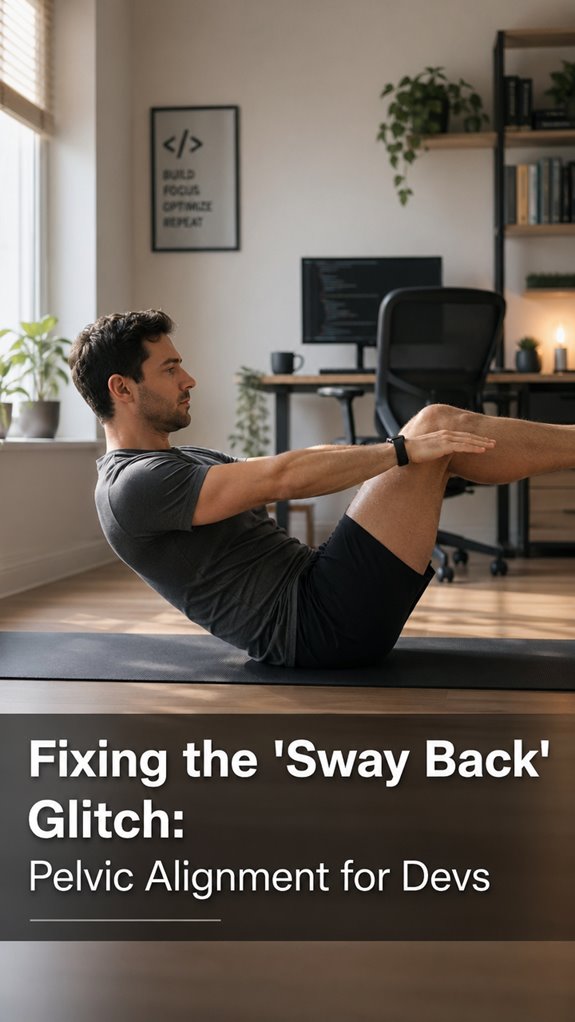
Why does my lower back feel like it’s carrying the weight of every deprecated dependency I’ve ever ignored? Because my pelvis rolled forward, my glutes softened into mush, and my hip flexors seized up like a merge conflict nobody wants to touch. Classic me.
I spent three years ignoring the warning logs. Twinges became screams. My Standing Desk Era lasted exactly eleven days before I rebelled, then paid for it.
The fix? Stack hips over heels. Brace your core like you’re protecting production on a Friday deploy. Flatten that lumbar curve. Small commits, daily. Your spine’s uptime depends on it.
Will I actually do my hip flexor stretches tonight? Unsure. But I’ve learned the hard way: some technical debt lives in your flesh, not your repository.
My Herniated Disc Was Not a Feature Branch
Last spring I sneezed. Felt something pop. Couldn’t stand straight for a week. MRI confirmed what posture apps had been screaming: L5-S1 disc herniation, the occupational hazard nobody codes against.
Physical therapy revealed the rot. Years of chair-sitting had turned my psoas into rack-mounted cables, tangled and tensioned. We’d spend sessions just breathing into my hip flexors, releasing what sitting had locked down. The emotional weight of realizing I’d engineered my own failure… heavy.
Now I set movement standups. Pomodoro walks. My current commit streak includes thirty days of dead bugs and bird dogs. Still debugging my form.
Quick Takeaways
- Sway back occurs when tight hip flexors and weak glutes cause forward pelvic tilt, hyperextending the lumbar spine dangerously.
- Achieve neutral pelvis by stacking it beneath your torso, depressing your tailbone, and actively engaging core muscles consistently.
- Correct ergonomic debt: position monitor at eye level, maintain proper chair height, and optimize keyboard-to-desk positioning for alignment.
- Practice stability exercises like dead bugs, bird dogs, and planks systematically to restore core integrity and prevent postural drift.
- Take movement breaks every 90 minutes with stretching; use posture sensors for real-time feedback to catch alignment deviations early.
What Is Anterior Pelvic Tilt (and Why Developers Get It)
How’s your spine holding up while you’re debugging that memory leak?
You’ve deployed anterior pelvic tilt—a postural configuration where your pelvis tilts forward, hyperextending your lumbar spine. It’s the occupational hazard of sustained desk sessions: your hip flexors tighten from prolonged sitting while your glutes atrophy into dormancy. Your body’s fundamentally running legacy code on deprecated hardware. Using an ergonomic vertical mice can help reduce strain on your wrist and encourage better posture.
Developers accumulate this tilt through repetitive positioning at terminals, much like how technical debt compounds silently. You’re not consciously choosing spinal misalignment; rather, your musculoskeletal architecture defaults toward least resistance, defaulting toward sway-back posture.
It’s a system-level failure cascading from macro environmental design constraints down to granular postural mechanics. Consistent chair comfort tips can help alleviate some of the strain on your lower back.
How Your Desk Setup Triggers Anterior Pelvic Tilt
Your workstation—that carefully optimized rectangle of ergonomic mediocrity—isn’t neutrally positioned; it’s actively architecting your postural degradation through a cascade of poorly calibrated constraints.
Your monitor sits six inches too low, forcing cervical flexion that cascades downward like a buggy recursive function.
Your chair height misalignment creates hip angles exceeding ninety degrees, destabilizing your lumbar spine’s load-bearing architecture.
The keyboard-to-desk ratio compounds this failure exponentially.
Each constraint compounds systematically, forcing your pelvis anteriorly as compensation.
You’re essentially debugging broken hardware while running corrupted firmware.
This isn’t wellness theater; it’s infrastructure maintenance.
Fix Anterior Pelvic Tilt With Neutral Pelvis Positioning
Neutral pelvic positioning isn’t a lifestyle choice—it’s a prerequisite for executing any cognitive task without your own skeletal system sabotaging your stack.
You’re fundamentally debugging your spine’s anterior tilt by stacking your pelvis directly beneath your torso—think of it as proper memory alignment rather than pointer arithmetic gone wrong.
Achieving this requires depressing your tailbone slightly while engaging your core muscles. Your lumbar spine flattens. Your intervertebral discs stop compressing asymmetrically.
This isn’t meditation; it’s infrastructure maintenance. You’re running a critical service on faulty hardware. Neutral positioning is the patch. Additionally, investing in top posture braces can further aid in maintaining your alignment throughout your daily activities.
Which Exercises Lock In Your Alignment
Once you’ve debugged your pelvis into neutral positioning, the next phase involves runtime validation—you can’t simply declare alignment and expect it to persist across your eight-hour sprint without active reinforcement.
Dead bugs, bird dogs, and planks function as your integration tests: they systematically validate spinal stability under load conditions. Incorporating easy desk stretches can enhance flexibility and promote better posture during these exercises. Pallof presses interrogate anti-rotation resilience.
These exercises aren’t wellness theater; they’re regression prevention protocols. Your core musculature requires constant CI/CD deployment.
Incorporating additional support like top desk heaters can help maintain a comfortable workspace as you focus on your alignment drills.
Without systematic rehearsal, you’ll revert to anterior tilt—your system’s default fail state. Think of it as preventing memory leaks in your skeletal infrastructure.
Desk Setup and Movement Breaks That Work

All those integration tests collapse the moment you dock yourself at a desk for forty consecutive sprints without environmental refactoring. Your lumbar spine’s load balancing degrades exponentially.
Configure your monitor at eye level—approximately arm’s length distance—establishing proper vector alignment. Your keyboard and mouse demand neutral wrist positioning, minimizing repetitive strain injuries that compound like technical debt.
Implement movement breaks every ninety minutes. Stand. Walk. Execute dynamic stretches targeting hip flexors and glutes. Engaging in dynamic stretches can significantly improve your posture and reduce the risk of further shoulder issues.
This isn’t wellness theater; it’s infrastructure maintenance. Your nervous system requires periodic state resets. Without deliberate environmental reconfiguration, you’re essentially running production code on deprecated hardware.
The 3-Minute Progress Test: Before and After
Before you’ve even finished your first espresso, your posture’s already degrading—a cascade failure you won’t notice until your L4-L5 discs are submitting pull requests to your brain stem. You’re running a distributed system without monitoring. That’s negligent. The right posture sensors can provide real-time feedback, helping you stay aware of your alignment. Using a mineral sunscreen can also protect your skin, allowing you to focus on alignment without worrying about sun damage.
| Metric | Day 1 |
|---|---|
| Lumbar curve | Anterior pelvic tilt |
| Shoulder elevation | 3cm asymmetry |
| Hip flexor ROM | 68 degrees |
| Thoracic kyphosis | Excessive |
| Disc compression | Cumulative |
Execute this three-minute assessment protocol weekly. Measure ankle-to-wall distance, perform active hip flexion testing, and document shoulder blade positioning. You’re debugging your own hardware now. Track deviations like you’d track memory leaks—obsessively, mathematically, without sentiment.
Why Your Whole Posture Matters
Your spine isn’t a standalone microservice—it’s the load balancer for your entire skeletal architecture, and you’ve been running it in production without proper observability. Monitoring your heart rate while working can help you identify stress and enhance your performance.
Postural degradation cascades systematically. When your pelvis tilts anteriorly, compensatory mechanisms propagate upward: thoracic kyphosis intensifies, cervical lordosis compounds, and your visual debugging becomes literally painful.
You’re essentially executing nested try-catch blocks across multiple muscle groups. This isn’t theoretical. Your shoulders, wrists, and neck aren’t independent services—they’re interdependent systems.
Misalign the foundational infrastructure, and you’re shipping bugs throughout the entire stack, one keystroke at a time. Maintaining good posture is crucial for preventing these cascading issues and promoting overall well-being.
Lumbar Support Cushion Failed
I’ve spent the better part of eight years debugging distributed systems—tracing latency cascades, profiling memory leaks, parsing stack traces at 3 AM—only to discover the root cause wasn’t in my code at all, but in the lumbar support cushion that’d disintegrated into foam dust somewhere around sprint 47.
The cushion’s failure cascaded systematically:
- Compression degradation accelerated postural drift
- Disc herniation risks compounded exponentially
- Cognitive load increased proportionally to pain signals
- System reliability tanked despite optimization efforts
You can’t ship production-grade architecture from a deteriorating biological substrate. The cushion wasn’t infrastructure—it was technical debt materialized. Furthermore, utilizing the best muscle scrapers for recovery can help alleviate some of the pain that a faulty ergonomic setup causes. Adding a weighted lap pad can further enhance comfort and focus during long coding sessions.
Desk Posture Causing Lower Back Pain
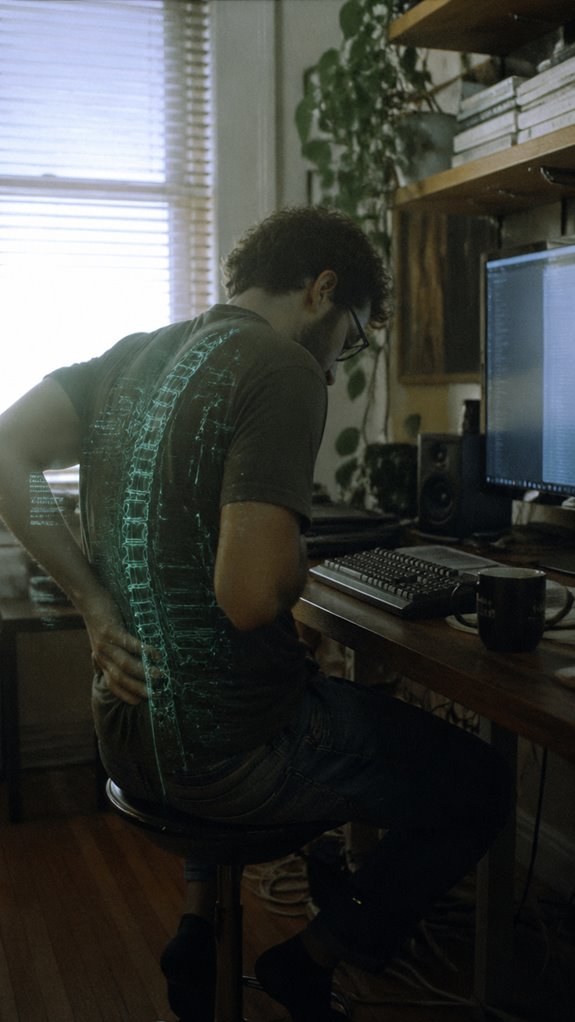
The problem compounds with architectural debt. You’re staring at your monitor, spine curved like a deprecated API endpoint, pelvis tilted anteriorly—a classic forward-slouch pattern.
Your L4-L5 intervertebral discs absorb compressive loads they weren’t designed to handle, much like running production code on staging hardware.
This postural misconfiguration creates a cascading failure: tight hip flexors, weakened glutes, hyperextended lumbar vertebrae. Your system’s experiencing resource exhaustion in real-time.
You’ve debugged worse infrastructure problems. Except this one’s your own skeletal framework, currently executing with suboptimal I/O.
The fix requires deliberate repositioning—neutral spine, engaged core, proper pelvic orientation—essentially a system reboot your vertebrae desperately need. Repetitive strain injuries can further exacerbate discomfort, so addressing posture is crucial for long-term relief.
Core Weakness and Hip Flexors
Once you’ve identified the postural misconfiguration, you’ll notice the root cause isn’t actually sitting—it’s what’s atrophied during all those years of sitting. Your core’s been deprecated; your hip flexors have hardened into legacy code that won’t refactor. You’re running a system where the stabilizer muscles—your rectus abdominis, transverse abdominis—are fundamentally null pointers.
The dysfunction cascade:
- Weakened deep core creates anterior pelvic tilt
- Chronically shortened hip flexors override neutral positioning
- Lumbar spine compensates with excessive extension
- Lower back pain emerges as your system’s stack trace
Deploying activation drills restores the architectural integrity your frame desperately needs. For developers, using eye tracking technology can help you maintain focus during these restorative practices by minimizing distractions in your workspace. Incorporating certain techniques, such as enhancing focus with earplugs, can optimize your productivity during these restorative practices.
FAQ
How Long Does It Typically Take to Correct Anterior Pelvic Tilt?
You’ll typically need 4-8 weeks of consistent corrective work to notice significant improvements in anterior pelvic tilt. However, you’re looking at 3-6 months for substantial structural changes and postural retraining to become automatic.
Can Anterior Pelvic Tilt Cause Pain Beyond the Lower Back?
Yes, you’ll experience pain beyond your lower back. Anterior pelvic tilt radiates discomfort through your hip flexors, knees, and shoulders as you’ll compensate throughout your kinetic chain.
Are Standing Desks Better Than Sitting Desks for Pelvic Alignment?
You’ll find standing desks superior for pelvic alignment, but you’ll need proper posture discipline. Neither position’s inherently perfect—you’ll achieve ideal results by alternating frequently and maintaining conscious neutral spine positioning throughout your workday.
Should I See a Physical Therapist for Anterior Pelvic Tilt?
You should see a physical therapist for anterior pelvic tilt. They’ll assess your specific imbalances, design targeted corrective exercises, and guarantee you’re executing proper movement patterns that standing desks alone won’t fix.
What Clothing or Footwear Choices Affect Pelvic Alignment While Working?
You’re losing 15% productivity with poor footwear choices. Wear flat, supportive shoes—they’re non-negotiable for neutral pelvis positioning. Avoid heels; they’ll anteriorly tilt you. Choose compression shorts strategically; they’ll reinforce proper alignment during extended sitting sessions.